Start your studies and gain professional experience at the same time – on campus, online and in the field of social work.
The Dual-Digital Social Work degree programme makes it possible.
Start your studies and gain professional experience at the same time – on campus, online and in the field of social work.
The Dual-Digital Social Work degree programme makes it possible.
6 semesters, incl. 300 hours of integrated professional practice per semester
15/06 – 15/08 (free of admission)
180 ECTS
In the combined in-person and online Social Work Dual-Digital programme, you are immersed in professional practice from the very beginning and develop a deep understanding combined with academically grounded knowledge, transforming lived experience and knowledge into professional practice. From the start of your studies, you will help shape good living conditions for people in challenging situations and within society, and take on responsibility in your role within the team and as a future social worker.
You will develop:
You will address:
You will develop:
The six semester Bachelor’s in Social Work (Dual-Digital) is structured around a weekly model of “3 days of studying and 2 days of practical experience.” This proven model of work-integrated learning offers not only continuity but also space for practicing and reflecting on practical experiences.
During this time, you will receive a monthly stipend from your employing organisation. Both the university and partner organisation will provide you with dedicated advice to support your professional development. Upon completion of the programme, you will receive state recognition as a social worker or social pedagogue.
For more information, see Career Prospects, Programme Content, Practice Partners, and Application and Contact.
You would like to
We offer you

The aim of the certificate programme is to provide scientific, conceptual, strategic and action-oriented skills for managerial, planning, coordinating and evaluating activities in the field of fan and spectator management.
Social work in daycare centres, also known as daycare centre social work, has been a growing field of activity in Germany for the last ten years. The aim is to mitigate the consequences of social inequality for children's education. This issue is currently under discussion as part of the planned Startchancen programme for daycare centres, which the federal government intends to implement from 2026…

Extended reality and AI-supported counselling for parents in understanding and dealing constructively with their children's emotions
The staff members at the Student Counselling Services provide information to prospective students, first-year students, parents, teachers and students on all general questions about studying. For specific questions and concerns about the Bachelor's degree programme in Social Work Dual-Digital, please contact the subject counsellig service. For programme-specific questions, the programme-specific student advisory is the right place to go.
The programme-specific student advisory is provided by the team of the Social Work Dual-Digital degree programme.
Please send your e-mail to:
basa-d2@fh-potsdam.de
Follow our department on Instagram and get an impression of everyday student life, projects, students and staff.
| Department | Degree programme | Teaching language | Start of study | Application deadline |
|---|---|---|---|---|
| |
Childhood Education (BA) | German | Winter semester | 15/05 - 15/07 (admission restricted) |
| |
Childhood Education Dual (BA)* | German | Winter semester | 15/06 – 15/08 (admission-free) | |
| |
Early Childhood Education (BA) | German | Winter semester | Until 15/07 (admission restricted), only higher semesters | |
| |
Early Childhood Education Research (MA) | German | Winter semester | 15/06 – 11/10 (free of admission) |
| |
Social Work (BA) | German | Winter semester | 15/05 – 15/07 (restricted admission) |
| |
Social Work (part-time for professionals) (BA) | German | Summer semester | 15/12 – 15/01 (admission restricted) |
| |
Social Work Dual-Digital (BA) | German | Winter semester | 15/06 – 15/08 (free of admission) |
| |
Social Work with Families (MA) | German | Winter semester | Disclaimer: Starting in the winter semester 2026/27, this programme will be offered as a Master's degree in Sustainable Social Work: Children and Families. |
| |
Sustainable Social Work: Child/hood and Family (MA)* | German, English | Winter semester | 15/05 - 22/06 (admission restricted) Note: Studies begin in the winter semester 2026/27 |
In a dual degree programme, you have the opportunity to grow directly into a social organisation and shape your professional career. You can advise, accompany, coordinate, manage, represent and much more. Your career is possible in over 100 fields of work:
1 Adventure playgrounds 2 Adoption agencies 3 Employment agencies 4 Contact points for children who have experienced abuse 5 Work and employment initiatives 6 Outreach social work 7 Counselling centres for domestic violence 8 Counselling centres for prostitutes 9 Counselling centres for senior citizens 10 Career counselling 11 Vocational training centres 12 Vocational support 13 Employment and unemployment projects 14 Assisted living for people with disabilities 15 Company social work 16 Probation services 17 Educational work 18 Drug consumption rooms 19 Drug therapy facilities 20 Development aid 21 Assisted living for young people 22 Marriage and family counselling centre 23 Parenting schools 24 Experiential education 25 Educational assistance 26 Educational counselling centre 27 Family education centres 28 Family centres 29 Residential care 30 Girls' residential groups 31 Mother and child homes 32 Foster families 33 Social group work 34 Social-educational family assistance 35 Separation and divorce counselling 36 Women's education centre 37 Women's shelters 38 Early detection 39 Early intervention 40 Community psychiatry 41 Geriatric psychiatric clinic 42 Gender-specific work 43 Health counselling 44 Violence prevention 45 After-school care 46 Hospice 47 Intercultural youth work 48 Youth welfare office 49 Youth career assistance 50 Youth clubs 51 Youth leisure activities 52 Youth court assistance 53 Youth centres 54 Youth welfare planning 55 Youth cultural work 56 Youth care 57 Youth protection 58 Youth social work 59 Youth detention centre 60 Youth association work 61 Youth hostels 62 Prison system 63 Child protection centres 64 Daycare centres 65 Daycare social work 66 Contact points for homeless people 67 Hospital social work 68 Hospital social services 69 Health insurance social services 70 Nurseries 71 Mediation and conflict counselling 72 Methadone programmes 73 Mobile youth work 74 Multi-family therapy 75 Multicultural work 76 Mother's convalescent homes 77 Mother's centres 78 Emergency shelters for homeless people 79 Open elderly care 80 Open child and youth work 81 Prevention work 82 Psychiatric outpatient clinics 83 Psychosomatic counselling 84 Psychosocial services 85 Neighbourhood management 86 Queer counselling 87 Rehabilitation facilities 88 Pension insurance social services 89 Debt counselling centre 90 School social work, 91 Pregnancy conflict counselling 92 Self-help support and projects 93 Retirement homes 94 Day centres for the elderly 95 Residential homes for the elderly 96 Sex education 97 Social welfare office 98 Social planning 99 Social psychiatric counselling centres 100 Playmobile 101 Neighbourhood work 102 End-of-life care 103 Prison system 104 Street work 105 Addiction counselling centre 106 Addiction prevention 107 Addiction therapy 108 Day care facilities for people with disabilities 109 Day group 110 Day clinic 111 Day care 112 Emergency telephone number 113 Assistance for homeless people 114 Workshop for people with disabilities 115 Housing for refugees or during migration 116 Shared accommodation 117 Residential homes for people with disabilities 118 Residential homes for homeless people
This means, for example:
... as our graduates, you will receive state recognition as a social worker, which is required for some fields of work.
Click here for the application form.
Why not stay with us and apply for one of our Master's programmes:
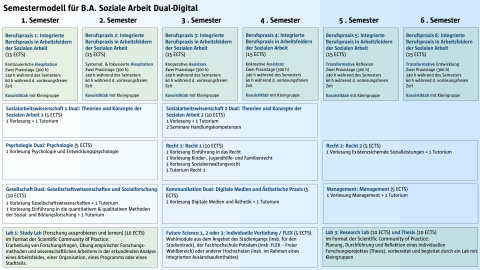
The Bachelor's degree programme in Social Work Dual-Digital lasts six semesters and has a modular structure. In addition to immediate professional experience, you will gain comprehensive insight into the broad field of society and social work. The semester model provides an overview of the modules and content.
The standard period of study for the full-time degree programme Social Work Dual-Digital is six semesters and concludes with a Bachelor of Arts degree.
The Bachelor's programme consists of foundational and in-depth modules as well as elective track modules. Through the "Integrated Professional Practice", a close interlocking of theory and practice is established in each semester. This includes continuous coaching at the University of Applied sciences Potsdam, mentoring in practice and the development of reflection skills and confidence in casuistry. The programme is completed with the writing of a Bachelor's thesis.
| Semester 1 – 2 | Basic studies, practical phase "Hospitation", research-based learning in the workshop |
| Semester 3 – 4 | Basic and advanced studies, practical phase "assistance", practice-relevant research in the real laboratory |
| Semester 5 – 6 | Basic and advanced studies, practical phase "transformation", individual action research project, bachelor thesis |
In the currently valid module handbooks and study and examination regulations of the Department of Social and Educational Sciences, you will find the module overview, a detailed description of the modules and study contents as well as the study plan for the degree programme Social Work Dual-Digital.
In the Social Work Dual-Digital degree programme, we use the principle of blended learning to offer you the greatest possible flexibility during the highly practice-oriented studies. During the theory study days in presence or digitally, we work with different teaching formats so that the knowledge transfer fits the respective topic and the students' daily study routine is varied.
In consultation with your practice partner, short study visits to one of our partner universities or practical work experience abroad are possible.
We offer many English-language seminars and excursions abroad. In addition, you can get to know students from other universities from your desk via VirCamp's international digital course offerings and round off your international portfolio.
The currently valid module handbooks and study and examination regulations of the Department of Social and Educational Sciences contain an overview of the modules, a detailed description of the modules and course content, and the study plan for the Social Work Dual-Digital programme.

Pilot phase social work dual-digital with 10 practice organisations
The practice-integrated Bachelor's degree programme in Social Work Dual-Digital at the Department of Social and Educational Sciences can look back on an exciting first year. At the start of the winter semester 2022/23, the two programme directors Prof. Dr. Karsten Krauskopf and Prof. Dr. Armin Schachameier and their team welcomed six new practice organisations to the joint training network in addition to the four existing practice/transfer partners.
If you would like to become a practice/transfer partner, you can read information about the framework conditions at the bottom of the page. Below you will find the list of our recognised practice organisations.
Please find our practice and transfer partners and their current vacancies on our German website.

You would like to become a practice/transfer partner for our Bachelor's degree programme in Social Work Dual-Digital? Organisations in the social economy as well as comparable institutions and facilities outside the social economy can be recognised as practice/transfer partners. Find out about our principles for recognition.
The currently valid module handbook and the study and examination regulations for Social Work Dual-Digital can be found on the pages of the Department of Social and Educational Sciences.
The most important deadlines, dates and admission requirements for the Bachelor's degree programme in Social Work Dual-Digital are compiled here. You can find out which steps you need to take for a successful application in the next section.
In the following, we explain which aspects you should consider from the conclusion of an education contract to matriculation (enrolment).
The following links provide you, and especially international applicants, with further information on the topics of application and enrolment at the University of Applied Sciences Potsdam.
You would like to apply for studies from the first or a higher semester and have acquired your school-leaving qualification and/or university degree abroad? Then you can have degrees and achievements acquired abroad recognised and study with us.
The application and study service provides information and advice on general questions regarding the application process, admission and enrolment at the University of Applied Sciences Potsdam, application for a higher semester, but also on topics such as compensation for disadvantages, part-time studies, waiting semesters and hardship applications.
The Student Counselling Services provides information and advice on general questions about studying as well as on topics such as choosing a degree programme, application, enrolment and study organisation. For programme-specific questions on module content, credit transfer, examinations or specialisations in the Social Work Dual-Digital degree programme, the programme-specific student advisory is the right place to go.
The programme-specific student advisory is provided by the team of the degree programme Social Work Dual-Digital.
Please send your email to:
basa-d2@fh-potsdam.de
Study Info Service
studien-info-service@fh-potsdam.de
bewerbungs-service@fh-potsdam.de
campuskarte@fh-potsdam.de
Study Service
studien-service@fh-potsdam.de
Exam Service
pruefungs-service@fh-potsdam.de
Office hours
Monday and by appointment