Skip to main content Skip to main navigation Skip to footer

Organisational Development Project – "Freiraum"

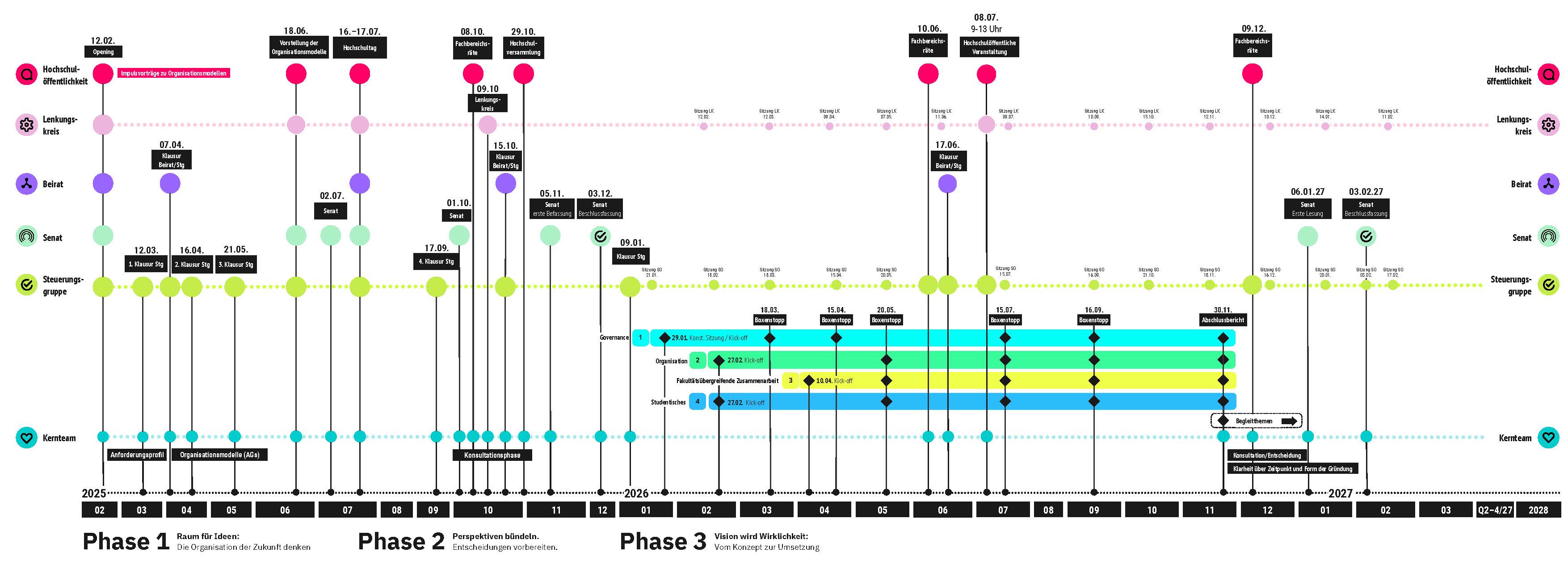
With the organisational development project "Freiraum", the university has set out to reform its internal organisation. The aim is to create scope for its strategic development and thus secure the university's future viability. The project is designed to be participatory and organised in the form of a waterfall model.

Hochschulöffentliche Veranstaltung am 8. Juli 2026

Am 8. Juli 2026 haben die Redaktionsgruppen die Ergebnisse ihrer bisherigen Arbeit der Hochschulöffentlichkeit vorgestellt. Etwa 100 Hochschulmitglieder aus allen Statusgruppen und Organisationseinheiten der Hochschule waren im Hörsaal Haus D zusammengekommen; 65 Hochschulmitglieder waren digital dabei. 

Nach den Berichten aus den Redaktionsgruppen Governance, Fakultätsübergreifende Zusammenarbeit, Organisation und Studentisches konnten beim Gallery Walk individuelle Fragen gestellt und Erfahrungen sowie Erwartungen ausgetauscht werden. Die Ergebnisse wurden dokumentiert und im anschließenden Plenum zusammengetragen. 

Während der gesamten Veranstaltung wurden via Slido Fragen gesammelt und gewichtet. Diese Fragen wurden zum Abschluss im Plenum beantwortet; sie werden aber auch Eingang in die geplanten FAQs auf der Website von „Freiraum“ finden.

Die Stimmung war gut und eine gewisse Aufbruchsstimmung, aber auch der Wunsch nach Konkretisierung spürbar. In den Sitzungen der Fachbereichsräte am Nachmittag und beim Sommerfest wurde weiter diskutiert. 

Präsentation zur Veranstaltung 

Dates

More events
No content available.

Latest news on the work of the editorial groups

Since February 2026, four editorial groups have been working on key areas of organisational development: governance, organisation, cross-faculty collaboration and student affairs. Each group consists of 8–10 members and involves experts from across the university in its work. The findings are regularly reported back to the steering group and fed into discussions with the university’s governing bodies.

15/04/2026 – Pit Stop an Stearing Group 

The editorial group has taken on board the ideas from the first meeting on 18 March and discussed, in particular, the structure of the posts of Vice-Dean for Studies and Teaching and Student Vice-Dean, as well as the role of the SKSL and the Study Commission. The core idea remains that the central structure should be mirrored at a decentralised level. The ‘university management’ is complemented by the ‘faculty management’. Each level has its own networking structures. By reducing the number of departments from five to three faculties whilst maintaining the composition of the faculty councils, faculty management teams and examination boards, and also by reducing the number of people directly involved in other committees, fewer people than before will be involved in committees. This therefore creates more time; however, it also brings with it an obligation to document decision-making and to professionalise the members. Transparency is to be achieved by creating role profiles (profiles) for all committees, which can then also be used in the onboarding of new members.

12/02/2026 – Start of Work

Following discussions on the terms of reference for the Governance Working Group at the Senate’s January meeting, these have now been finalised. The Working Group consists of 8–10 members and regularly consults experts from across the university as part of its work.

Task: Governance Editorial Group

15/04/2026 – Pit Stop in the Stearing Group

The editorial group discussed fundamental questions: What is ‘freiraum’? How can it be organised at a state university? Who are the university’s stakeholders? What are the implications of a centralised or decentralised organisational structure? The aim was to make frequently cited problems – including through an analysis of the findings from the 2025 University Day – more tangible. As part of the Organisation Editorial Group, the first step involves identifying and naming problems; these can be categorised into structural, technical and procedural issues. Furthermore, a concept for future process management at the FHP is being developed, taking into account the possibilities offered by AI. The aim is not to determine every detail, but to create reliable structures and to organise cooperation between centralised and decentralised units effectively.

12/02/2026 – Start of Work

At the Senate’s February meeting, the composition of the Organisation Editorial Group was presented. The terms of reference have now been finalised. The Editorial Group consists of 8–10 members and regularly consults experts from across the university during its work.

Task: Organisation Editorial Group

15/04/2026 –Pit stop in the Steering Group

The editorial group initially focused on the specific challenges involved in organising cross-faculty teaching in accordance with the FLEX module handbook. At present, the potential of this range of courses is not being fully exploited – due to a diffusion of responsibility, differing procedures in course planning and a lack of awareness. As FLEX modules worth at least 10 ECTS credits are implemented with every new accreditation, a growing demand is to be expected, which the university must meet. In accordance with the Senate resolution on organisational development, this is to be organised through a new cross-faculty body. Moving forward, the working group will address the question of how innovation in cross-faculty teaching can be ensured, before turning its attention to the broader issues of research and knowledge transfer.

12/02/2026 – Start of WorkAt the Senate’s February meeting, the composition of the Inter-Faculty Collaboration Working Group was presented. The terms of reference have now been finalised. The Working Group consists of 8–10 members and regularly consults experts from across the university as part of its work.

Task: Inter Faculty Collaboration Editorial Group

15/04/2026 – Pit Stop in the Stearing Group 

Since autumn 2025, the RG has been working on models for student-run bodies and their interfaces with academic self-governance. Key questions include: the understanding of democracy within higher education structures; fairness and representation in electoral processes; the reliable institutionalisation of student participation; and the risk of informal preliminary consultations taking place without student involvement. At a closed-door meeting in March 2026, the profile of the student vice-dean and future structures of the student bodies were explored. Various models for the student councils were developed, focusing on electoral procedures with quotas, departmental structures and interfaces with other bodies. The RG is now consulting the existing bodies on an iterative basis (faculty student councils, AStA, inter-body networking meetings).

Autumn 2025 – Formation of the Student Affairs Editorial Group The Student Affairs Editorial Group began its work as the fourth editorial group in autumn 2025 and has since been developing models for student-run bodies.

Project phases

Two sub-projects are planned:

  • The first sub-project is dedicated to conceptualisation and implementation planning (duration: Q1 2024 to Q4 2026).
  • The second sub-project deals with the actual implementation of the agreed structural reform, which is scheduled to begin in 2027.
Contact us

You can reach the project team at: fhp2.0@fh-potsdam.de

Project management

Participation in the core team

Head of University Planning and Development

Participation in the core team

Speaker of the President

Participation in the core team

Managing Director of the Senate, the Ethics Committee and for committee elections; Official Announcements / Consultant