Would you like to know more about how children develop and learn? Would you like to work with children and families? Then our bachelor's degree programme in Childhood Education (BA) is the right place for you! In our practice-oriented degree course, you will specialise in accompanying and supporting children up to the age of twelve and families in crèches, kindergartens, family centres and more. With your degree, you will receive state recognition as a childhood educator.
Childhood Education (BA)
Become a childhood educator: Practical degree programme with state recognition and diverse career prospects
Profile:
Social Space – Education, Participation, Community

©
INA.KINDER.GARTEN
Degree:
Bachelor of Arts
Type:
full-time
part-time
Course language:
German
Standard study period:
6 semesters; incl. practical days and blocks totalling 800 hours
Start of study:
Winter semester
Application deadline:
15/05 - 15/07 (admission restricted)
Admission requirements:
General higher education entrance qualification/ entrance qualification for universities of applied sciences/ equivalently recognised practical vocational training
Credits:
Module Manuals & Regulations
180 ECTS credit points
Profile
The best for the youngest
The Childhood Education (BA) degree programme qualifies you for educational work with children from birth up to the age of 12 and for working with families.
The six-semester full-time degree programme enables you to understand, reflect on and shape work with children and families. In particular, you will study in seminars with a high degree of practical relevance. You will deal with a wide range of subjects relating to childhood and family and learn to think, work and research scientifically. You will gain practical experience in childhood education institutions throughout your degree programme. This allows you to put your professional knowledge directly into practice.
After enrolment, you can apply for recognition of competences acquired outside the university, e.g. from a previous educator training programme.
Find out more about the course content, career prospects and the application process for our degree programme.

Campus life
The campus of the FH Potsdam is manageable – this is where people meet. Campus life offers you many opportunities to pursue your own interests. In our library you can read and write assignments in peace and quiet, but also work together in groups. The student-run cultural centre Casino is a place where you can meet, exchange ideas and relax. University-wide festivals are organised several times a year, for example the summer and Christmas festivals.
You can find tips on living in Potsdam here.
Is this degree programme right for me?
You have these qualities
- Interest in and willingness to familiarise yourself with the day care and kindergarten fields of work
- Empathy and good observation skills
- Interest in the individual development and educational processes of children
- Openness and communication skills towards children and adults
- Willingness to self-reflect
- Interest in scientific work and developing your own questions
- Enjoyment of creative activities
FB 1 goes Insta
Follow us digitally via our new Instagram account of the Department of Social and Educational Sciences and get to know us better!
Paths into the world - Childhood Education International
Would you like to discover the world during your degree programme? Then take the opportunity to complete a semester or internship abroad – without having to extend your studies. You will gain valuable experience, broaden your view of childhood education practice in other countries and acquire valuable skills for a multilingual professional life.
You can also obtain the "Childhood Education International" certificate by taking a language course, a seminar on international education plans and an English-language specialised seminar of your choice in addition to your experience abroad. This will sharpen your international profile.
Contact us:
What we are currently dealing with
Dates
- Conference on daycare social work on the 25th of September, 2025 in Erfurt
- InnoPrax 2025 meeting fair: We open our doors!
- Professional exchange on childhood education topics between students from the University of Applied Sciences Potsdam and the University of Amsterdam on the 15th of October, 2025
Review
Anniversary conference 2024: 20 years of childhood education degree programmes at the University of Applied Sciences Potsdam
Research
Research project "Social work in daycare centres and family centres in Brandenburg" by Prof Dr Tanja Salem:
The project deals with the implementation of social work in daycare centres and family centres.
Contact us
The staff members at the Student Counselling Services provide information to prospective students, first-year students, parents, teachers and students on all general questions relating to the degree programme. If you have specific questions or concerns about the Bachelor's degree programme in Childhood Education, please contact the programme-specific student advisory or the degree programme coordinator.
Head of degree programme

Professor of Theory and Practice of Childhood Education
Transfer professor by lottery
Programme-specific student advisory

Academic staff member in the degree programme Early Childhood Education (BA)
Degree programme coordination

Coordinator Degree Programme "Social Work with Families (MA)"
Coordinator Degree Programme "Early Childhood Education (BA)"
Coordinator Degree Programme "Childhood Education (BA)"
Career prospects
Childhood educator - one profession, many perspectives
State-recognised childhood educators are in high demand in child daycare and many other fields of work.
After studying Childhood Education at the University of Applied Sciences Potsdam, you will enrich multi-professional teams by specialising in working with children up to the age of twelve and collaborating with their families as well as your inquiring mind.
Find out more about the professional profile of childhood educators.
Possible occupational areas
- Educational and childcare facilities: Daycare centers, kindergarten, after-school care, mixed-age facilities, child day care, (all-day) primary school, family centres
- Family support services: Family education, family centres, early help, psychosocial counselling, family and educational counselling
- Help with parenting
- Child protection
- Integration assistance for children
- Sports, leisure, media and cultural programmes for children and families
- Politics and advocacy for children and families
- Specialist advice for early education centres
- Quality development and organisational consulting
- Training and further education
- Universities and research institutes
Possible Master's programmes at the FH Potsdam
Testimonials


State recognition as a childhood educator
After completing your Bachelor's degree, you can apply for state recognition as a childhood educator. State recognition is based on the Brandenburg Social Professions Act (Brandenburgisches Sozialberufsgesetz). You can find all the important information on the pages of Landesamtes für Soziales und Versorgung des Landes Brandenburg.
The information sheet from the Brandenburg Ministry of Education, Youth and Sport summarises (Landesamtes für Soziales und Versorgung des Landes Brandenburg) the documents to be submitted for state recognition as a childhood educator.
You may also be interested in these degree programmes
More degree programmes| Department | Degree programme | Teaching language | Start of study | Application deadline |
|---|---|---|---|---|
| |
Childhood Education (BA) | German | Winter semester | 15/05 - 15/07 (admission restricted) |
| |
Childhood Education Dual (BA)* | German | Winter semester | 15/06 – 15/08 (admission-free) | |
| |
Early Childhood Education (BA) | German | Winter semester | Until 15/07 (admission restricted), only higher semesters | |
| |
Early Childhood Education Research (MA) | German | Winter semester | 15/06 – 11/10 (free of admission) |
| |
Social Work (BA) | German | Winter semester | 15/05 – 15/07 (restricted admission) |
| |
Social Work (part-time for professionals) (BA) | German | Summer semester | 15/12 – 15/01 (admission restricted) |
| |
Social Work Dual-Digital (BA) | German | Winter semester | 15/06 – 15/08 (free of admission) |
| |
Social Work with Families (MA) | German | Winter semester | Disclaimer: Starting in the winter semester 2026/27, this programme will be offered as a Master's degree in Sustainable Social Work: Children and Families. |
| |
Sustainable Social Work: Child/hood and Family (MA)* | German, English | Winter semester | 15/05 - 22/06 (admission restricted) Note: Studies begin in the winter semester 2026/27 |
Programme content
Programme content
In the soon to be available module handbooks and study and examination regulations of the Department of Social and Educational Sciences, you will find the module overview, a detailed description of the modules and course content as well as the study plan for the Childhood Education degree programme. Soon you will also find information on the practical days and internships. All course times and course details for the Childhood Education degree programme can be found from the winter semester 2026/27 in the course catalogue.
On the Childhood Education degree programme, we work with different teaching/learning formats to ensure that the knowledge transfer matches the respective topic and that everyday study life is varied.
Teaching-learning formats
- Digital lectures with cumulative multimodal testing (KMP)
- Research projects as a Scientific Community of Practice (SCoP)
- Trying out research and learning in small groups in the Study Lab
- Supervision and coaching of the final thesis in the Research Lab
- Study groups as casuistry labs - safe space
- Seminars, block and weekly formats
- Moodle as a learning platform
- Self-organised study groups
- Excursions
- Practical days and practical blocks
- Training supervision
- Co-operation projects outside the university
Compulsory modules
- Childhood education 1 and 2
- Psychology
- Social sciences and social research
- Law
- Communication: Digital Media and Aesthetic Practice
- Research labs – Study Lab, Real Lab and Research Lab
- Professional practice
- Training supervision
Elective area
Individual specialisation from the range of the degree programme
- Future Science 1, 2, 3
- Aesthetics and Management or Abroad: Childhood Education in International Contexts
- Flex modules (optional modules offered by all departments of the FH Potsdam)
Specialisation options – optional integrated study tracks
- Social work in schools and day care centres
- Counselling, mediation and conflict resolution
- Children's perspectives
- Exercise, sport and nature
- Educational support and social services
- International Social Work or International Childhood Education
Praktikum
Während Ihres Studiums absolvieren Sie ein 800-stündiges Praktikum als integrierte Praxistage/-wochen in selbst gewählten Arbeitsfeldern, verteilt über die gesamte Studiendauer. Kasuistiklabs und Supervisionen an der Hochschule bieten Ihnen Raum für Reflexion, Austausch und individuelles Coaching.
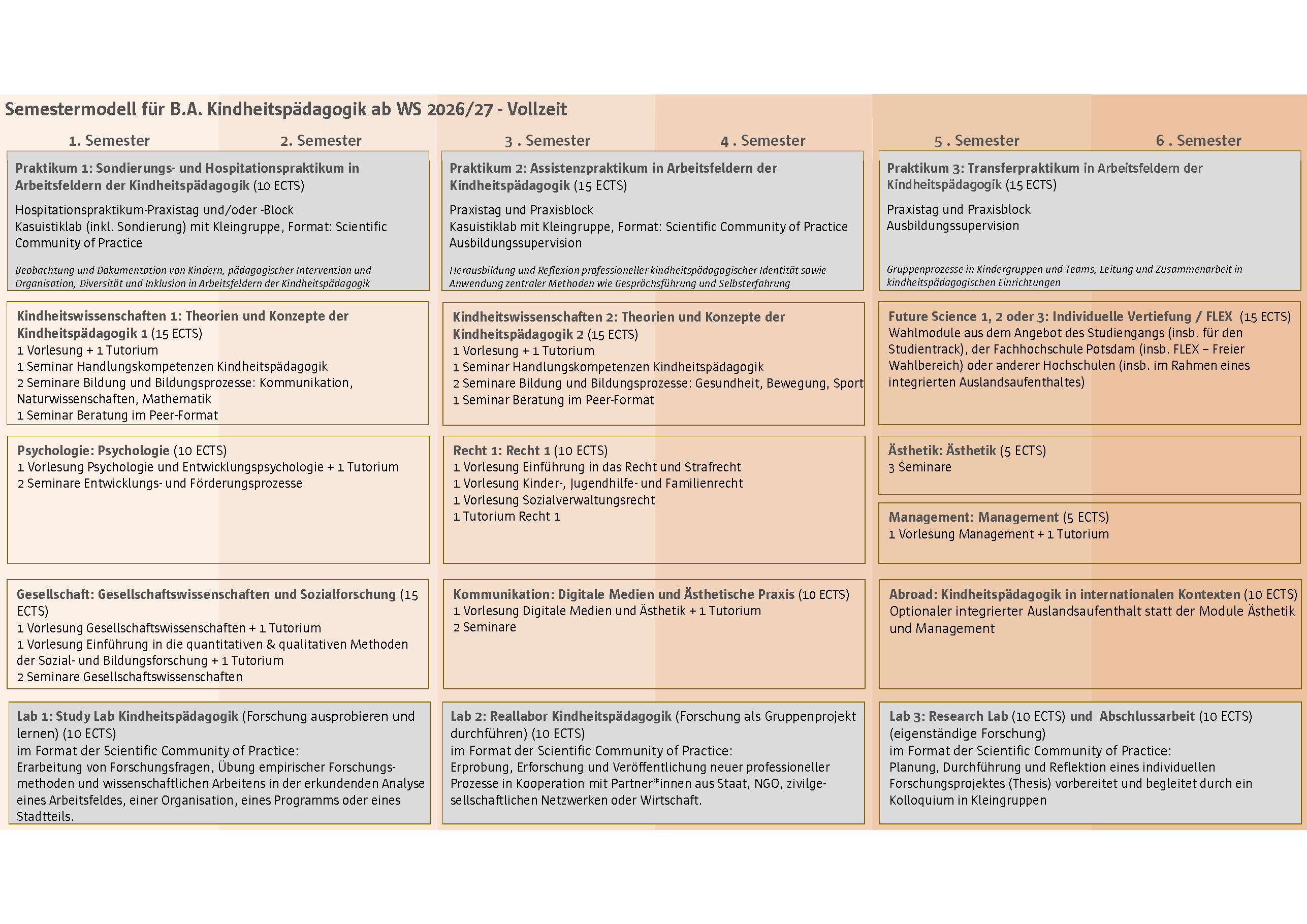
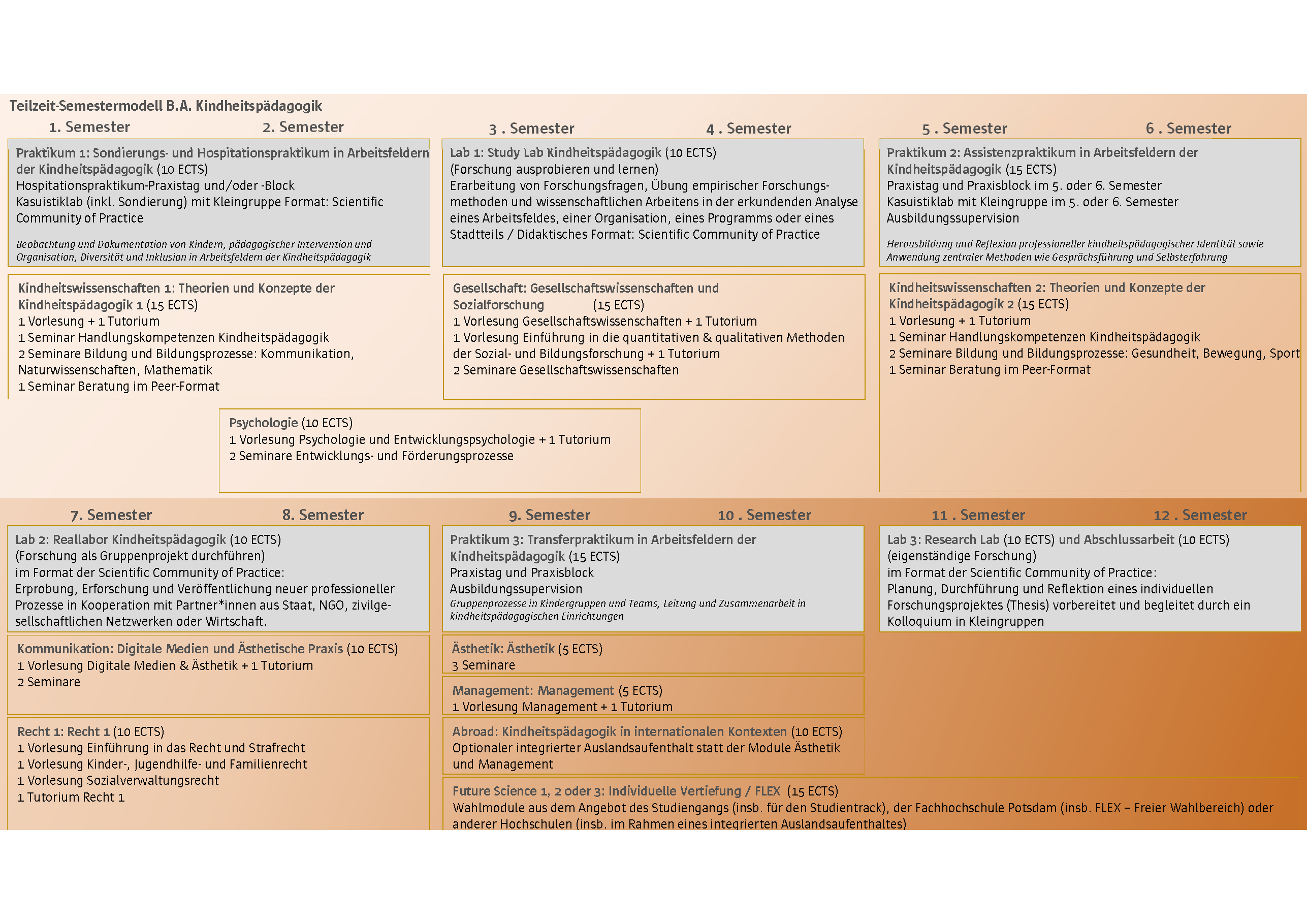
Semester and module overview full-time and part-time
The standard period of study, including the integrated practical study phases and the final thesis, is 6 semesters for full-time study and 12 semesters for part-time study. Part-time study semesters are counted as half semesters and as full university semesters.
The change between full-time and part-time study can be made on application at the beginning of each winter semester and is valid for at least one academic year. Once the application for admission to the final thesis has been submitted, it is no longer possible to change the type of study programme.
The following full-time and part-time semester models provide an overall view of all modules in the degree programme.
Recognition of competences acquired outside the university
Here you will find questions and answers on the recognition of competences acquired outside of higher education.
Projects from the department
More projects

FEEL - Feeling, Recognising, Assessing, Learning
Extended reality and AI-supported counselling for parents in understanding and dealing constructively with their children's emotions

Transfer research project: Social work in daycare centres and family centres in Brandenburg
Social work in daycare centres, also known as daycare centre social work, has been a growing field of activity in Germany for the last ten years. The aim is to mitigate the consequences of social inequality for children's education. This issue is currently under discussion as part of the planned Startchancen programme for daycare centres, which the federal government intends to implement from 2026…

App Prototyping as an Inclusive Teaching-Learning Arrangement for the Integrative Development of Digital Skills at Upper Secondary Level
The planned project will develop and empirically test a new approach to teaching digital skills through app prototyping.
FAQ
Frequently asked questions about the Bachelor's degree programme in Childhood Education
Application & Contact
Dates & requirements for your application
The most important deadlines, dates and admission requirements for the Bachelor's degree programme in Childhood Education are summarised here. You can find out which steps you need to follow for a successful application in the next section.
Dates
- by the 15th of July: register and submit online application
- by the 15th of July: Apply for a higher semester in order to continue your studies at the University of Applied Sciences Potsdam
Admission requirements
- General higher education entrance qualification in accordance with the Brandenburgisches Hochschulgesetz: General higher education entrance qualification or entrance qualification for universities of applied sciences or a professional qualification recognised as equivalent
How to apply!
In the following, we explain which aspects you should consider from registration for the central allocation of study places to enrolment.
Further information
Under the following links you, and especially international applicants, will find further information on the topics of application and enrolment at the University of Applied Sciences Potsdam.

International applicants
Would you like to apply for a degree programme from the first or a higher semester and have obtained your school-leaving certificate and/or university degree abroad? Then you can have your qualifications and achievements from abroad recognised and study with us.

Application & enrolment procedure
The Application and Study Administration Services provides information and advice on general questions about the application process, admission and enrolment at the University of Applied Sciences Potsdam, application for a higher semester, but also on topics such as compensation for disadvantages, part-time study, waiting semesters and hardship applications.
Contact & Services
The Student Counselling Services provides information and advice on general questions about studying and on topics such as choosing a degree programme, application, enrolment and study organisation.
For programme-specific questions about module content, credit transfer, examinations or study specialisations on the Childhood Education (BA) degree programme, the programme-specific student advisory or the degree programme coordinator is the right place to go.
Head of degree programme
Professor of Theory and Practice of Childhood Education
Transfer professor by lottery
Programme-specific student advisory
Academic staff member in the degree programme Early Childhood Education (BA)
Study programme coordination
Coordinator Degree Programme "Social Work with Families (MA)"
Coordinator Degree Programme "Early Childhood Education (BA)"
Coordinator Degree Programme "Childhood Education (BA)"
Study and Examination Services
Room H.0.14
(Main Building (H))
Study Info Service
studien-info-service@fh-potsdam.de
bewerbungs-service@fh-potsdam.de
campuskarte@fh-potsdam.de
Study Service
studien-service@fh-potsdam.de
Exam Service
pruefungs-service@fh-potsdam.de
Accessibility and Inclusion Officer
Room H.0.17
(Main Building (H))
Office hours
Monday and by appointment
Contact Study Administation Services

Hauptsachbearbeiterin Bewerbungs- und Studien-Service

Application and Study Service Officer

Staff member for Student Info Service