Skip to main content Skip to main navigation Skip to footer

Organisational Development Project – "Freiraum"

With the organisational development project "Freiraum", the university has set out to reform its internal organisation. The aim is to create scope for its strategic development and thus secure the university's future viability. The project is designed to be participatory and organised in the form of a waterfall model.

The project at a glance

Inspired by the review and recommendations of the German Council of Science and Humanities, the FH Potsdam will reform its organisational structure in the coming years. A concrete concept for this is to be developed by the end of 2026 and implementation will begin in 2027.

Goal

The aim is to secure the future viability of the FHP and to create the freedom to drive forward strategic development.

Duration

The project will run for the duration of the university contract (2024 to 2028).

Structure & participation

The project structure provides for working and decision-making bodies with specific roles and responsibilities and continuous involvement of the university public.

Latest news on the work of the editorial groups

Since February 2026, four editorial groups have been working on key areas of organisational development: governance, organisation, cross-faculty collaboration and student affairs. Each group consists of 8–10 members and involves experts from across the university in its work. The findings are regularly reported back to the steering group and fed into discussions with the university’s governing bodies.

15/04/2026 – Pit Stop an Stearing Group 

The editorial group has taken on board the ideas from the first meeting on 18 March and discussed, in particular, the structure of the posts of Vice-Dean for Studies and Teaching and Student Vice-Dean, as well as the role of the SKSL and the Study Commission. The core idea remains that the central structure should be mirrored at a decentralised level. The ‘university management’ is complemented by the ‘faculty management’. Each level has its own networking structures. By reducing the number of departments from five to three faculties whilst maintaining the composition of the faculty councils, faculty management teams and examination boards, and also by reducing the number of people directly involved in other committees, fewer people than before will be involved in committees. This therefore creates more time; however, it also brings with it an obligation to document decision-making and to professionalise the members. Transparency is to be achieved by creating role profiles (profiles) for all committees, which can then also be used in the onboarding of new members.

12/02/2026 – Start of Work

Following discussions on the terms of reference for the Governance Working Group at the Senate’s January meeting, these have now been finalised. The Working Group consists of 8–10 members and regularly consults experts from across the university as part of its work.

Task: Governance Editorial Group

15/04/2026 – Pit Stop in the Stearing Group

The editorial group discussed fundamental questions: What is ‘freiraum’? How can it be organised at a state university? Who are the university’s stakeholders? What are the implications of a centralised or decentralised organisational structure? The aim was to make frequently cited problems – including through an analysis of the findings from the 2025 University Day – more tangible. As part of the Organisation Editorial Group, the first step involves identifying and naming problems; these can be categorised into structural, technical and procedural issues. Furthermore, a concept for future process management at the FHP is being developed, taking into account the possibilities offered by AI. The aim is not to determine every detail, but to create reliable structures and to organise cooperation between centralised and decentralised units effectively.

12/02/2026 – Start of Work

At the Senate’s February meeting, the composition of the Organisation Editorial Group was presented. The terms of reference have now been finalised. The Editorial Group consists of 8–10 members and regularly consults experts from across the university during its work.

Task: Organisation Editorial Group

15/04/2026 –Pit stop in the Steering Group

The editorial group initially focused on the specific challenges involved in organising cross-faculty teaching in accordance with the FLEX module handbook. At present, the potential of this range of courses is not being fully exploited – due to a diffusion of responsibility, differing procedures in course planning and a lack of awareness. As FLEX modules worth at least 10 ECTS credits are implemented with every new accreditation, a growing demand is to be expected, which the university must meet. In accordance with the Senate resolution on organisational development, this is to be organised through a new cross-faculty body. Moving forward, the working group will address the question of how innovation in cross-faculty teaching can be ensured, before turning its attention to the broader issues of research and knowledge transfer.

12/02/2026 – Start of WorkAt the Senate’s February meeting, the composition of the Inter-Faculty Collaboration Working Group was presented. The terms of reference have now been finalised. The Working Group consists of 8–10 members and regularly consults experts from across the university as part of its work.

Task: Inter Faculty Collaboration Editorial Group

15/04/2026 – Pit Stop in the Stearing Group 

Since autumn 2025, the RG has been working on models for student-run bodies and their interfaces with academic self-governance. Key questions include: the understanding of democracy within higher education structures; fairness and representation in electoral processes; the reliable institutionalisation of student participation; and the risk of informal preliminary consultations taking place without student involvement. At a closed-door meeting in March 2026, the profile of the student vice-dean and future structures of the student bodies were explored. Various models for the student councils were developed, focusing on electoral procedures with quotas, departmental structures and interfaces with other bodies. The RG is now consulting the existing bodies on an iterative basis (faculty student councils, AStA, inter-body networking meetings).

Autumn 2025 – Formation of the Student Affairs Editorial Group The Student Affairs Editorial Group began its work as the fourth editorial group in autumn 2025 and has since been developing models for student-run bodies.

What happens when

Two sub-projects are planned:

  • The first sub-project is dedicated to conceptualisation and implementation planning (duration: Q1 2024 to Q4 2026).
  • The second sub-project deals with the actual implementation of the agreed structural reform, which is scheduled to begin in 2027.
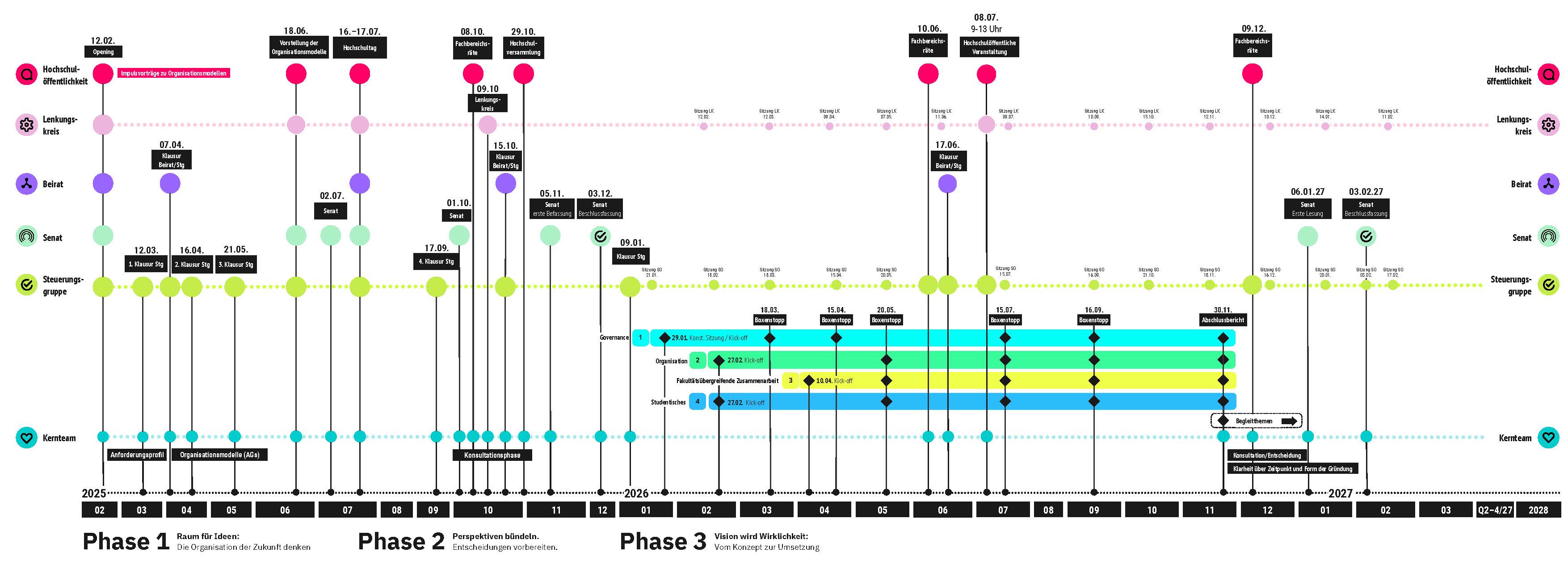
Projektmeilensteine

Von der Auftaktveranstaltung im Februar 2025 bis zum Senatsbeschluss im Dezember 2025: Hier finden Sie die zentralen Etappen auf dem Weg zur Umsetzungsplanung.

Nach einer erfolgreichen Konsultationsphase im Freiraum-Projekt wurden ein überarbeitetes Struktur- und Konzeptpapier und ein Papier zu den Grundprinzipien des Veränderungsprozesses erstellt, die in der Novembersitzung dem Senat zur ersten Lesung vorgelegt wurden. Die Beschlussfassung erfolgte in der Senatssitzung am 03.12.2025 mit einstimmigem Votum. Mit diesem Beschluss endet die zweite Phase des Freiraum-Projekts. Im Januar 2026 startet Phase 3, die sich auf die Umsetzungsplanung konzentriert.

Ein wesentliches Element der Konsultationsphase im Projekt war die Hochschulversammlung am 29.10.2025, bei der Vertreter*innen der Organisationseinheiten, der Personalvertretungen, der Studierenden, aber auch alle Hochschulmitglieder und -angehörigen Gelegenheit hatten, sich zu informieren und sich aktiv an der Diskussion zu beteiligen.

Ein wesentliches Element der Konsultationsphase im Projekt war die Hochschulversammlung am 29.10.2025, bei der Vertreter*innen der Organisationseinheiten, der Personalvertretungen, der Studierenden, aber auch alle Hochschulmitglieder und -angehörigen Gelegenheit hatten, sich zu informieren und sich aktiv an der Diskussion zu beteiligen.

Am 12.02.2025 fiel der Startschuss für unser Organisationsentwicklungsprojekt Projekt Freiraum/FHP 2.0 unter dem Motto "Die FHP von morgen mitgestalten".

Strategic reorganisation at the FHP: Initial situation

The FHP is facing a significant development: in order to help shape the world of tomorrow and remain successful and capable of acting as a university, it will reduce the number of its basic organisational units.

The idea of interdisciplinary learning and research , with its unusual combination of information science and engineering, socio-cultural and design degree programmes, was already in place when the University of Applied Sciences Potsdam was founded and has been a recurring theme throughout the university's development. Since its foundation, the FHP has grown significantly. It has differentiated itself in terms of content, but has basically retained its basic structure of five faculties.

In its structural and development planning 2021 to 2025 (StEP 2025), the university has set itself the goal of working on the transformation of society with both specialist expertise and interdisciplinary interface skills as a unique selling point and has formulated corresponding development goals for the areas of study and teaching, research, transfer and continuing education as well as with regard to infrastructure and cooperation. However, day-to-day work shows that the existing structures, with their high use of resources for self-administration and few synergies, inhibit interdisciplinary collaboration.

In 2022/23, the German Council of Science and Humanities assessed the state's universities on behalf of the state government and recommended that the FHP: "Following the growth of recent years ... undertake a strategic consolidation" in university development . "In addition to the objectives set out in the StEP 2025, the Council of Science and Humanities considers a reform of the internal organisation, a streamlining of the range of courses offered and their stronger alignment with the strategic requirements of the university, a stronger interdisciplinary networking of teaching, research and transfer, particularly along the three profile lines, as well as an intensification of cooperation with universities, scientific institutions and commercial enterprises to be central to this. The key prerequisites for this are strengthening the university management's ability to steer and the release of resources and their strategic reutilisation. The upcoming generational change offers an excellent opportunity to further develop the university on the path it has already taken, which should definitely be utilised." (S. 319)

According to the Council of Science and Humanities, the small-scale structure of the FHP – with five departments and a manageable size of the university – results in "an unnecessarily high level of self-administration, which manifests itself in multiple functions, especially among professors" and "has an inhibiting effect on the interaction and interdisciplinary cooperation between the individual subjects – which the university strives for". He sees an opportunity to make the FHP fit for the future as an agile organisation by overcoming this fragmentation and "strongly recommends at least reducing the number of departments by merging them appropriately" (p. 320f.).

The Science Council's recommendations to the University of Applied Sciences Potsdam (Drs. 1693-24) are aimed at various fields of action. In addition to reforming the internal organisation, the Council of Science and Humanities focuses on streamlining the range of courses on offer and strengthening the interdisciplinary networking of teaching, research and transfer, particularly along the three profile lines. It also recommends intensifying cooperation with other universities, scientific institutions and commercial enterprises.

The aim of further developing the organisational profile of Potsdam University of Applied Sciences is enshrined in the 2024 to 2028 university agreement. A university-wide discussion and change process should clarify what form the university should take in future (departmental or faculty structure) and how its performance and innovative capacity can be increased by more closely linking the organisational structures with the profile lines. The state expects the FHP to present a concept and implementation plan for the reform of its internal structure by the end of 2026 in order to begin implementation from 2027.

Project Feedback

Do you have any questions or suggestions regarding "Freiraum"? You can submit your feedback here (anonymously if you wish). The feedback will be collected and - depending on the topic - discussed in the various project committees.

Indicates required field
Name

Impressions: Kick-off organisational development project "Freiraum"

On the 12th of February 2025, we kicked off our "Freiraum" organisational development project under the motto "Helping to shape the FHP of tomorrow". Together, we collected and discussed ideas and provided initial impetus. Below you will find an insight into the event.

Project structure & roles

As project manager, the president is responsible for the project and for achieving the project goals; she has the authority to issue guidelines.

Below you will find an overview of the distribution of roles and tasks within the project.

The steering group makes all important decisions and is responsible for the content and strategic organisation of the project.

The steering group is made up of

The steering group meets monthly before the Presidential College meeting and as required.

As the administrative office for the project, the core team prepares documents and concepts, organises meetings and events and serves as the central information and communication point for all project committees and the university public as well as the agency and external partners.

The core team includes the President, the University Planning and Development Officer and the President's Officer.

The core team meets weekly for a jour fixe and as required.

The steering committee acts as an internal sounding board for the project. It provides feedback and brings in perspectives from the respective organisational unit and/or function.

The steering committee is made up of

The steering committee meets monthly and as required.

The advisory board contributes external expertise and experience to the organisational development project. It advises those responsible for the project and ensures that the project development complies with the recommendations of the German Council of Science and Humanities.

The advisory board is made up of ten personalities from science, business and society.

Two meetings a year are planned for the advisory board, as well as an exchange of views when required.

The university public is regularly informed about the progress of the project. It is involved through open formats and active participation in events. It is expected to provide input and feedback on possible organisational models, as well as discussions on the advantages and disadvantages of the proposed concepts and implementation planning.

Formats for the participation of university members are

  • Kick-off event for the project,
  • surveys,
  • university day,
  • group work and
  • regular information.

The project is supported by an agency team. The team moderates important meetings and events, supports the project committees and contributes creative, communicative and technical experience from similar projects.

As a result of a public tender, Prognos AG and its subcontractor Nordsonne Identity were awarded the contract.

Important documents

Contact us

You can reach the project team at: fhp2.0@fh-potsdam.de

Project management

Participation in the core team

Head of University Planning and Development

Participation in the core team

Speaker of the President

Participation in the core team

Managing Director of the Senate, the Ethics Committee and for committee elections; Official Announcements / Consultant