Skip to main content Skip to main navigation Skip to footer

Urban Futures (MA)

Profile: Digital Space – Data, Interaction, Knowledge Social Space – Education, Participation, Community Built Space – Design, Construction, Preservation
Blick auf Berlin mit Fernsehturm

The MA programme Urban Future offers students from different disciplinary backgrounds the opportunity to study urban transformation processes in an inter- and transdisciplinary way. You will acquire the necessary subject-specific and interdisciplinary skills and knowledge that will enable you to work independently, scientifically, creatively and interdisciplinarily, to critically reflect on scientific findings and to act responsibly in the context of urban transformation processes. In each academic year, there is a specific cohort topic on which in-depth content-related knowledge and contacts in research-based practice are established.

Degree:
Master of Arts
Type:
full-time
Course language:
German
Standard study period:

4 semesters

Start of study:
Winter semester
Application deadline:

15/05 – 15/06 (restricted admission)

Admission requirements:
Thematically relevant first university degree qualifying for a profession
Credits:

120 ECTS credits

Module Manuals & Regulations
Profile

Main topics

With regard to disciplinary specialisation, three thematic specialisations are offered that describe central aspects of urban systems and focus on the design of spatial, social, infrastructural, cultural and aesthetic processes and structures – each from a different perspective: the built, social and digital city.

Built city

  • Sustainable infrastructures
  • Sustainable neighbourhood development
  • Urban metabolism

Social city

  • Demographic change, heterogeneity and social inequality
  • Participation and active shaping of transformation processes
  • Attitudinal and behavioural change

Digital city

  • Analysis and visualisation of urban data
  • Digital transformation in media, culture and economy
  • Algorithmic ethics and responsibility

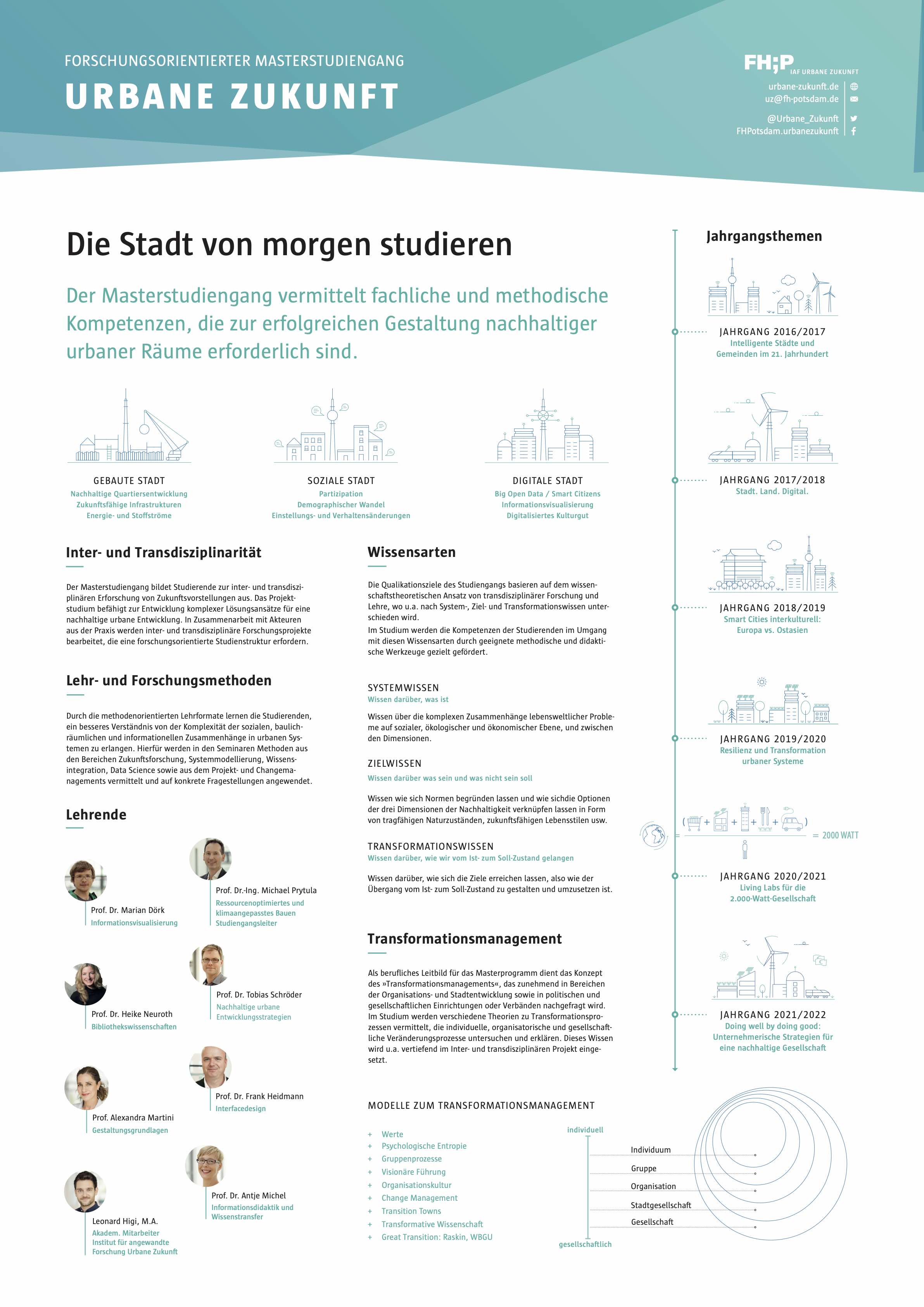
Study the city of tomorrow

The transformation of urban spaces into sustainable structures is one of the great challenges of our time. This transformation encompasses ecological, spatial, structural, social, cultural, design, infrastructural, technological and economic aspects equally and interdependently, for whose challenges there are no simple and sectoral solutions. The research-oriented MA programme Urban Futures enables you to think in a networked manner and to work in an interdisciplinary manner, to tap your creativity and innovation potential and to acquire profound knowledge and contacts for research-based practice.
Video Urban Futures

The major challenges of sustainable urban development include demographic change, climate protection strategies, measures as a result of social segregation, participation processes and big data in the context of urban infrastructure (smart cities). The MA degree in Urban Futures provides the technical and methodological competences required to carry out well-founded analyses of these tasks and to develop integral solutions.

Is this degree programme right for me?

In the Master's programme, you will be enabled to think in a networked manner in the context of urban development and to work in an interdisciplinary manner, as well as to tap into your creativity and innovation potential. You will be provided with profound knowledge and contacts in research practice. The variety of content-related and methodological topics and questions inherent in the complexity of the topic of "Urban Futures" cannot be fully covered in a four-semester master's programme. This makes it all the more important to practise an attitude of lifelong research-based learning during the degree programme in order to be able to move competently in the worldwide and constantly changing range of knowledge.

You bring these qualities with you

  • Interested in research and engagement with building, social science or information technology issues in the bachelor's degree programme
  • Interest in creative activity
  • Analytical and conceptual way of thinking
  • Independence, communication, organisational and team skills

Further information

Key visual of the Open Day with symbols of the departments of CITY | BUILDING  | CULTURE, Civil Engineering and Information Sciences
© Mandy Puchert

Information day 2026: We are opening our doors

Open Day at the University of Applied Sciences Potsdam: On the 6th of June 2026, you will get to know the diverse degree programmes at our university, explore the campus and gain exclusive insights into our modern laboratories and workshops.

Take the opportunity to talk to students and lecturers in person and look forward to a varied programme.

FAQ

This list is intended to help you answer the most frequently asked questions about our Master's programme urban futures. If you have any further questions, please feel free to send us a personal request via the email address uz@fh-potsdam.de. We will answer you as soon as possible.

Urban Futures (MA) is not a degree programme where the classical qualifications for urban and regional planning are taught. The focus is on inter- and transdisciplinary project work, but not on urban planning or urban design as is usually the case in planning degree programmes. We deal with the diverse questions of sustainable urban development in an interdisciplinary way. The article "Learning Transformation" describes the intentions, methods and teaching formats of the degree programme in more detail.

The composition of the Master's programme is interdisciplinary: About half of the 20 places in each year are allocated to students with a background in planning and design, natural sciences and technology, and the other half to students with a background in cultural and social sciences. In concrete terms, these are mainly geographers, urban and regional planners, architects, cultural and social scientists, political scientists, designers, media and communication scientists, psychologists, economists, but also cultural work, social work, information and library sciences, art history, choreography are represented disciplines – if there is a strong interest in the city and interdisciplinary work.

In the Master's programme, a distinction is made between compulsory and elective subjects. The programme is designed so that the compulsory courses take place from Tuesday to Thursday. On Mondays and Fridays, as well as in the peripheral periods, there is the possibility to take elective subjects, to prepare for and follow up on courses, for self-study and for part-time work.

Further information on the study structure, the study and examination regulations and the module regulations

The Master's degree programme offers plenty of scope for deepening individual study interests within the framework of the electives. In addition to the electives at the University of Applied Sciences Potsdam (practically from all degree programmes), you can also attend courses at other universities and receive credit. Furthermore, MOOCs or "special forms" (such as summer schools, etc.) are possible course variants.

Since the introduction of the Master's programme in the winter semester of 2016, we have seen a steady increase in demand. In the last two years, we have had between 90 and almost 120 applicants for every 20 places. Since the selection for the admission procedure is based on the bachelor's grade and the application letter, no clear NC can be determined for admission. If you are interested, we recommend that you apply regardless of your grade point average.

Get all important information on the application procedure.

Individual part-time study is also possible. Please see our further information and requirements.

The aim of the research internship in the third semester (module 9 with a scope of 20 ECTS credit points or 600 working hours) is to gain practical experience with organisational structures and operational processes in the internship institution and to work on complex research questions in the context of urban transformation processes. With a qualified secondary activity, the intended qualification goals can also be achieved during the course of study; crediting of secondary activities for the research internship is therefore possible upon application. In order to avoid a time overload, other study achievements may then have to be completed in deviation from the planned regular course of studies.

Urban Future Talks

The Urban Future Talks address issues of urban transformation. We want to use them to better understand the complexity of urban processes in a digital age and show ways to achieve sustainable urban development. As a discursive format, they enable a close exchange between theory and practice. #UrbanFutureTalks

Urban Future Talk #1 | Participation in the digital Age

Guests and topics:

Jörg Noenning − Professor for Digital City Science at the HCU Hamburg

Beyond the Smart City. The smart city as a cyber-physical system

Yannick Haan − Project Manager at Hack Your City

How to Hack your City

Carolin Schröder − Head of Participation at the Centre for Technology and Society at TU Berlin

On the Limits of Participation

Moritz Maikämper − Department of Urban Management at BTU Cottbus-Senftenberg

Participation on Site: Urban Development Processes in Brandenburg


Urban Future Talk #2 | Mapping as a Critical and Transformative Practice

Guests and topics:

Adrian Labaye − HU Berlin

Performing the Urban Commons trough Collaborative Mapping

Anne Fenk − Habitat Unit, TU Berlin / MOD Institute

Remapping − Questioning the Atlas

Herbert Lohner − BUND Berlin

Mapping Environmental Justice in Urban Areas

Nina Hälker und Katrin Hovy − HCU Hamburg

"Decision Support or Shaping Decisions? – the Use Case of Finding Places"

Alexandra Toland − TU Berlin

Aesthetic Cartography 

Adam Harvey − Artist & Researcher

Geo-Visual Forensic with Computer Vision

Sebastian Meier − Technologiestiftung Berlin Ideation and Prototyping Lab 

Personal Cartographic Perspectives

Urban Future Talk #3 | Communal living. Current trends and challenges

The social debate on communal forms of housing has changed in recent years. There is greater acceptance of communal forms of housing, whose contribution to sustainable urban development is recognised. However, the path from niche to trend is increasingly being blocked by rising land and construction prices. New funding instruments are only of limited help, as it is still unclear what makes communal forms of housing particularly worthy of funding. At the same time, the idea and practice of communal forms of housing are becoming more diverse: in addition to building groups and project initiatives that build their own homes via cooperatives or syndicates, large housing construction companies also want to integrate elements of communal living into new builds. And in new, partly commercial, partly non-profit-based mini-apartment blocks or co-work/co-living, community is being organised even more flexibly and partially. At the event, four perspectives were presented and discussed on the questions of what makes communal living special and how the social and eligible added value of ‘communal living’ can be defined.

Barbara König – Bremer Höhe eG, Berlin

Promoting communal forms of housing - the contribution of cooperatives to non-profit, innovative and sustainable housing

Robert Ostmann – urban coop berlin eG, Berlin

Utilising the last niches: New forms of cooperation and new housing concepts to realise communal living in tight housing markets

Michael Matuschka – BARchitekten, Berlin

What role do architects (still) play as initiators of communal housing projects?

Ricarda Pätzold – DifU, Berlin

"The relevance and added value of communal living from the perspective of local authorities"

Contact

The staff members at the Student Counselling Services provide information to prospective students, first-year students, parents, lecturers  and students on all general questions about the degree programme. If you have specific questions or concerns about the Master's programme Urban Futures, please contact the programme-specific student advisory.

Student Counselling Services

Room 102

Book an appointment online

Programme-specific student advisory

Programme-specific student advisory

Research professor for resource-optimised and climate-adapted construction
Head of Urban Future (M. A.)
Study Content

Course of studies

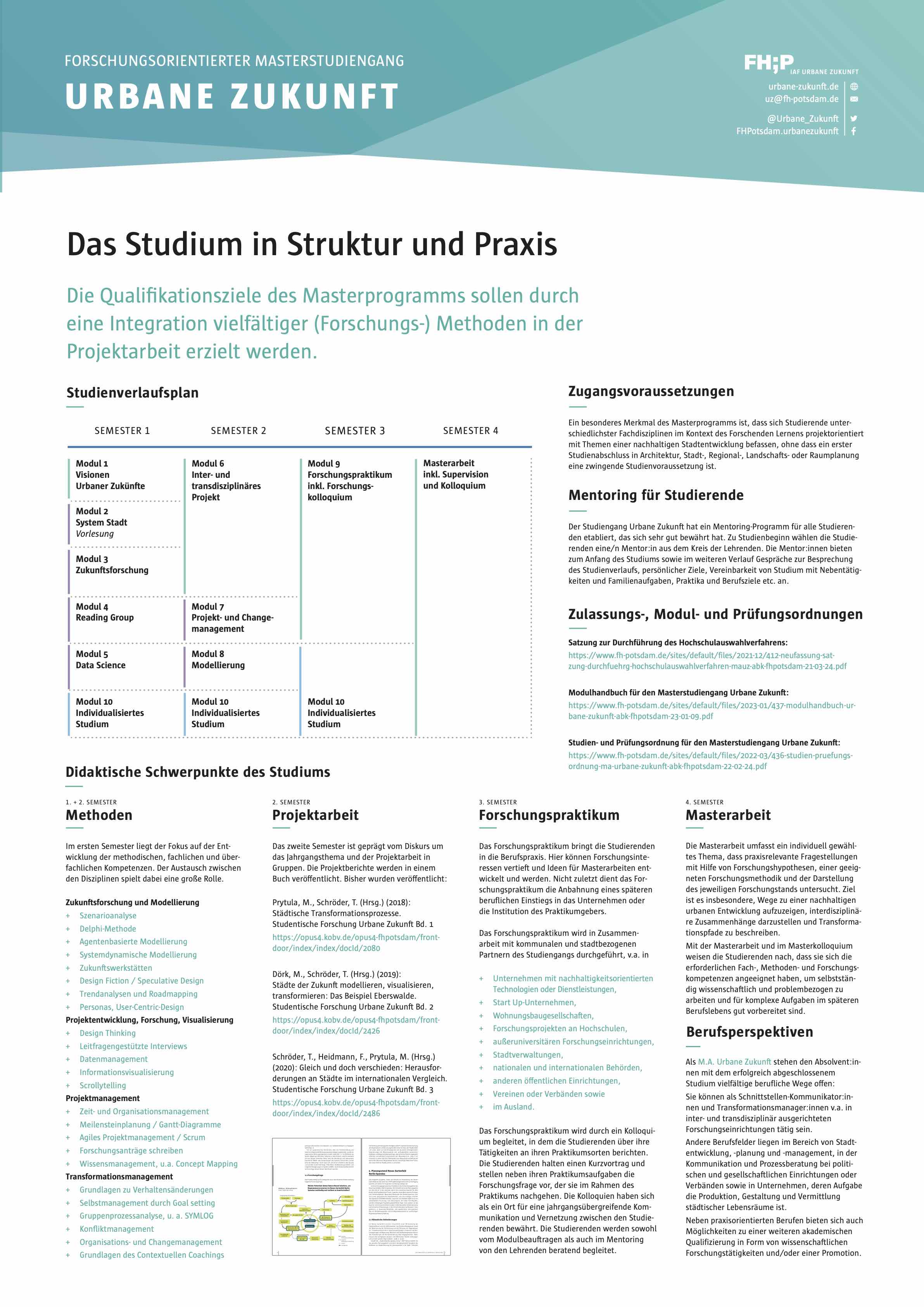
The standard period of study for the full-time degree programme Urban Futures is four semesters and concludes with a Master of Arts degree. The study plan gives you a detailed overview.

Semester 1Visions of urban futures, city as a complex system, methods, electives
Semester 2Inter- and transdisciplinary project, methods, electives
Semester 3Research internship, electives
Semester 4Master's thesis and colloquium


Study content

In the Master's degree programme Urban Futures, you will study with a high project component, which serves to translate and further develop the state of research taught in the degree programme into feasible concepts for urban problems in a practical manner. The focus is on promoting methodological competence while taking disciplinary in-depth studies into account.

In the currently valid module handbooks, study and examination regulations and statutes of the Urban Futures degree programme, you will find the module overview, a detailed description of the modules and study contents, the study plan as well as the statutes for the implementation of the university selection procedure for the Master's degree programme urban futures.

Modules

  • Visions of urban futures
  • System City
  • Futurology
  • Reading Group
  • Data Science
  • Inter- and transdisciplinary project
  • Project and Change Management
  • Modelling of Complex Systems
  • Individualised study (electives)

Research internship

In cooperation with municipal and city-related partners and under the supervision of lecturers, you will carry out a practice-oriented research internship of 560 hours.

Master thesis

  • Master's thesis and colloquium with accompanying supervision

Results from the Urban Futures degree programme (selection)
2024

  • Anna Reinhard: Mehrfachnutzung als Instrument gemeinwohlorientierter und nachhaltiger Flächen(um)verteilung. Das Beispiel Berlin
  • Barbara Herr: Warum hört der Radweg einfach hier auf?
  • Clara Lehmann: Vorteile von integrierter Gesundheitsversorgung aus unterschiedlichen Perspektiven am Modellprojekt integriertes Gesundheitszentrum (IGZ) Berlin-Lichtenberg
  • David Lennart Burkert: Modellierung, Evaluation und Iteration eines Geschäftsmodells zur Kompensation von klimaschädlichen Emissionen aus Humankremationen
  • Hannah Esselborn: Gemeinwohlorientierte Leerstandsentwicklung durch bürgerschaftliches Engagement im ländlichen Raum in Baden-Württemberg
  • Katharina Schürmann: ÖPNV im ländlichen Raum
  • Kübra Sari: What elements of social and physical infrastructure forst a sence belonging and safety among the members of the queer community in Berlin?
  • Leonie Große-Allermann: Monitoring von Klimaanpassung in deutschen Kommunen
  • Lorena Sigrist: What elements of social and physical infrastructure forst a sence belonging and safety among the members of the queer community in Berlin?
  • Nina Hasch: Ableiten einer Wertschöpfungsarchitektur für Cradle-to­Cradle-Nachhaltigkeitsinnovationslabor
  • Sebastian Strobel: Einsatz von KI in der Verwaltung

2023

  • Clara Dehlinger: Framings von Verkehrswende
  • Clara-Sophie Mau: Abriss verboten? Eine qualitative Studie zur Wirkweise des zweckentfremdungsrechtlichen Verbots von Gebäudeabriss als Instrument zur Sicherung der Wohnraumversorgung am Beispiel Berlin.
  • David Anmacher: Postkoloniale Perspektiven auf Verdrängung in Berlin
  • Dirk Heider: Innovation in der Verwaltung
  • Elise Rebien: Zu teuer, zu wenig, zu Hause in Berlin. Eine systemische Analyse zur Politik des bezahlbaren Wohnungsbaus in Berlin
  • Ella Eisemann: Auswirkungen der beschlossenen Verkehrsmaßnahmen auf das Mobilitätsverhalten unterschiedlicher ökonomischer Schichten in der nördlichen Luisenstadt Berlin. Untersuchung einer Personenverkehrsnachfragekontrollierung unter einem Aspekt distributiver Mobilität
  • Ester Scheck: Kartierung von öffentlichen Räumen auf Basis von OpenStreetMap Daten
  • Judith Vera Neidhardt: Community Mapping in the context of urban informality - The impact of Community Mapping on the empowerment and visibility of a so-called informal settlement in Colombia
  • Kilian Parker: Innerstädtische Hitzeanpassung: Flächendeckende Fassadenbegrünung als Planungsmaßnahme der Umgebungskühlung in Nord-Neuköln, Berlin
  • Laura Awad: Ansätze für eine machtsensible Gestaltung von Wissenszyklen im Kontext urbaner Transformationsprozesse
  • Lena Fuchs: Handlungsempfehlungen zur Klimaneutralität im kommunalen Rohrleitungsbau
  • Martin Parlow: Willkommen in Brandenburg? Über Wohnraumreserven im Land Brandenburg und deren Zugänglichkeit für Berliner Wohnungslose
  • Max Linnenschmidt: Die zukunftsfähige Planung gemeinschaftlicher Wohnformen. Eine systemische Betrachtung der planerischen Umsetzung Gemeinschaftlicher Wohnformen
  • Sarah Berg: Kulturelle und kreative Ansätze in der Stadtentwicklung
  • Sharmila Sharma: Intersektionale Perspektiven auf die Zukunft der Arbeit
  • Sigrid Obermeier: Hat die Fördermaßnahme QM Smart City Manager des Landes Brandenburg einen nachhaltigen Effekt? - Wirkungsanalyse zur Einbettung der Maßnahme in die Förderlandschaft "Nachhaltige Stadtentwicklung"
  • Sina Wenzel: Kompensationsproblematik im Land Berlin - Chancen und Grenzen des naturschutzrechtlichen Ökokontos
  • Sofia Helfrich: Zugänglichkeit gemeinschaftlicher Wohnformen
  • Sofie Schnitger: Maßnahmen zum Erhalt städtebaulicher Strukturen unter Berücksichtigung der aktuellen Voraussetzungen und vor dem Hintergrund des Berliner Hobrecht-Plans
  • Stefanie Voß: Einflußfaktoren für Design Curricula - Verwendung von Kompetenzen zur Stärkung des Qualifikationsprofils von Designerinnen im Feld des Social Designs
  • Theresia Schmidt: Gesellschaftlichen Zusammenhalt in ländlichen Regionen stärken. Entwicklung eines Planungswerkzeugs auf regionaler Ebene nach dem Soziale-Orte-Konzept
  • Ulrike Silz: Narrative für die zirkuläre Wende. Ein Tool zur Integration von Kreislaufwissen und Zukunftsperspektiven

2022

  • Annekathrin Bake: Wohnflächenkonsum der Zukunft – Szenarioanalyse richtungsweisender Zusammenhänge
  • Anne-Liese Lammich: Beteiligungskultur in Klein- und Mittelstädten
  • Annika Weseloh: Alles nur Schall und Rauch? Eine Szenariostudie zu Entwicklungspfaden einer produktiven Stadt Potsdam
  • Carol-Andrea Yousseu: Entschärfung des Berliner Wohnungsmarkts durch Baulandmobilisierung
  • Chantal Schöpp: Zirkuläre Stadtquartiere 2040 - Was wäre, wenn sich Stadtquartiere 2040 an den Prinzipien der Circular Economy ausrichten würden? Welche Planungsvarianten ergeben sich daraus?
  • Claas Fritzsche: Klänge des urbanen Alltags. Der Soundscape-Ansatz zur Bewertung von Qualitäten öffentlicher, urbaner Räume
  • David Siedke: Institutionalisierung informeller Bürgerbeteiligung – eine Bestandsaufnahme
  • Dominik Berton: ( Re-) Arranging parking spaces – Transformationspotentiale von Parkflächen
  • Ilka von Eynern: Hast Du Platz in Potsdam? Ein bedarfsorientiertes Konzept zur Beteiligung junger Menschen an der Innenstadtentwicklung in Potsdam
  • Jill Ann Theobald: Zirkuläre Quartiersentwicklung – Herausforderungen und Lösungsansätze für die zirkuläre Gestaltung von Neubauquartieren
  • Ken Dornberger: Die Straße der Zukunft jetzt gestalten – ein Quick-Check zur Neugestaltung und nachhaltigen Transformation öffentlicher städtischer Straßenräume im Bestand
  • Kyra Wohlgemuth: Gesundheitheitsfördernde Stadtentwicklung auf der Mierendorffinsel in Berlin
  • Laura Koch: ( Re-) Arranging parking spaces – Transformationspotentiale von Parkflächen
  • Laura van Altena: Die Pandemie als Ideenmotor für Beteiligungsprozesse in der integrierten Stadtentwicklung
  • Lena Blüggel: Die Transformation von urbanen Shopping Malls
  • Max Tristram: Realexperimente als Werkzeug der Stadtplanung: Vitalisierung von öffentlichen Räumen in Innenstädten
  • Nils Kaltenpoth: Systemwandel in der strategischen Planung
  • Oseanne Blech: Entrepreneurs and the smart city – An ambigiuous relationship
  • Paulina von Kietzell: Gestaltung von Innovationsökosystemen für die nachhaltige digitale Transformation im ländlichen Raum am Beispiel des 'Modellprojekt Smart City Bad Belzig/Wiesenburg'
  • Sophia Lenz: Gendergerechte Stadtplanung im Lehrplan deutscher Hochschulen. Analyse zum Status Quo der Lehre von gendergerechter Planung
  • Thomas Haas: Beschleunigte Landschaften – Zum Zustand peripherer Räume im urbanen Metabolismus
  • Yulia Aster: Visuelles Storytelling als Kommunikationsmethode für Transformationsprozesse im urbanen Raum

2021

  • Beatrix Unger: Reallabor als Beteiligungsinfrastruktur in der nachhaltigen Stadtentwicklung – Die Initiative Lokallabor Dudenschänke
  • Constantin Dubyk: Evaluierung von Modulen und Funktionen einer kollaborativen Arbeitssoftware mit dem Ziel einer gesteigerten Gruppenkohäsion in virtuellen Teams.
  • Cornelius Dauer: Urban Gardening als Beitrag zu einer nachhaltigen Quartiersentwicklung
  • Elise Werner: Zukunftsbilder zur Transformation der Mensch-Natur-Beziehung. Ein systematisches Review
  • Fabian Rösch: Wie kann Crowd Shipping vor dem Hintergrund der dortigen Anforderungen und Probleme sinnvoll in ländlichen Räumen etabliert werden?
  • Falko Boek: Herausforderungen und Potenziale bei der Umsetzung des Onlinezugangsgesetzes auf kommunaler Ebene. Roadmap für ausgewählte Modellkommunen in Brandenburg
  • Felix Jaekel: Auswirkungen der geplanten Klimaneutralität 2050 auf Offstreet-Mobilitätsinfrastruktur in Moabit
  • Fidel Thomet: Here, everything is still possible – a design fiction approach to explore futures of non-places
  • Franziska Schmidt: Grünräume in Berlin und Umland. Eine Analyse der stadtübergreifenden Entwicklungen aus historischer und zukünftiger Perspektive.
  • Iva Radic-Capuani: Healing Gardens as a concept for rethinking post-pandemic public spaces
  • Jana Schelte: Akzeptanz von & Erfolgsfaktoren für Mieterstromprojekte am Beispiel der Gartenstadt Drewitz (Potsdam)
  • Johanna Bröckel: Reallabor als Beteiligungsinfrastruktur in der nachhaltigen Stadtentwicklung – Die Initiative Lokallabor Dudenschänke
  • Judith Lenz: Generationsübergreifende Projektentwicklung in schrumpfenden Städten für eine nachhaltige Bildung
  • Krista Smathers: Entwicklungsstrategien für erschwinglichen Wohnraum in Sanierungsvierteln. Eine Vergleichsstudie zu Projekten in Deutschland und den USA
  • Kristin Bauer: Potenziale von Zukunftsforschungsmethoden in der
    Umweltkommunikation
  • Léonie-Anne Schwöbel: Die öffentliche Toilette
  • Lotte Langer: Eine Szenarioanalyse zur Wirksamkeit von urban citizienships/IDs auf Partizipationsmöglichkeiten
  • Marie-Ann Koch: E-Partizipation – Eine Lösung der Ressourcendilemmata? Eine Untersuchung am Beispiel der Kinder- und Jugendbeteiligung in Potsdam
  • Meike Ortmanns: Der Zusammenhang von psychischer und urbaner Resilienz
  • Merle Leisner: Die öffentliche Toilette
  • Mina Mahmoodian Esfahani: Safe Space im Kontext emanzipatorischer Raumpraxis
    am Beispiel vom Schumacher Club in Bochum
  • Mohamed Saleh: Chatbot im öffentlichen Sektor
  • Mohial-Dean Mansoor: Wie könnte eine rassismuskritische Behörde aussehen?
  • Regina Schröter: Welche Rolle spielt Coworking als Arbeitswelt in der Zukunft?
  • Thora Weidling: Großwohnsiedlungen als problembehaftetes Erbe der Nachkriegszeit – Die Wirksamkeit der Städte – Bauförderungsprogramme im Hamburger Quartier "Mümmelmannsberg"
  • Tobias Schmidt: Reallabor als Beteiligungsinfrastruktur in der nachhaltigen Stadtentwicklung – Die Initiative Lokallabor Dudenschänke

2020

  • Anika Lenk: Identifikation und Untersuchung der sozialen Akzeptanz von Flugtaxis im Personenverkehr in Deutschland anhand einer empirischen Studie
  • Caroline Zygmunt: Radverkehrsqualität im Berliner Planungsraum Boxhagener Platz.
  • Catherine Eckenbach: Visionen einer nachhaltigen Welt entwerfen: über die Rolle ästhetischer Praxis bei der Erarbeitung konkreter Utopien
  • Daniel Almgren Recén: Urban Trees in Berlin – Challenges and potentials in a changing climate.
  • Fabian Fleckenstein: Interkulturelles ökologisches Wohn- und Lernhaus in ressourcenpositiver Bauweise
  • Jana Lohmann: Treiber und Barrieren für die Inanspruchnahme von E-Scootern durch weibliche Nutzerinnen
  • Marie Vogelmann: Entwicklung eines neuartigen Kreativkonzeptes zur Unterstützung des eigenständigen Erlernens moderner Fertigungstechniken
  • Martina Dreßelt: Inside sheltered walkways - Deriving the Urban Futures. A Transformative Research Study on Human Mobility and Spatial Perception in Singapore’s Public Housing Estates
  • Nele Trautwein: Relevanz und Umsetzung stadtplanerischer Leitbilder am Beispiel des Leitbilds der Gartenstadt des 21. Jahrhunderts für die Neuen Stadtquartiere Berlins.
  • Pascal Schwerk: Agentenbasierte Modellierung eines Bikesharing-Angebots im suburbanen Raum. Eine praktische Modellentwicklung am Beispiel Luckenwaldes.
  • Susanne Helm: Urbane Klimagovernance in der Landeshauptstadt Potsdam
  • Valentina Troendle: Eine webbasierte Wissensplattform als Artefakt gesellschaftlicher Transformation und Grenzobjekt der Stadt-Land-Integration?

2019

  • Clara Guigas: #bikingberlin. Entwurf einer datenbasierten Social Marketing Kampagnenstrategie zur Förderung von Fahrradmobilität in Berlin.
  • Felix Grünziger: Sozial-ökologische Transformation der Ernährungswirtschaft im Kontext eines digitalen Social Impact Start-ups – Wie lassen sich Nachhaltigkeitsziele im Bereich des biologischen Obst- und Gemüsehandels am Beispiel der Querfeld GmbH identifizieren und operationalisieren?
  • Ilya Alexander Yacine: Digitale Formen der Kollaboration. Eine Vergleichsanalyse von physisch und digital organisierten Projektinitiativen.
  • Janik Fechner: Partizipationsprozesse in der Entwicklung städtischer Quartiere – Auswirkungen von partizipativ gestalteten Stadtentwicklungsprozessen auf urbane Qualität.
  • Julia Ullrich: Berufsfelder im Kontext zukünftiger Arbeitswelten – Am Beispiel des Innovationsclusters Verkehr, Mobilität und Logistik.
  • Katharina Mayer: Welche Perspektive bietet die Genossenschaft sozialer Träger in der wachsenden Stadt Berlin bei der sozialen Wohnraumversorgung marginalisierter Gruppen?
  • Marius Wittmann: Strategien urbaner Bodensicherungssysteme. Exploration innovativer Instrumente.
  • Michael Schmidt: Berufsorientierung 4.0 – Anforderungen, Handlungsbedarf und Entwicklungspotenziale der schulischen Berufsorientierung im Kontext der Arbeitswelt von morgen am Beispiel von Berlin
  • Nadine Neidel: E-Partizipation – Welchen Einfluss haben neue Beteiligungsmodelle auf Bürgerbeteiligungsprozesse?
  • Nathalie Wachotsch: Perspektiven queerer älterer Menschen auf den (Stadt-) Raum.
  • Nicolas Moegelin: Developing a business model for a Clean Air to Market concept.
  • Nicole Hengesbach: A Matter of Place? – Unpacking an Air Quality Data Assemblage.
  • Sarah Krebs: Vertikale Landwirtschaft im urbanen Raum – Chancen und Grenzen – Welche Projekte können hier als Vorbild dienen?
  • Selim Guelbas: Potentiale von autoarmen / autofreien Stadtquartieren
  • Tobias Kauer: tales of a street - Mixed-Methods Mapping of Local Knowledge.

2018

  • Julie Zwoch: Moralisches Framing in der Diskussion über Mobilität der Zukunft
  • Sebastian Gütte: Kommunikation von Energie- und Stoffströmen als Werkzeug für einen nachhaltigen Umgang mit Ressourcen.
  • Sonja Spital: Wohnen und Resilienz – Cluster-Wohnungen als eine Antwort auf Herausforderungen des Wohnens.

Mapping Cities – Making Cities.
Results from interdisciplinary project courses in which students from Urban Future and Interface Design dedicate themselves to the visual analysis and communication of urban data.

Building Social Ecology 
Building Social Ecology is a documentation of social-ecological building projects and typical design elements that occur in these projects. We have identified typical design patterns that can be found frequently and in different forms in the projects. The method is based on the "Pattern Language" (Alexander et al. 1977), which aims to be a tool for planning and designing living cities, buildings and constructions. This documentation was produced as part of the DBU-funded research project "Centrum für Metropolinnovation Bratislava" (06/2020 – 03/2022), for which, among other things, already realised social and ecological examples were analysed.

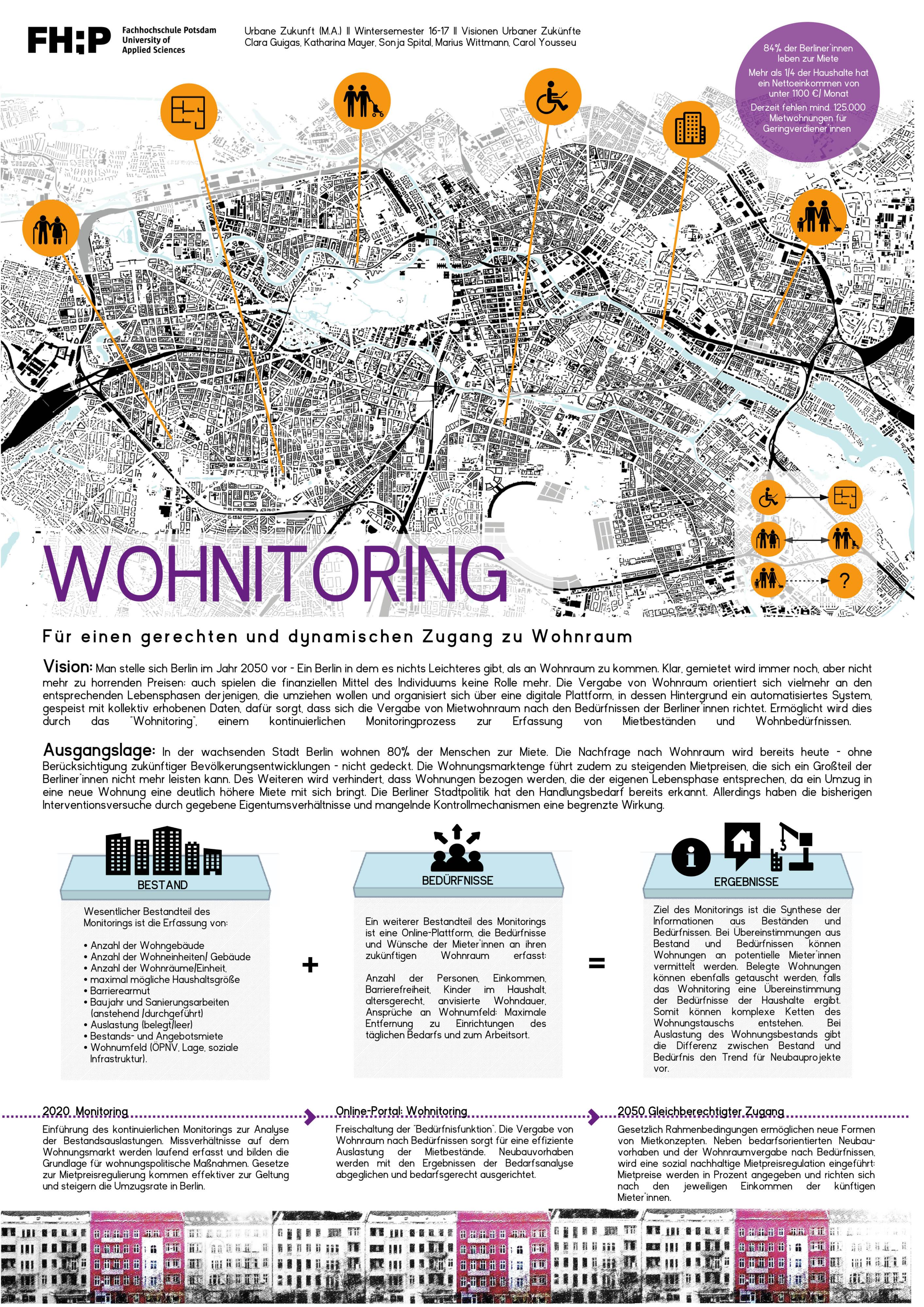
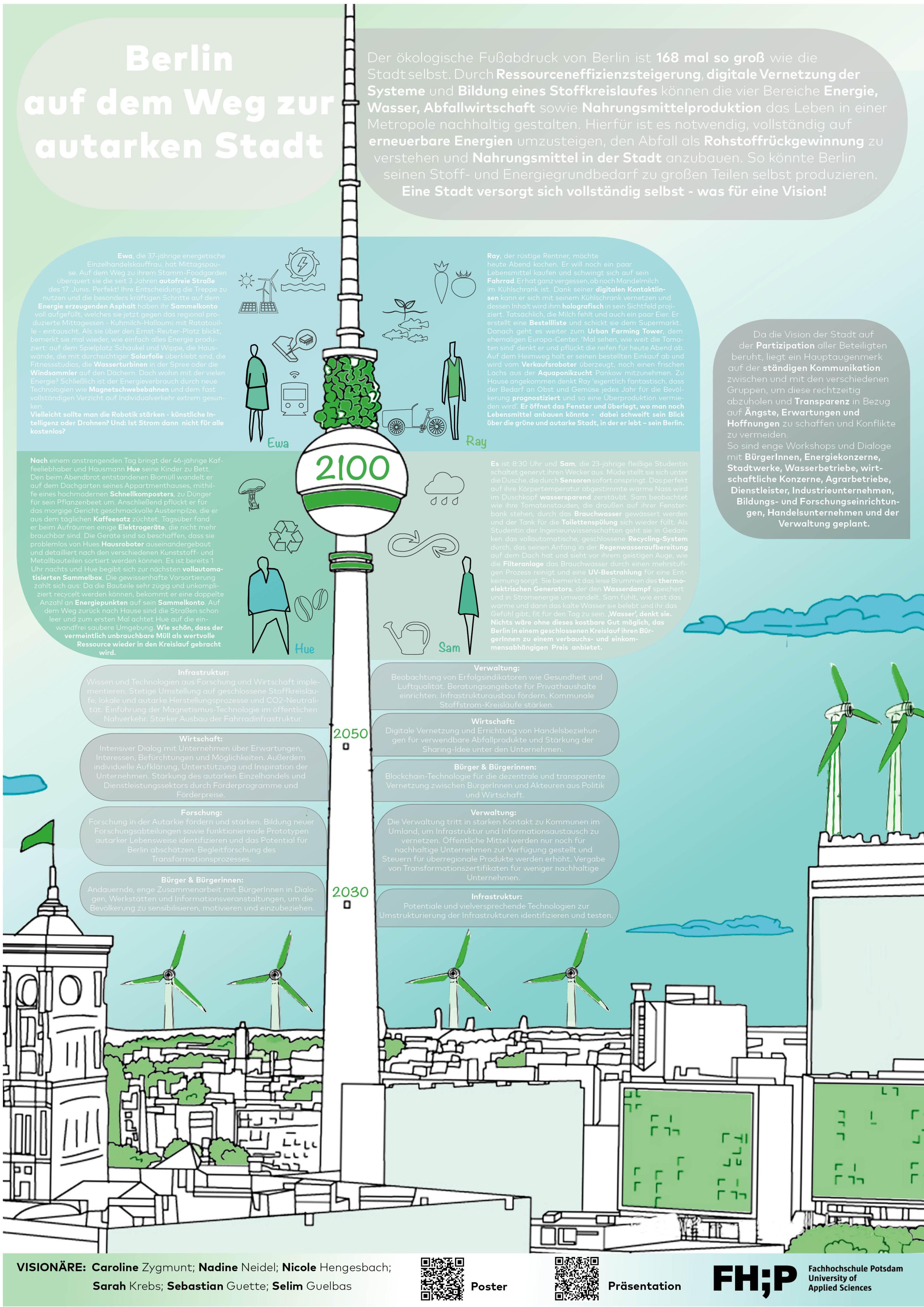
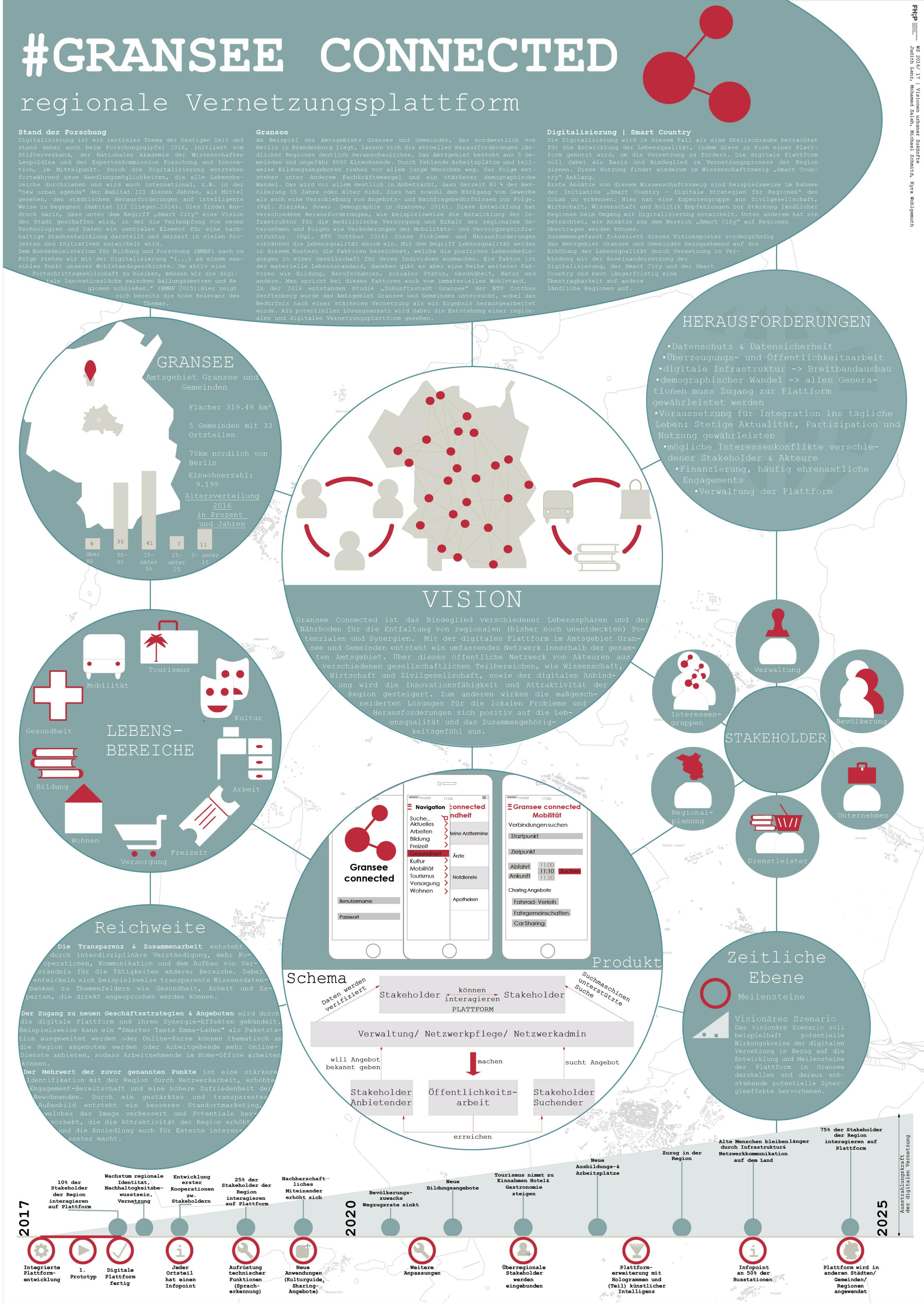
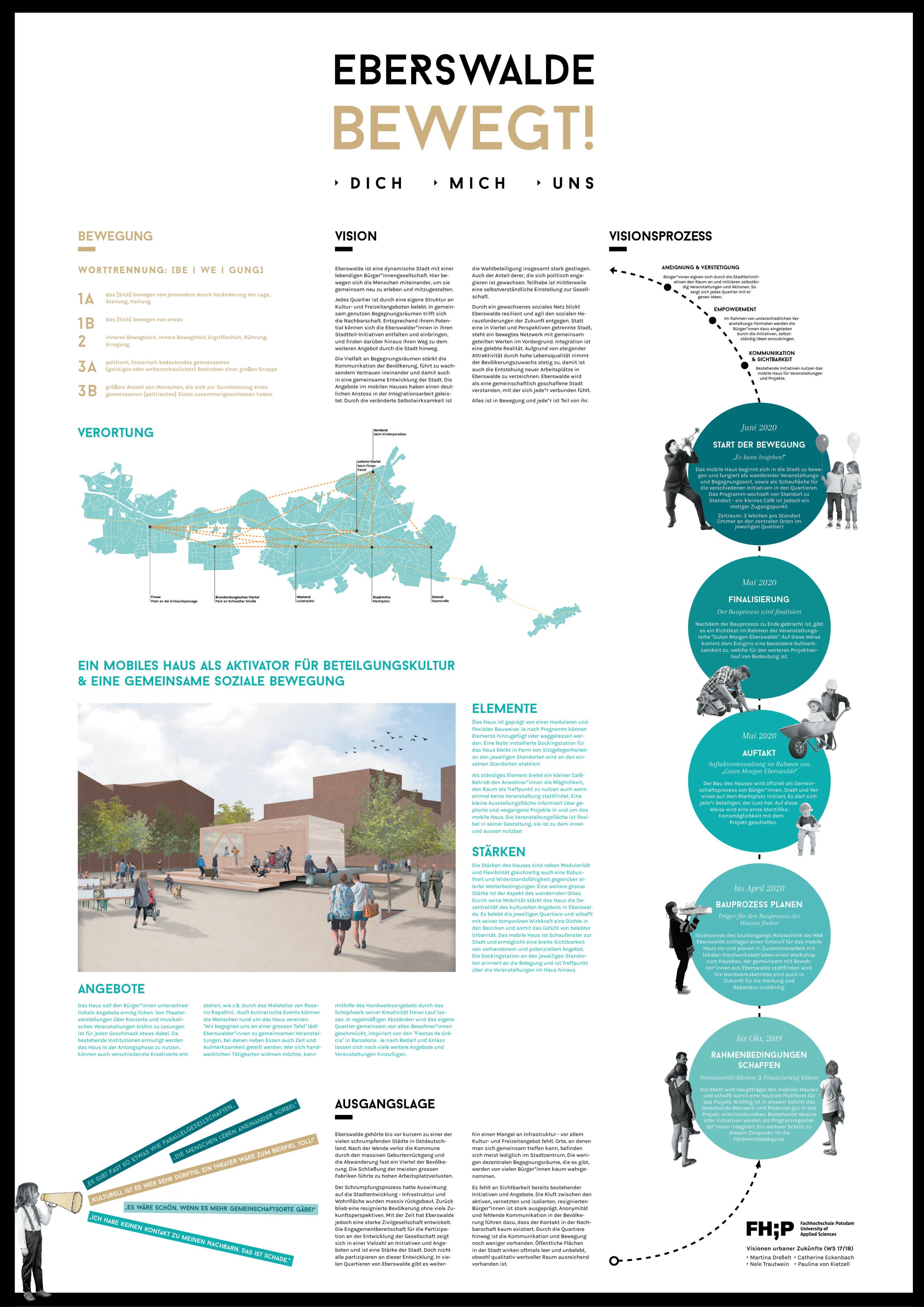
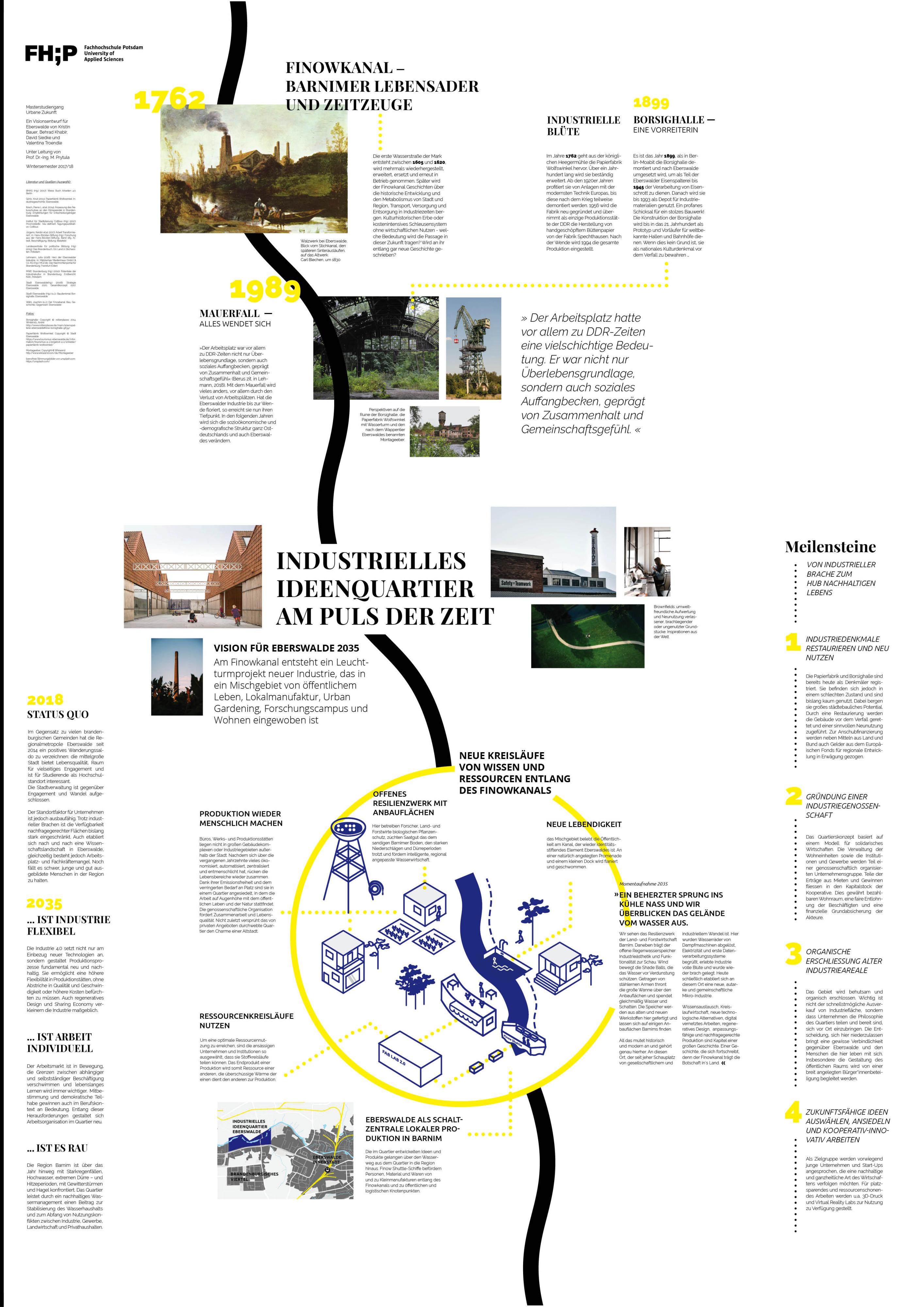
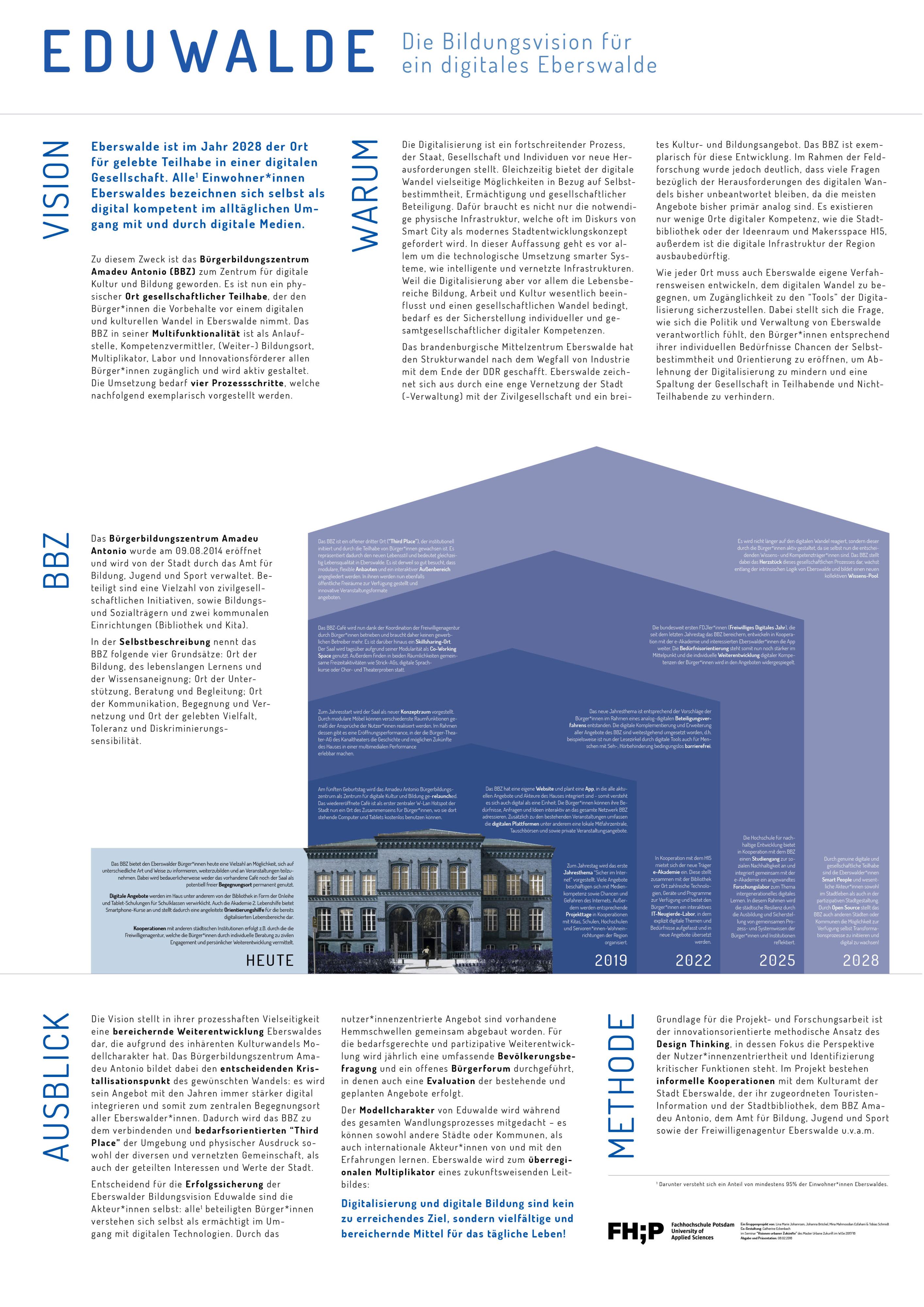
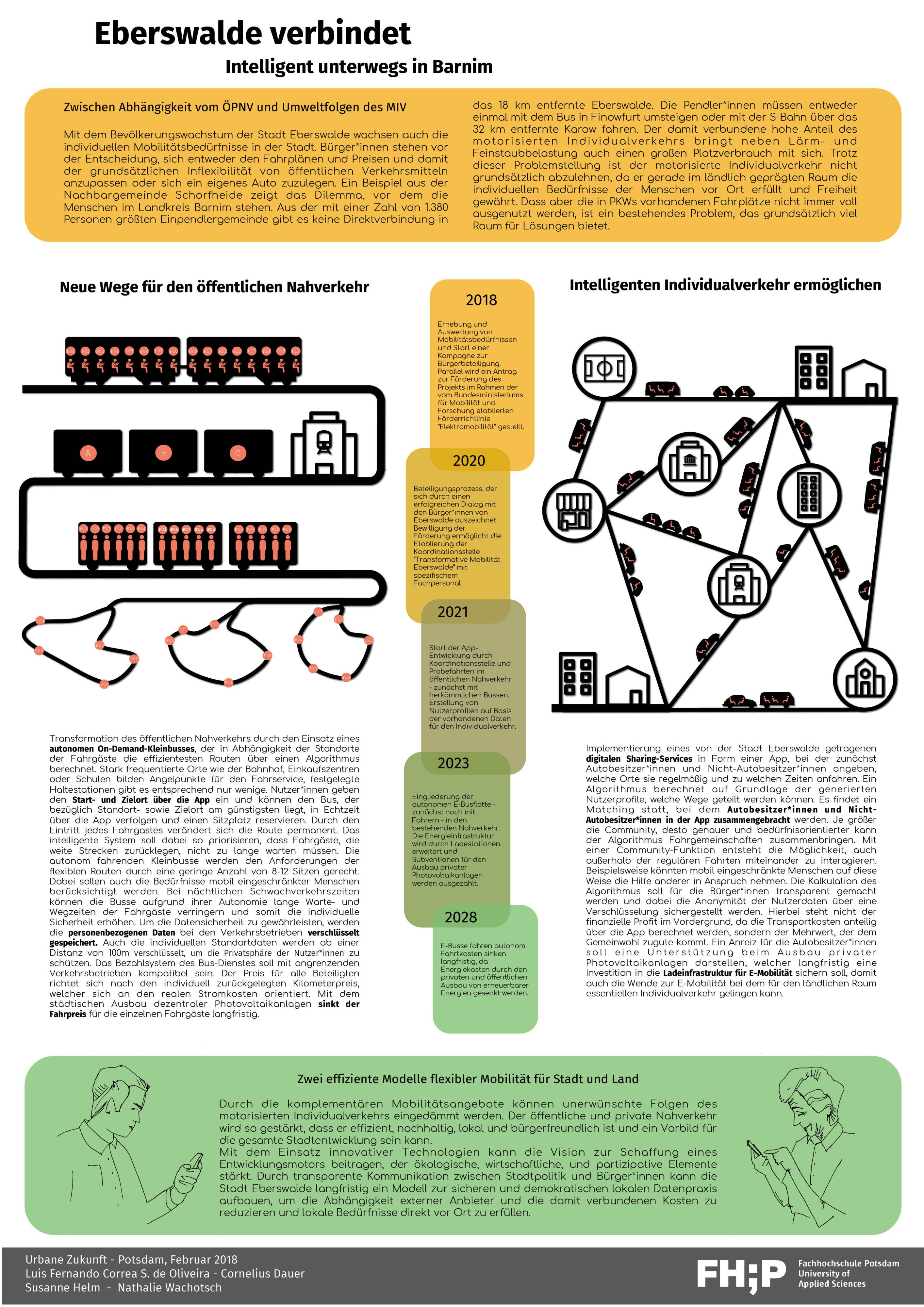
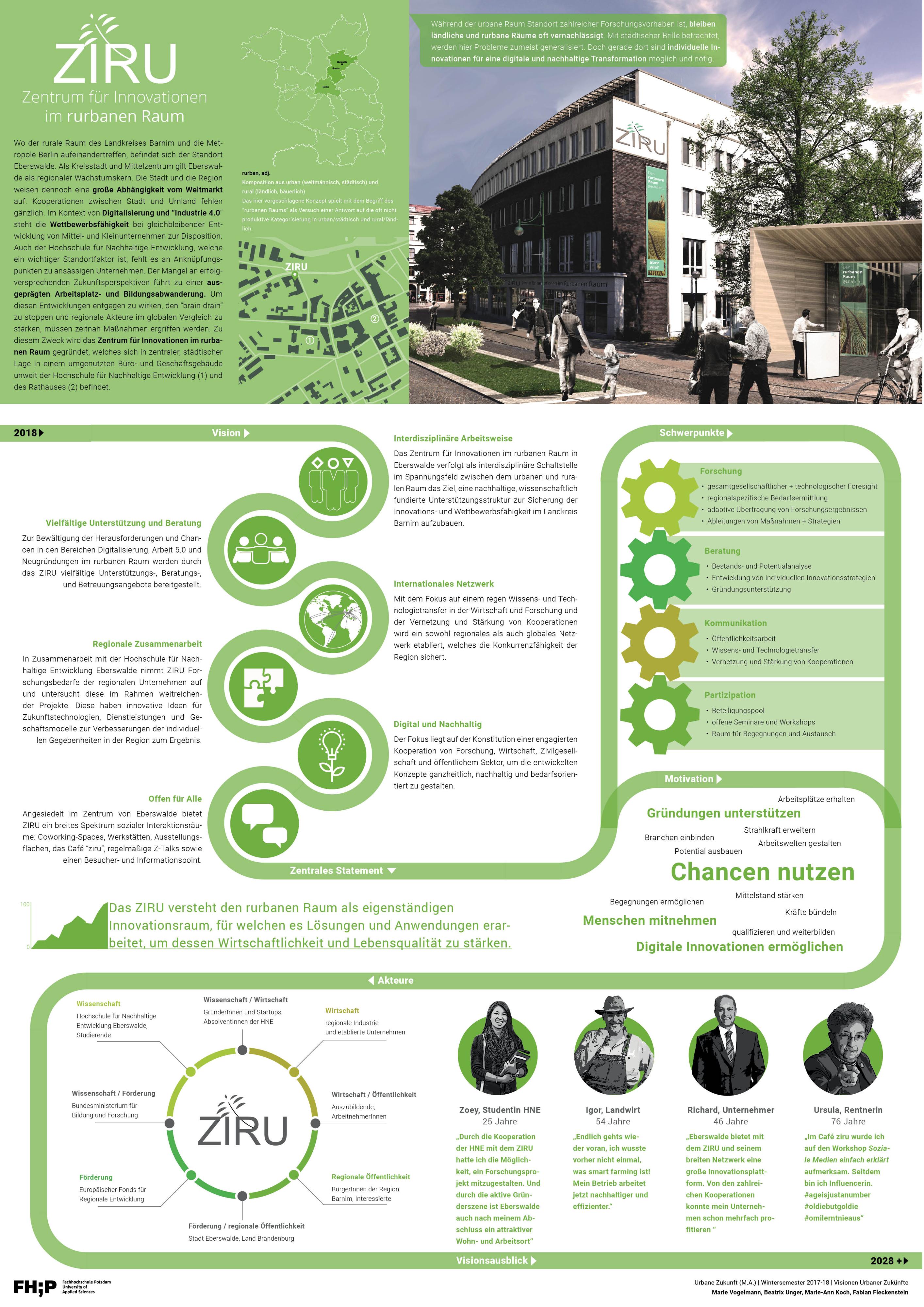
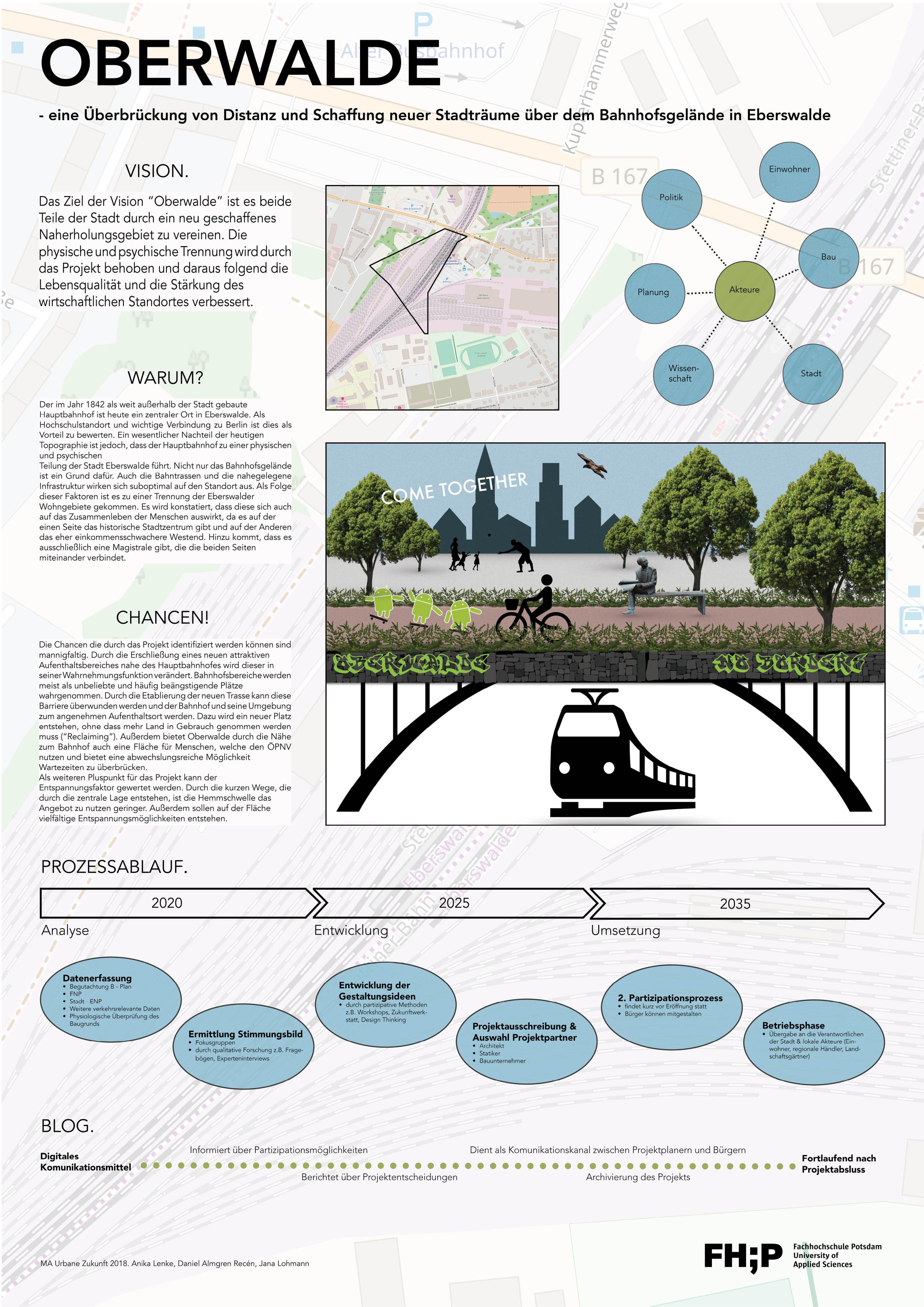
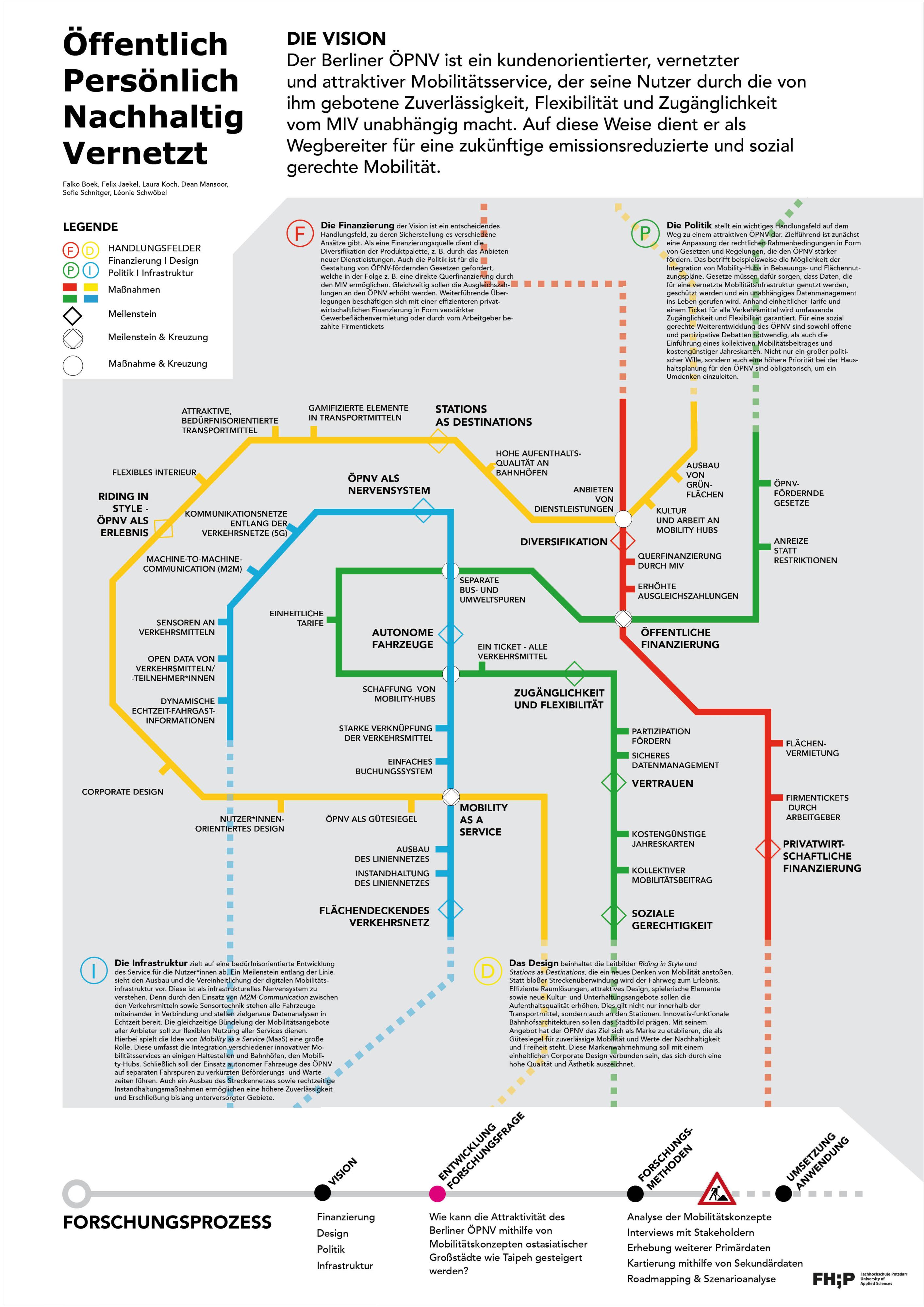
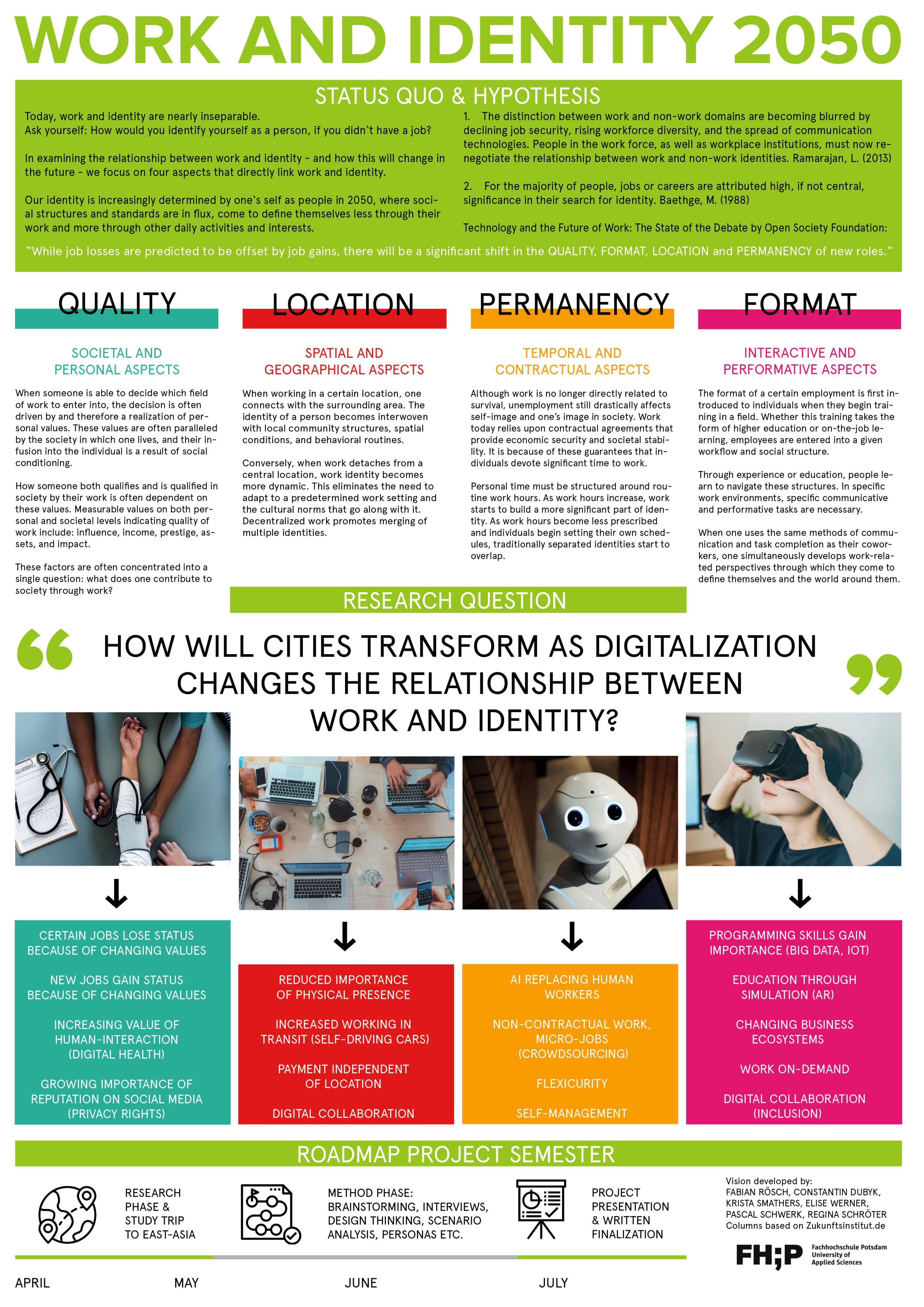
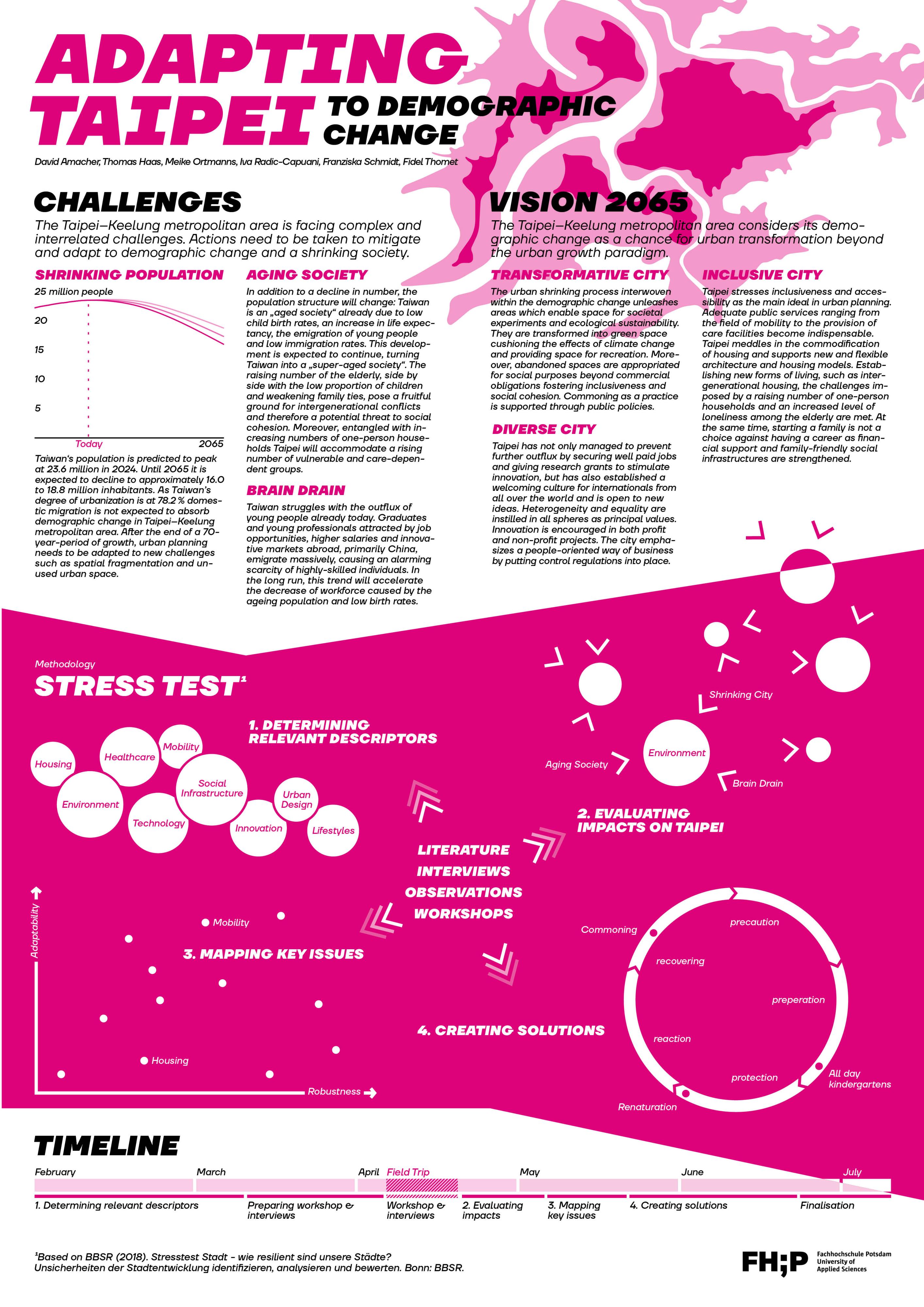
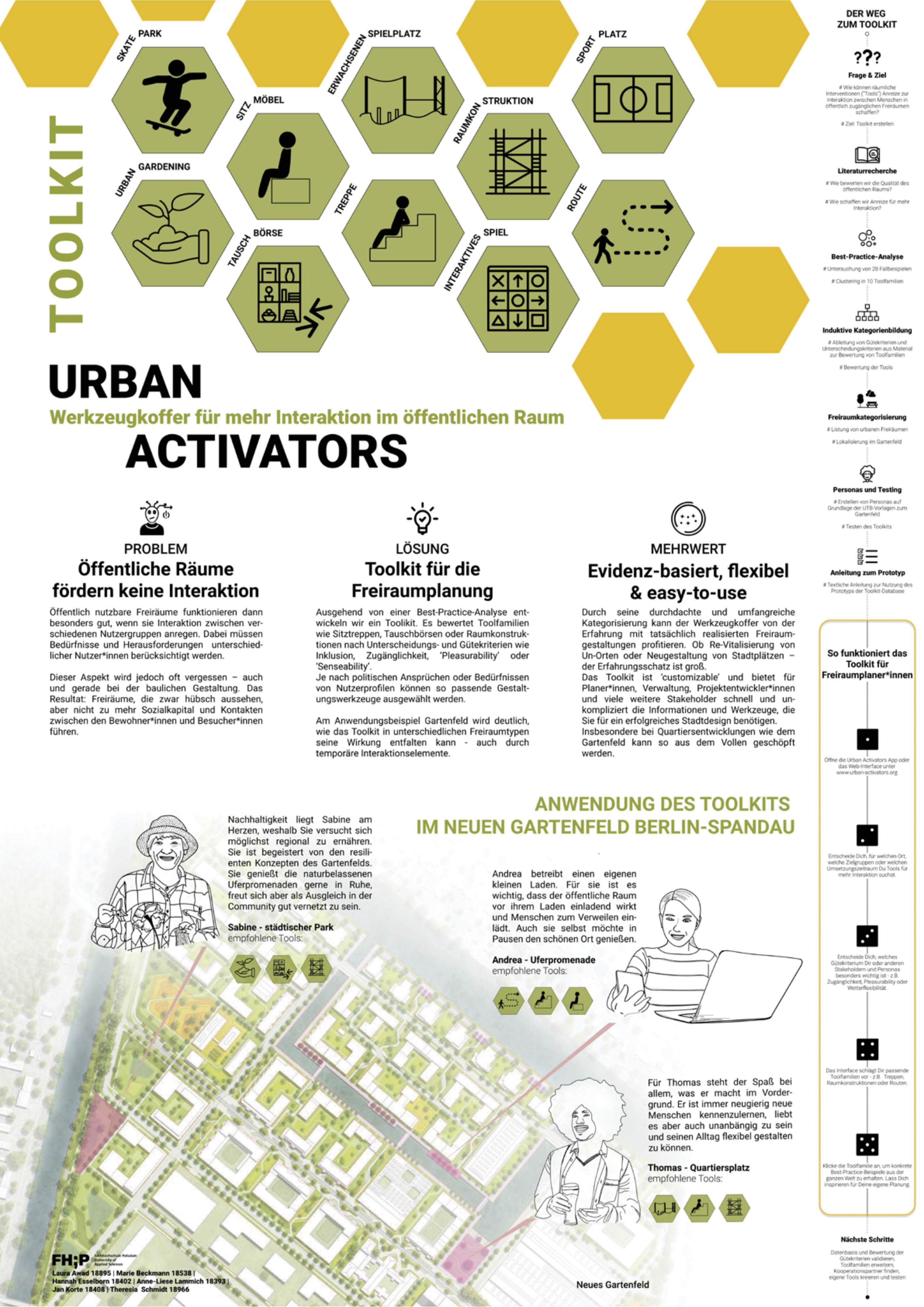
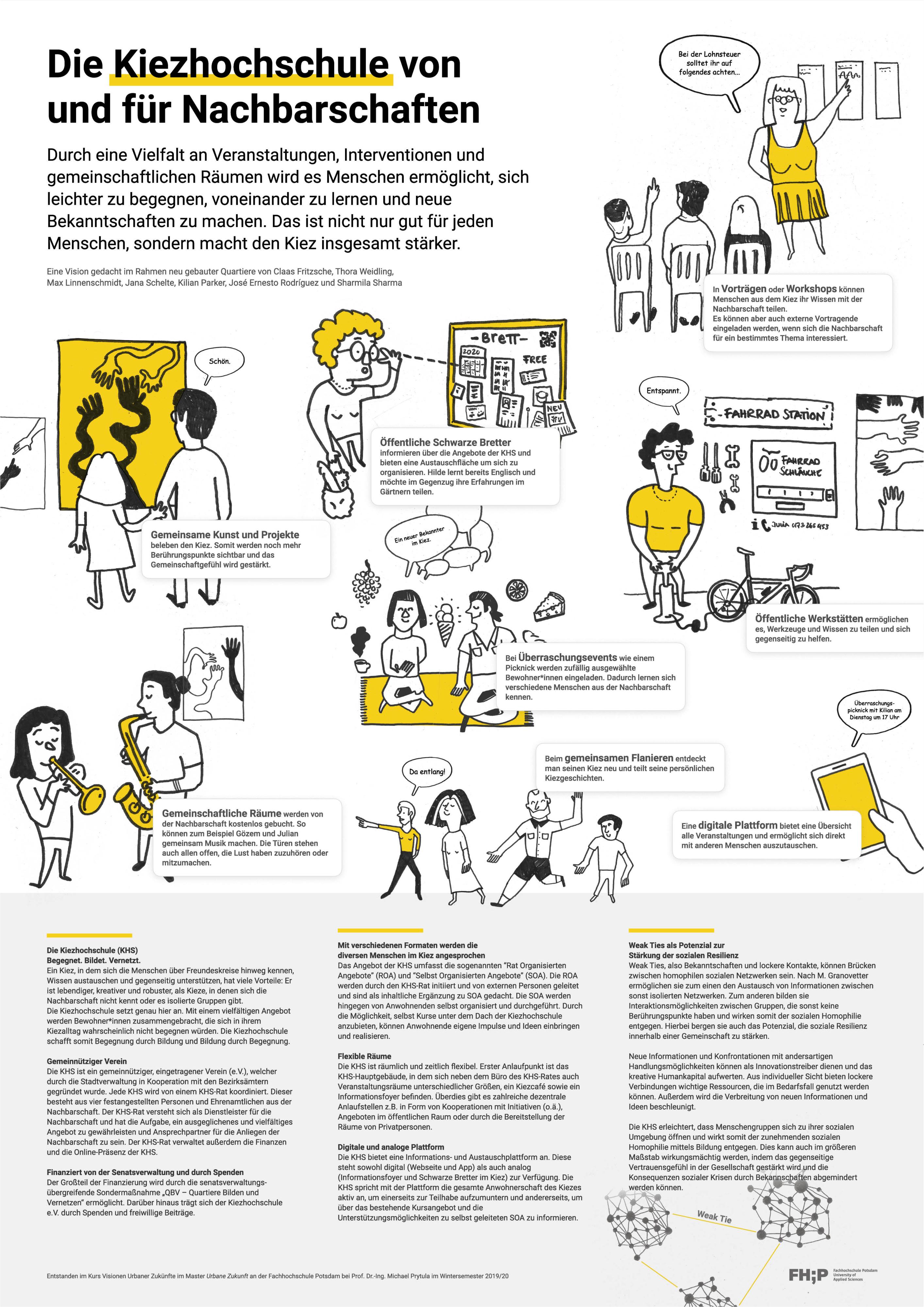
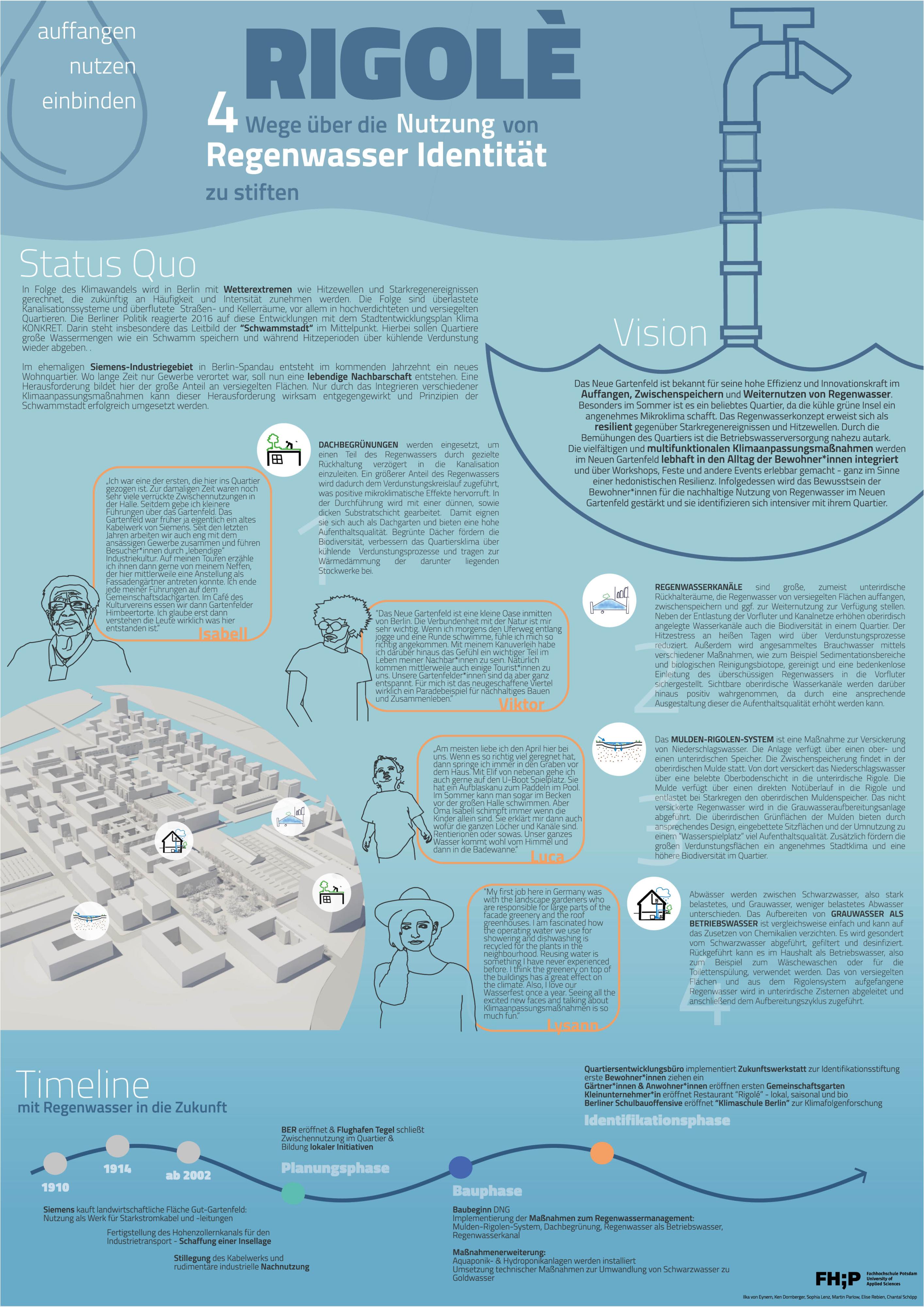
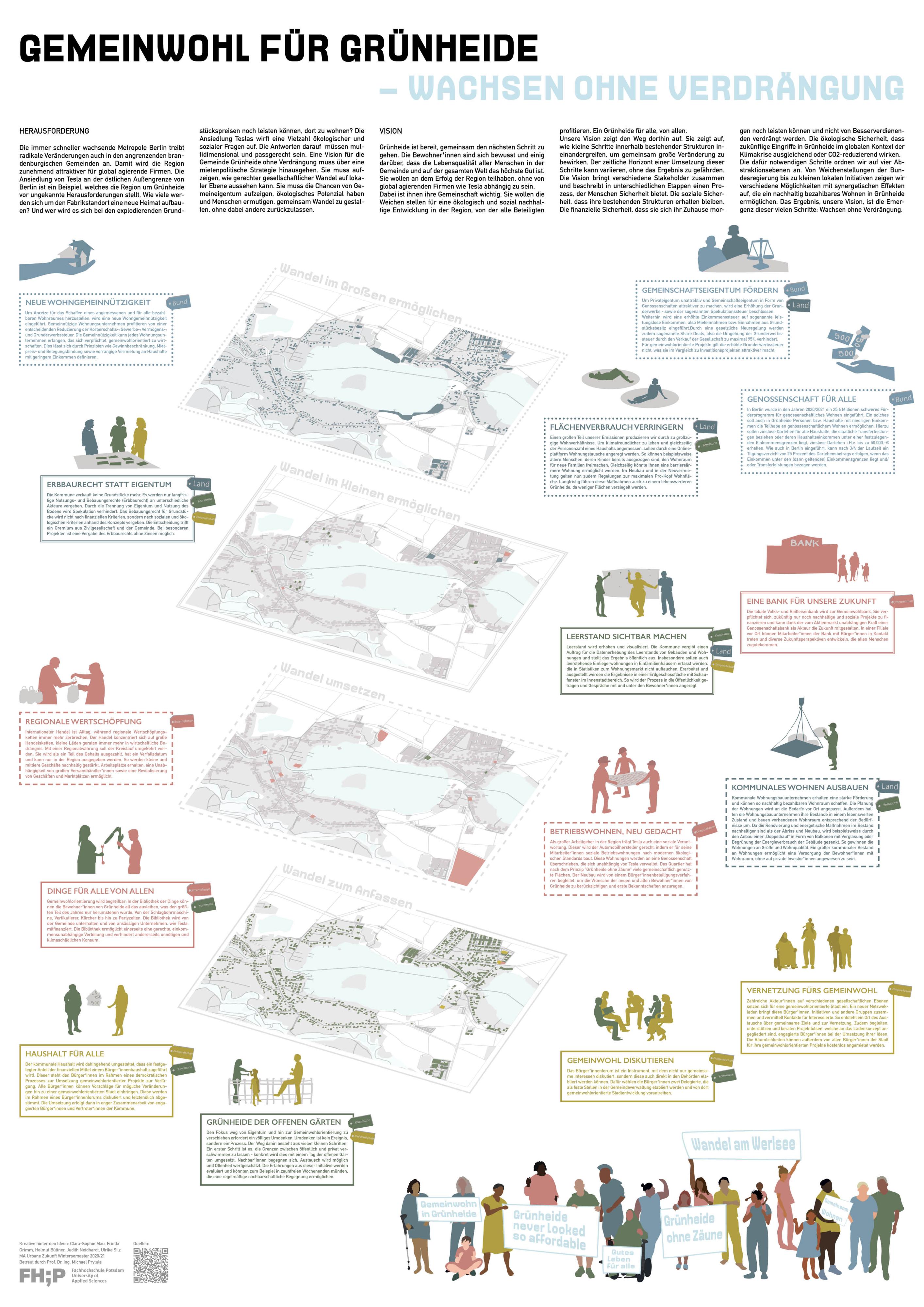
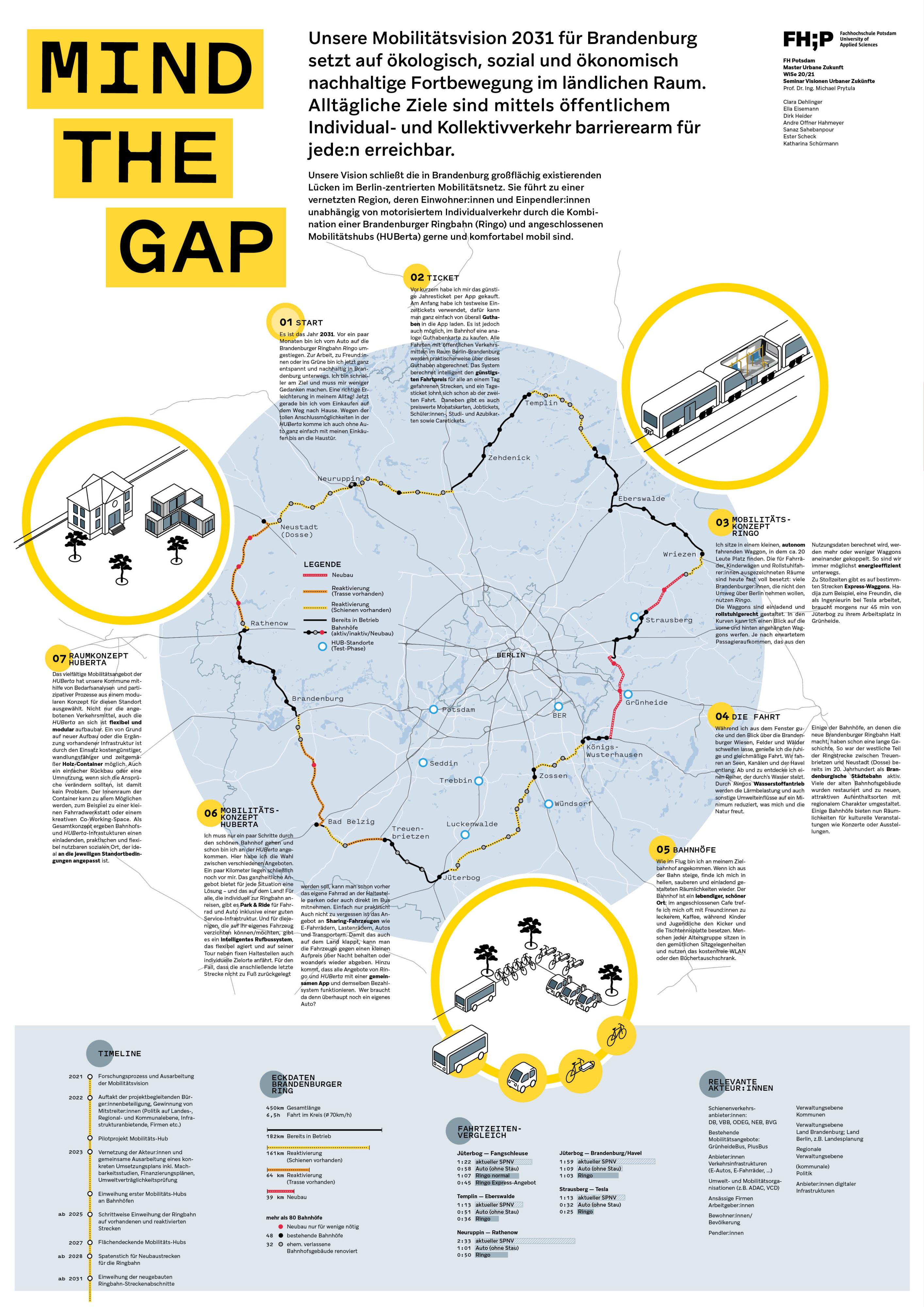
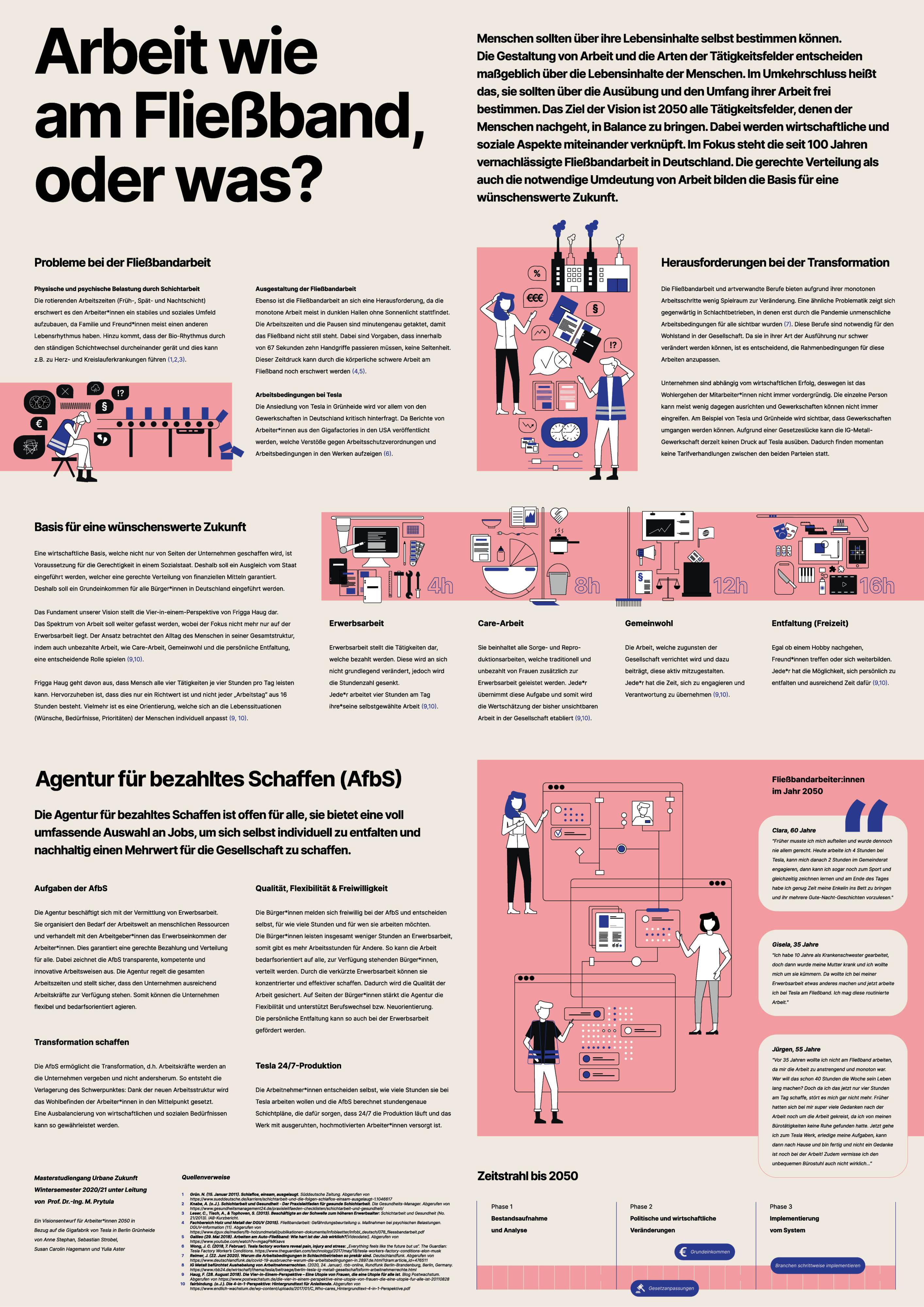
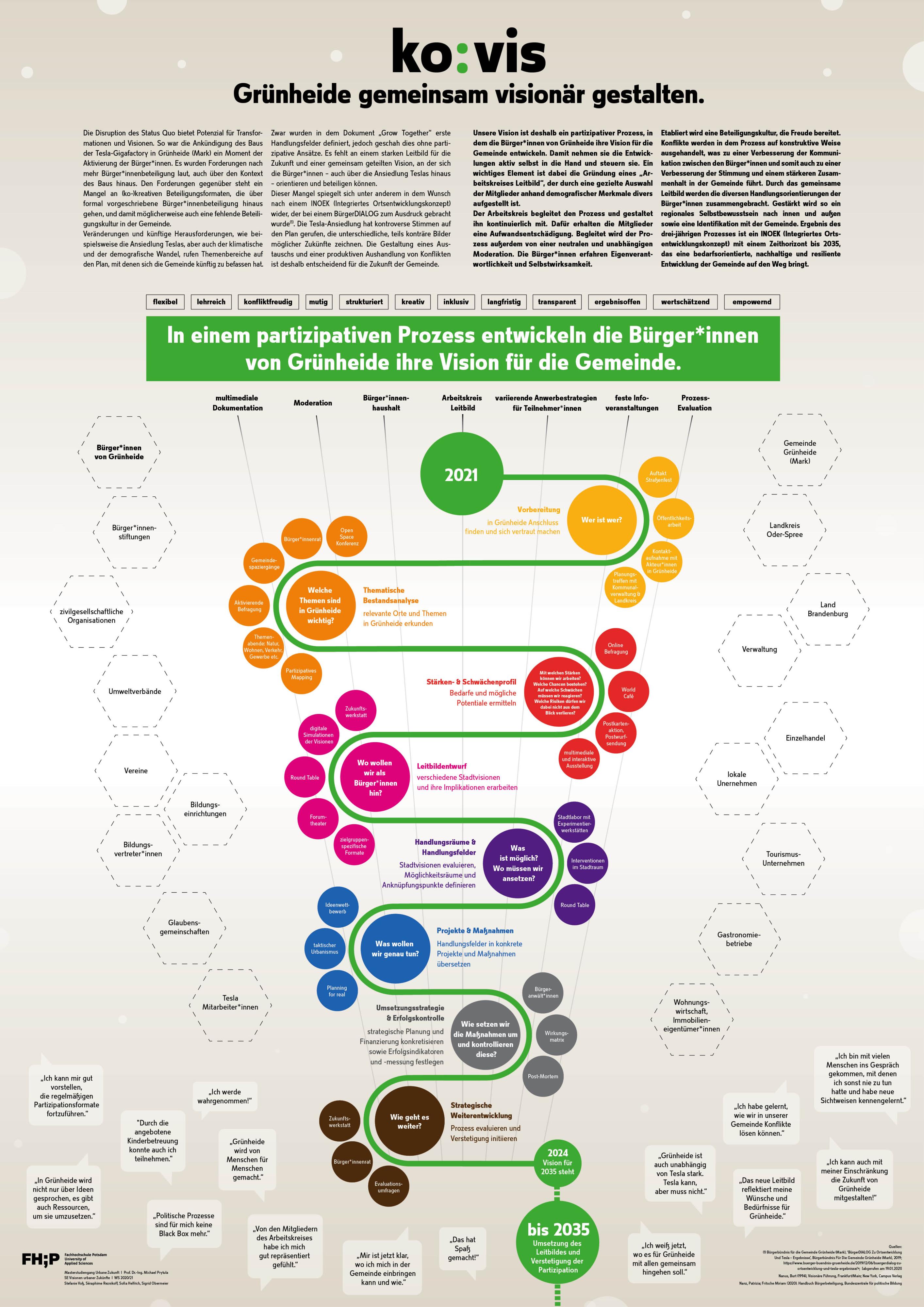
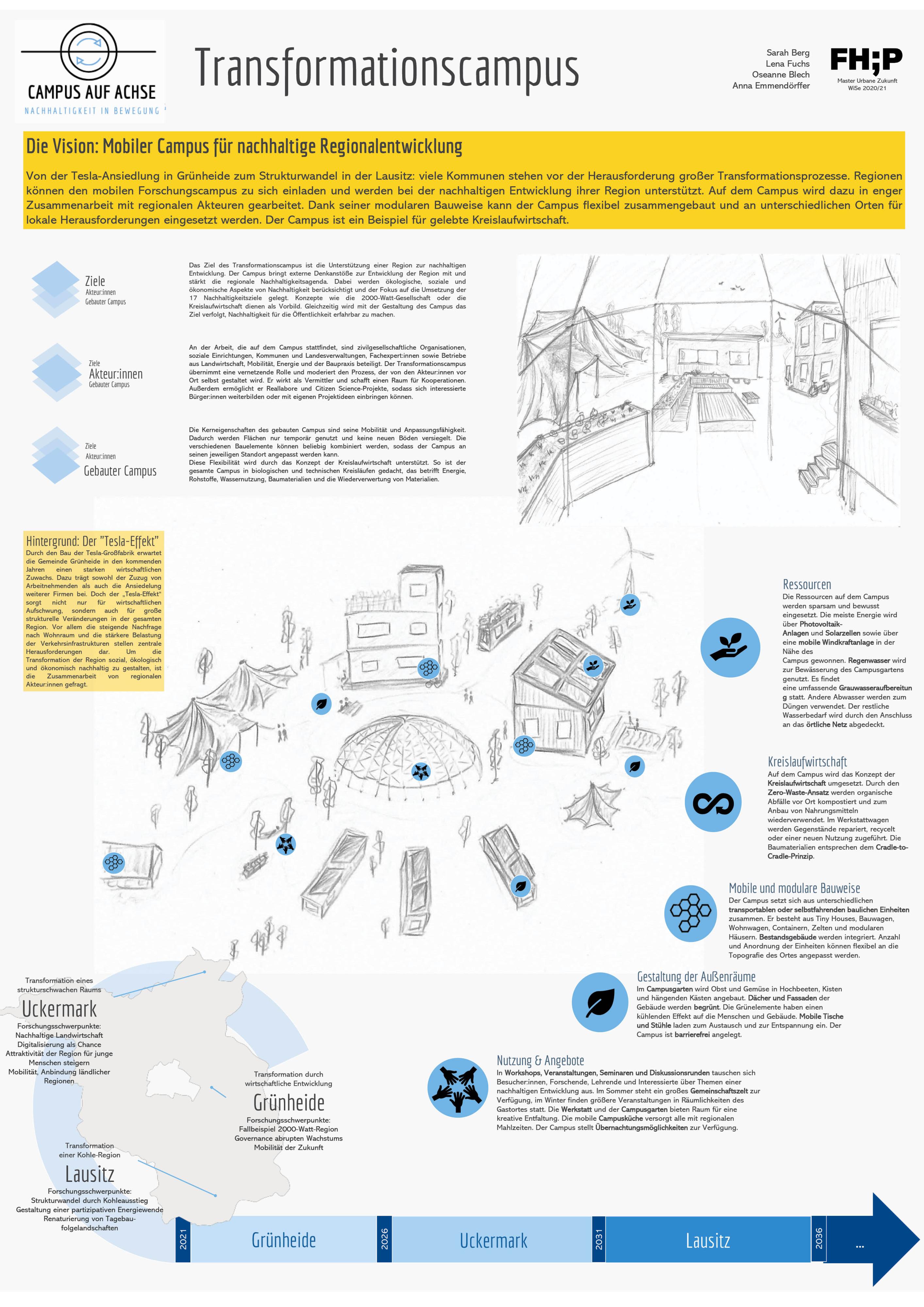
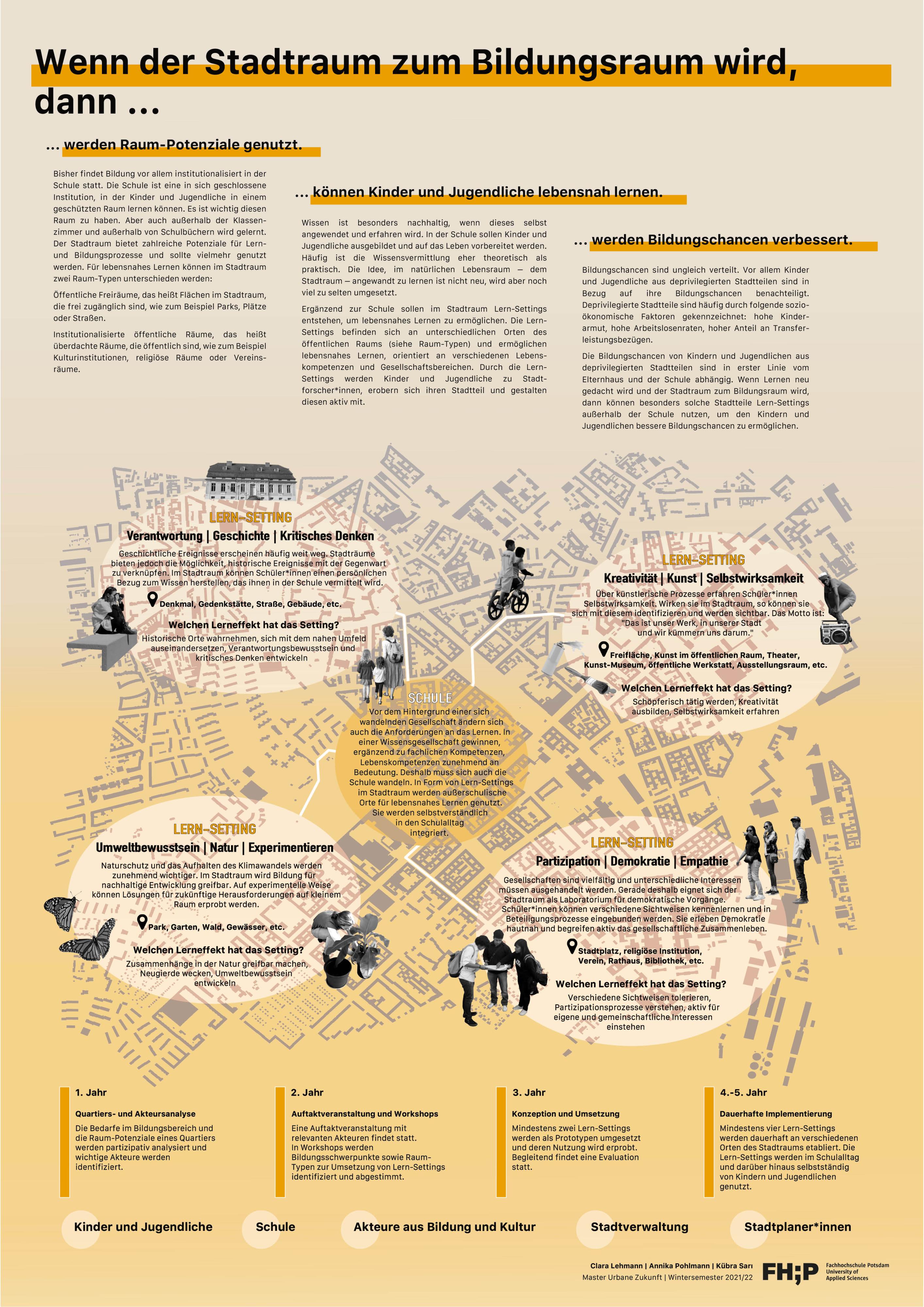
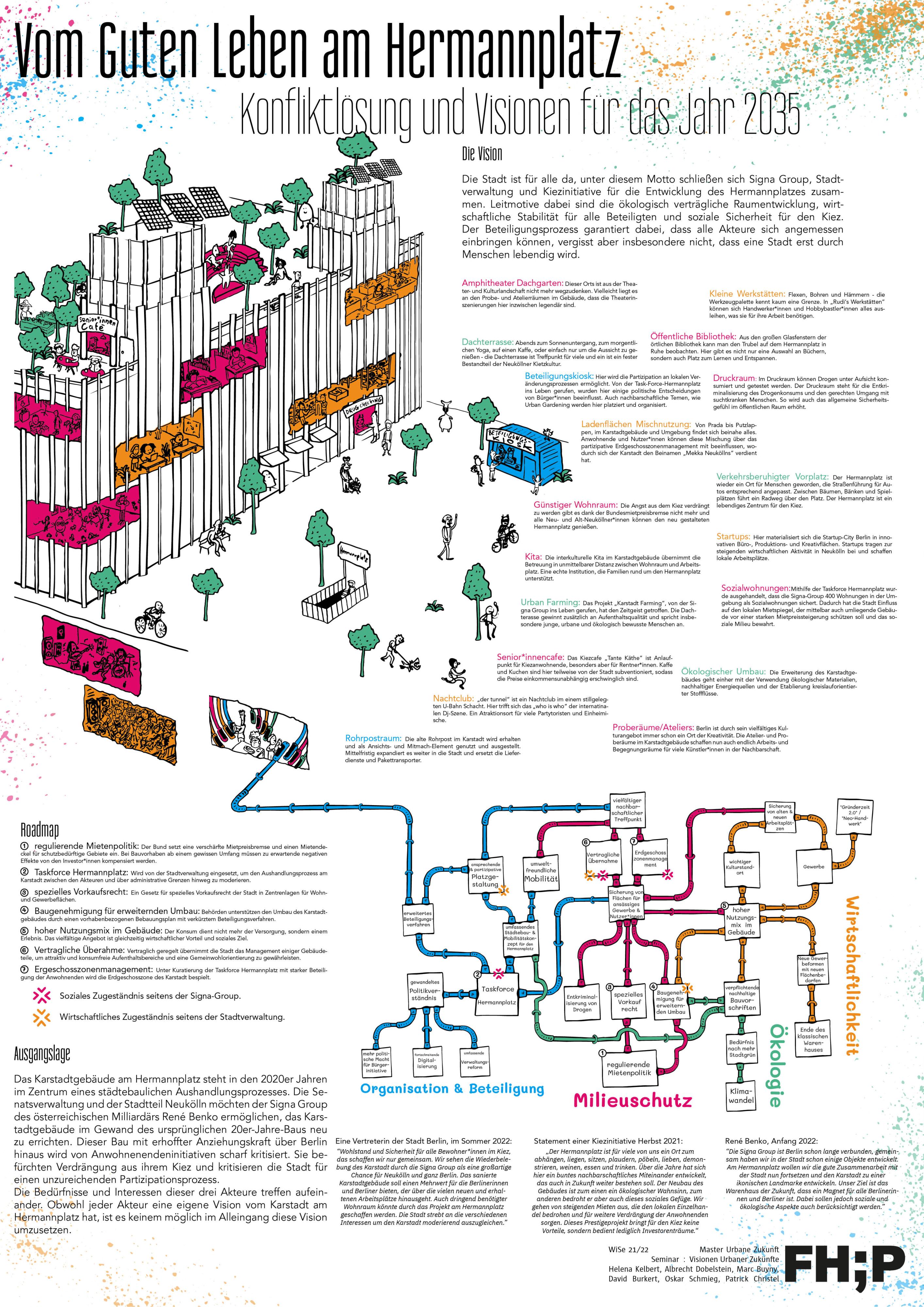
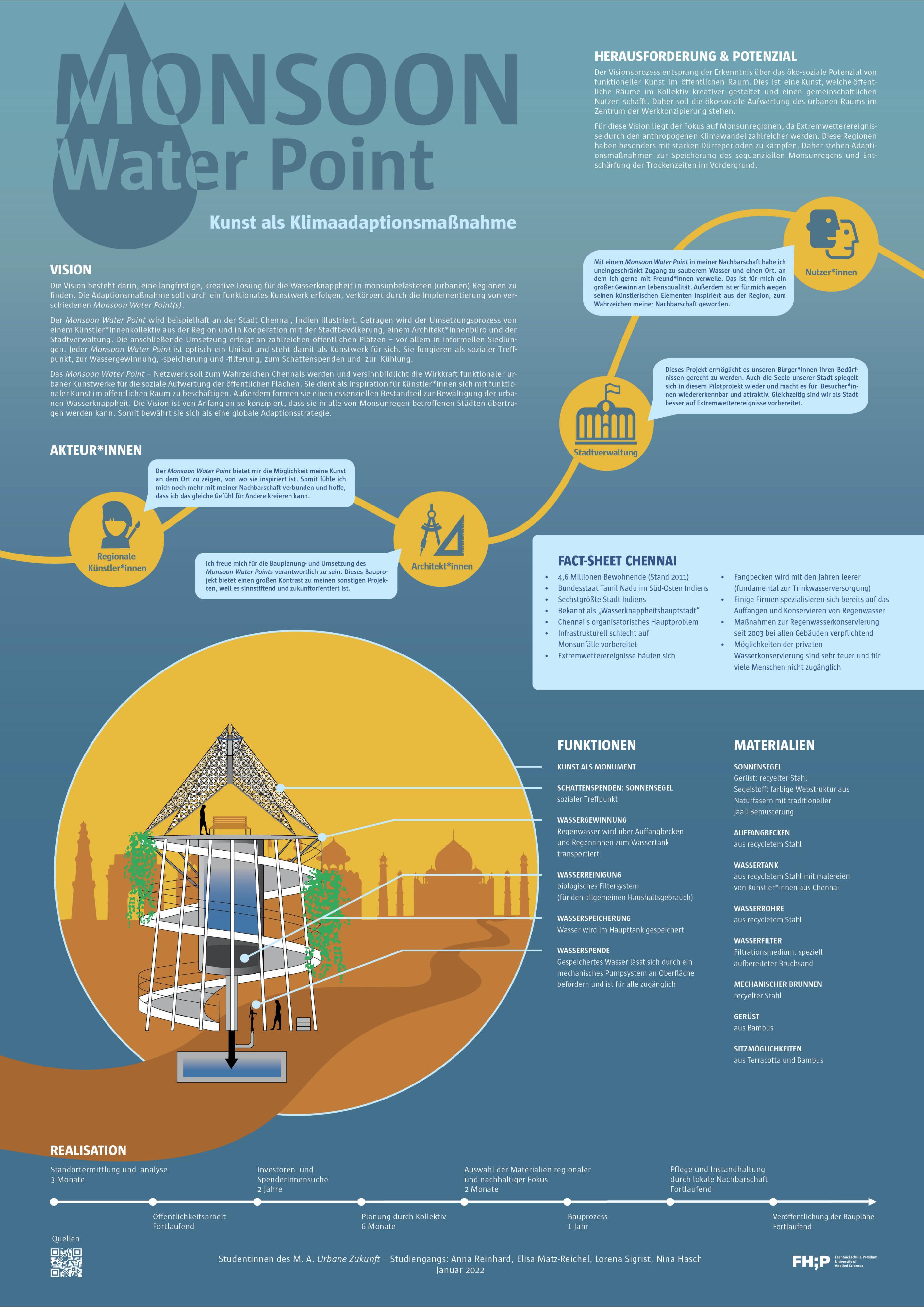
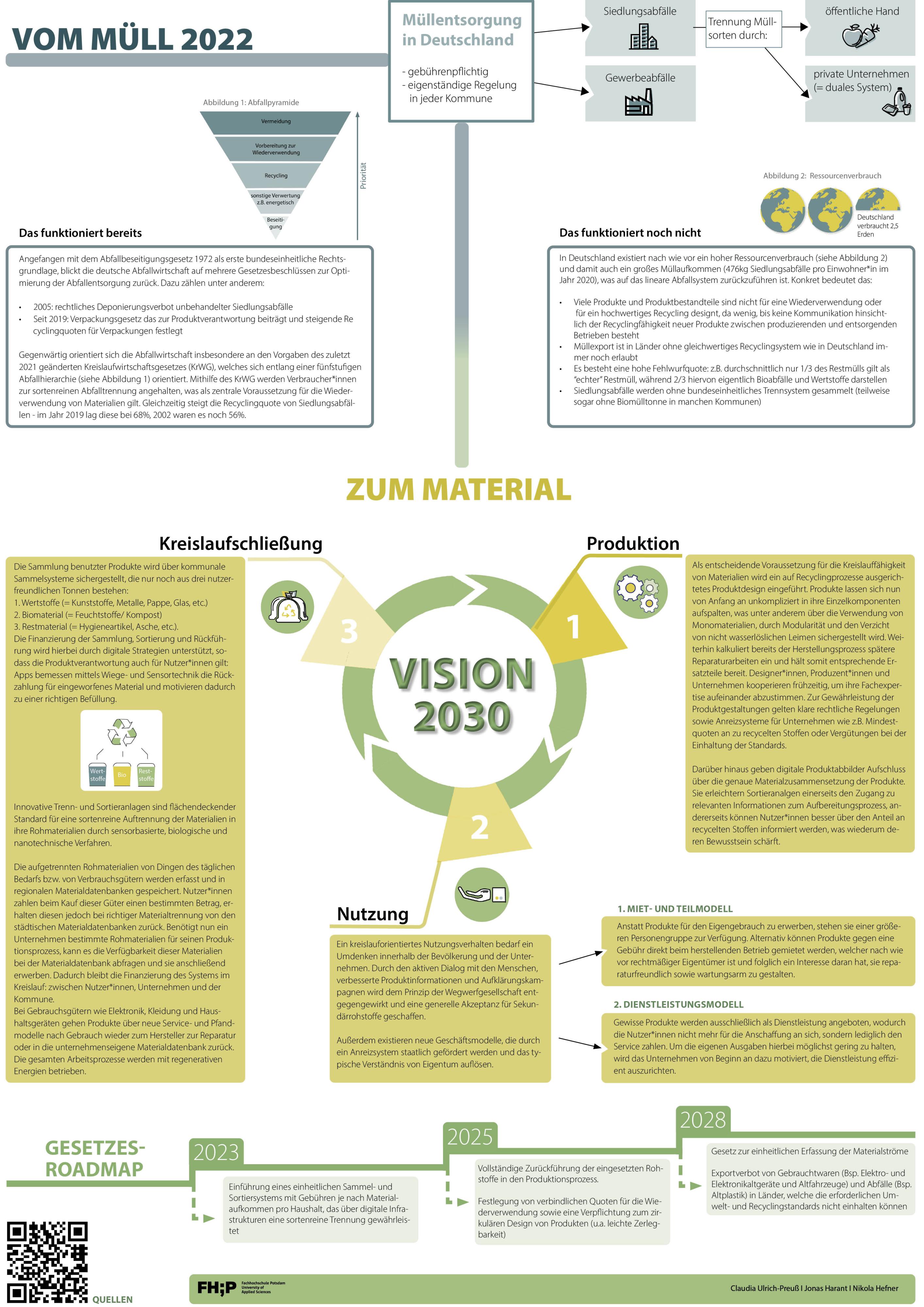
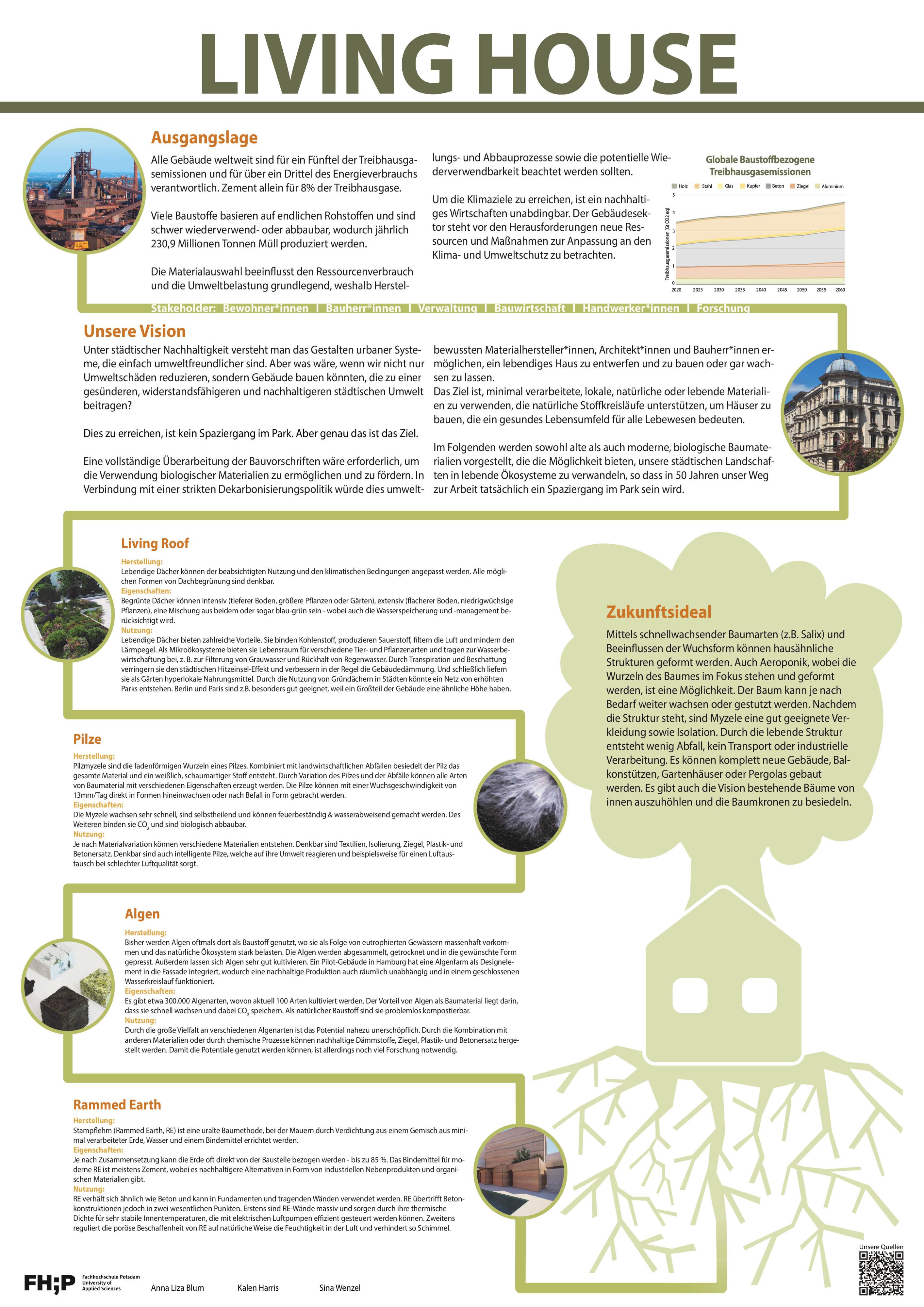
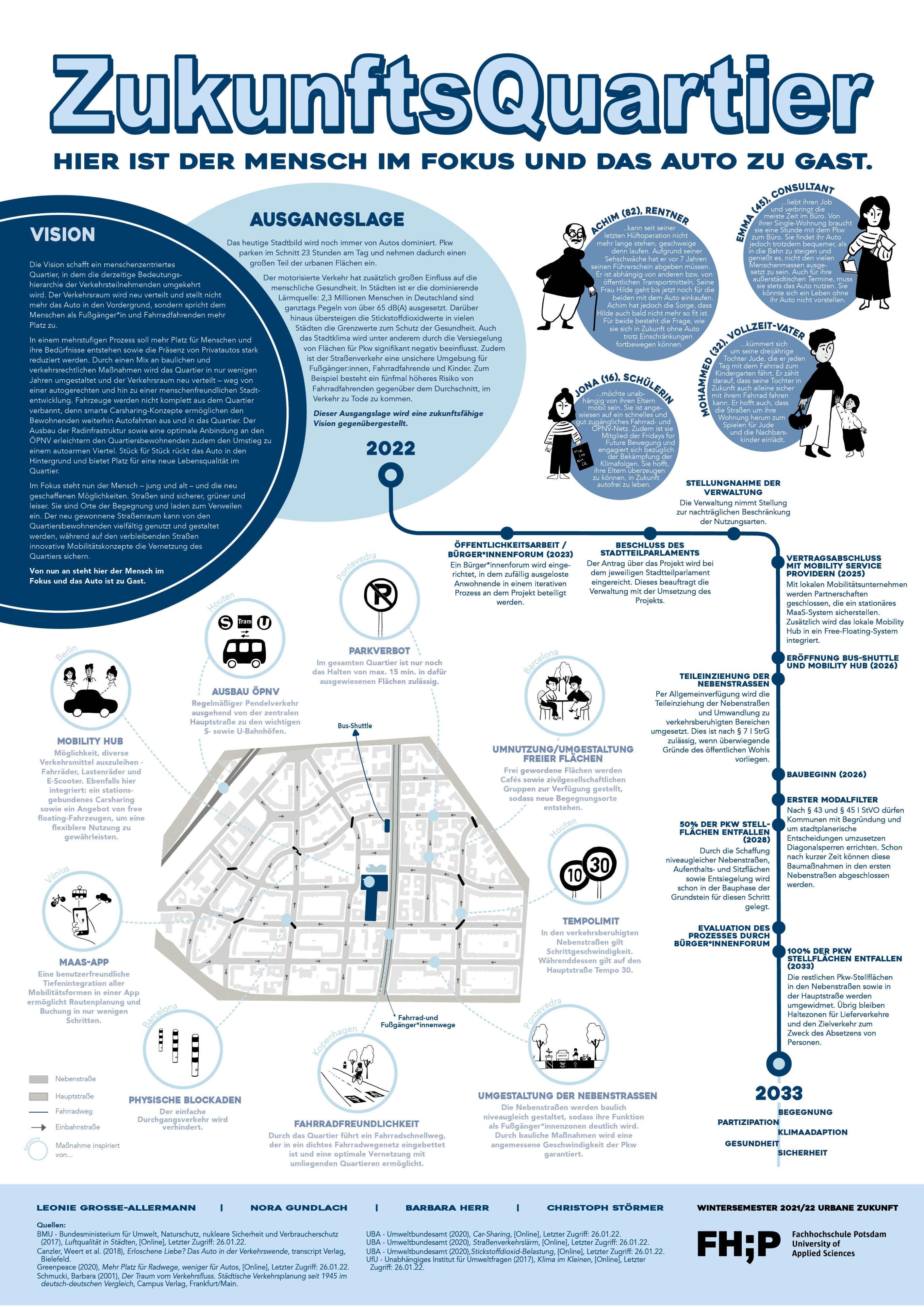
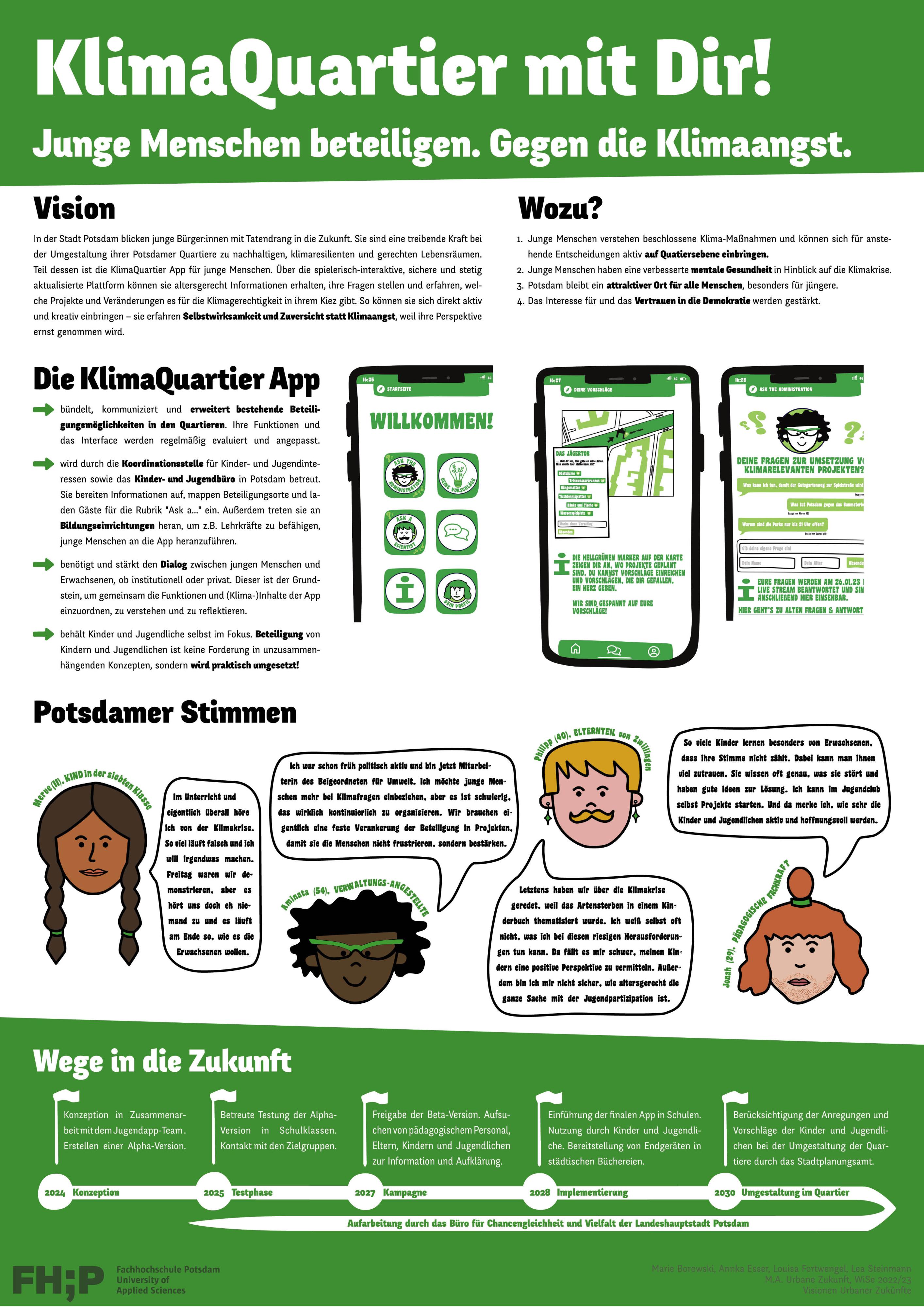
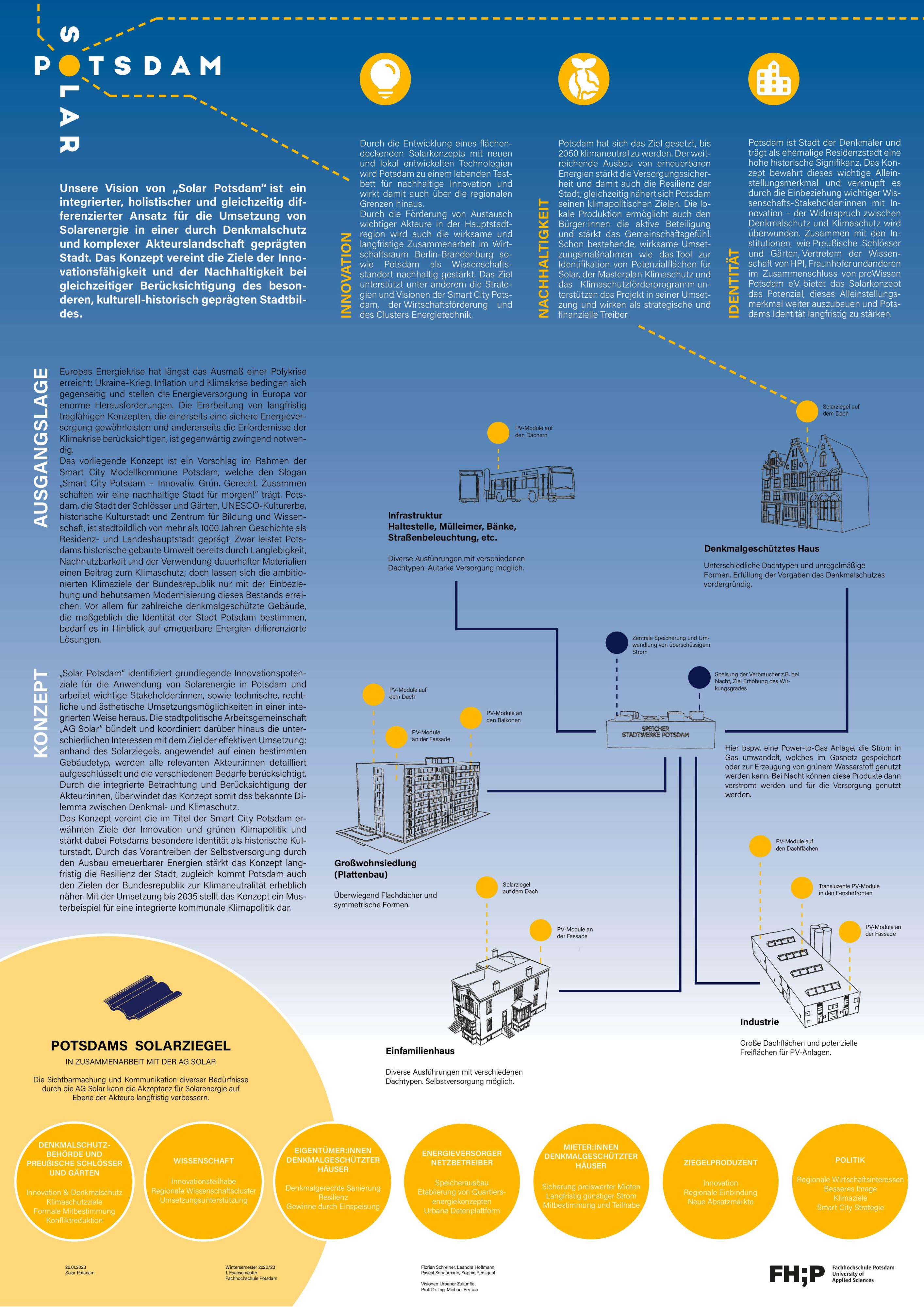
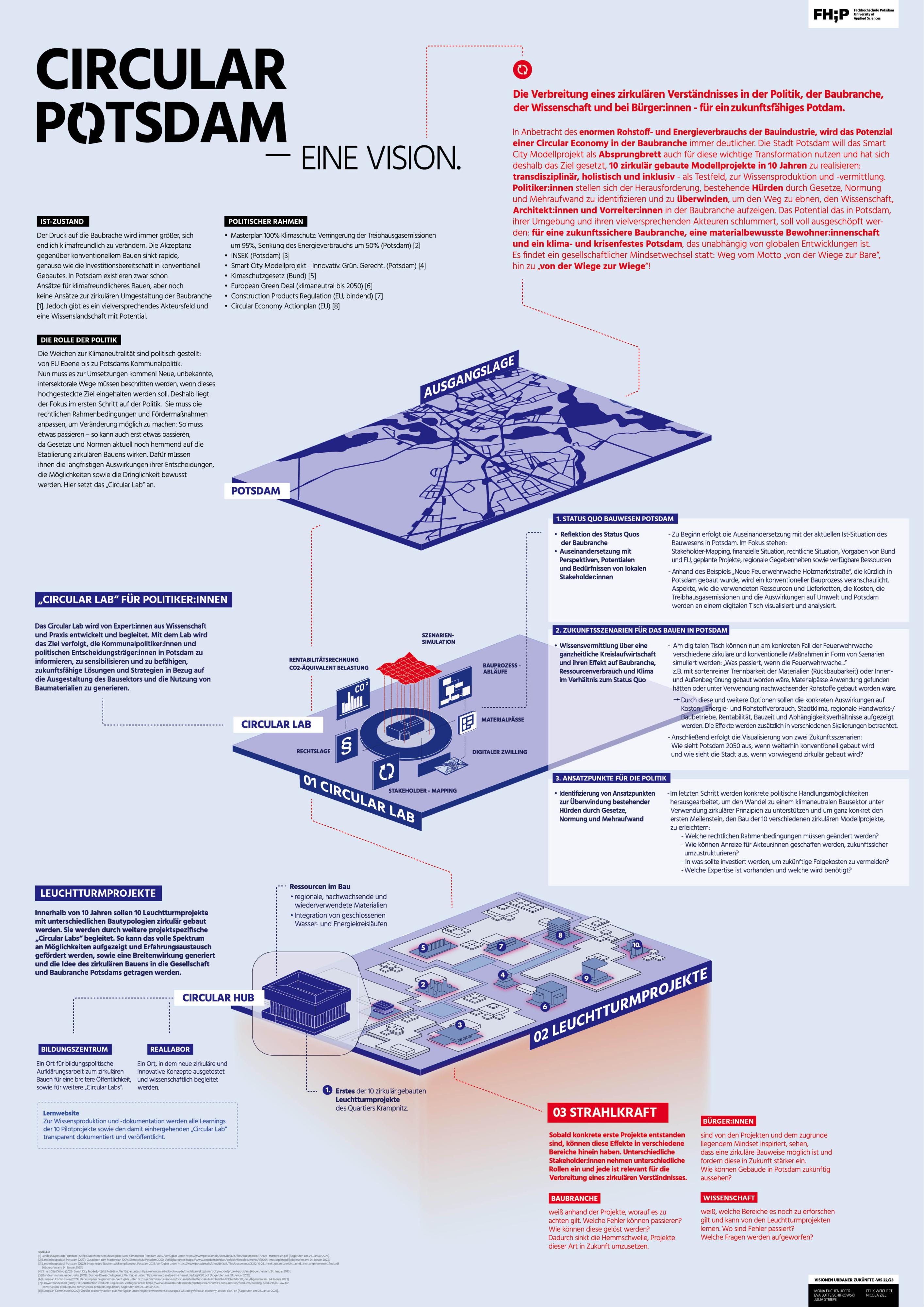
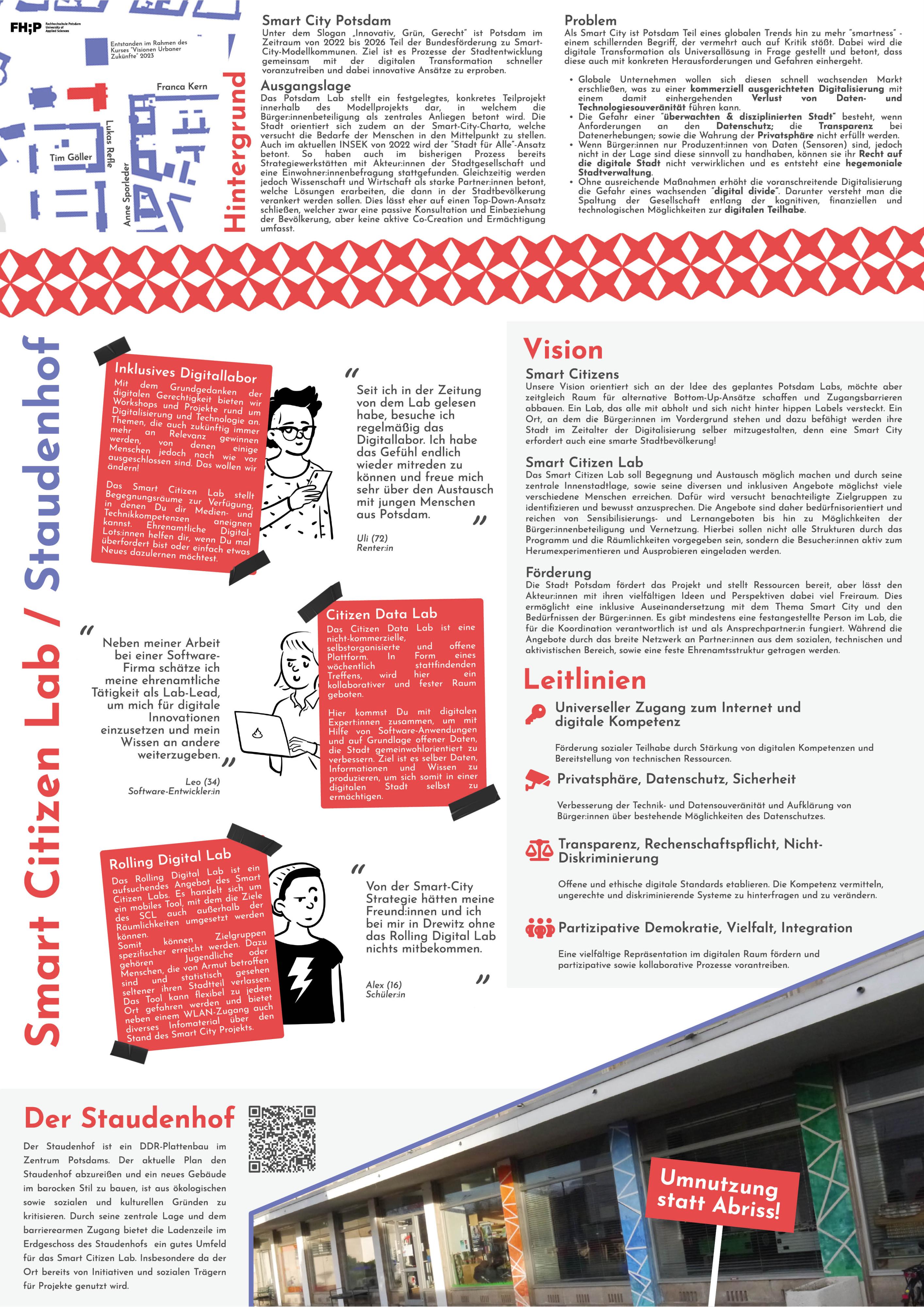
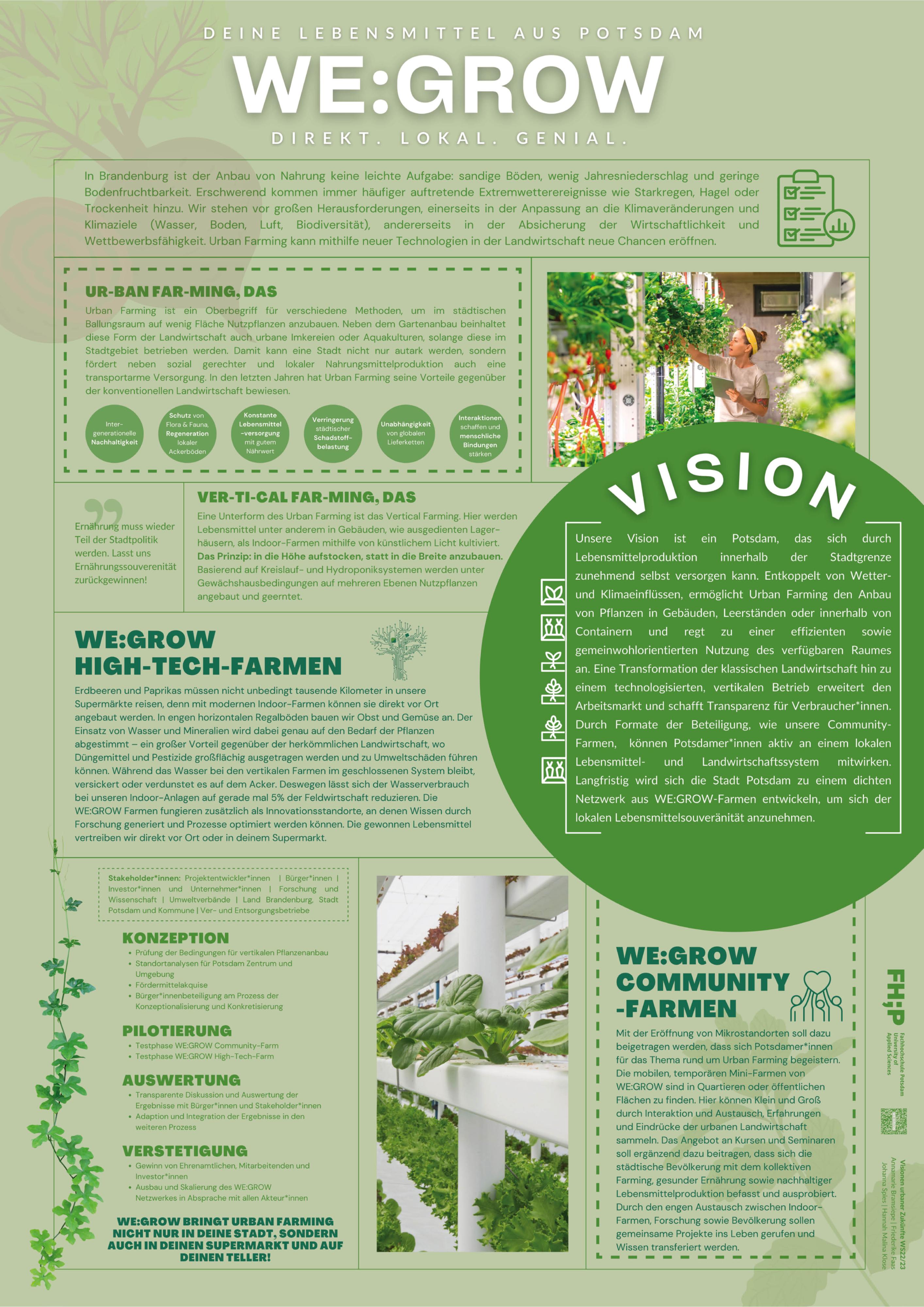
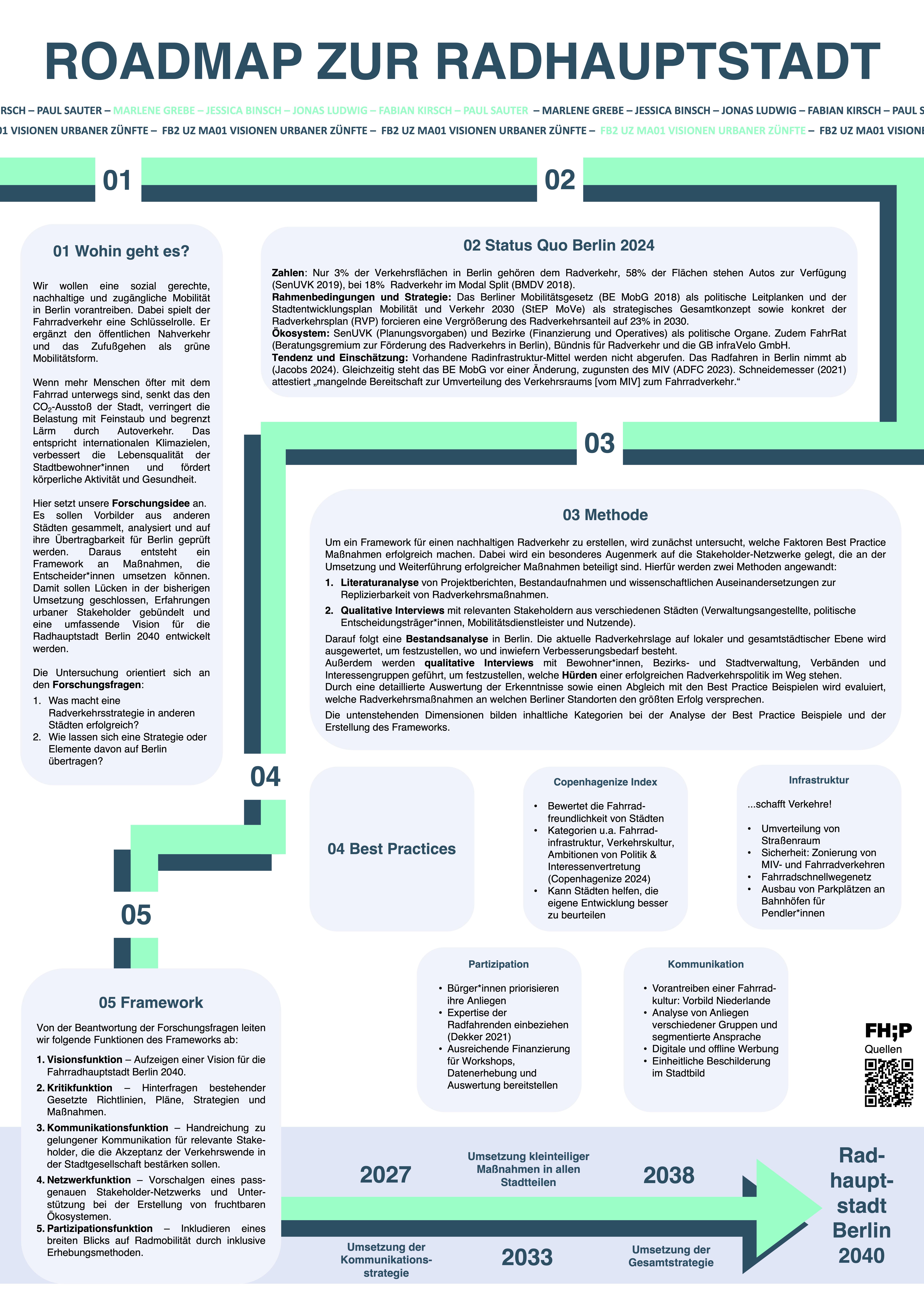
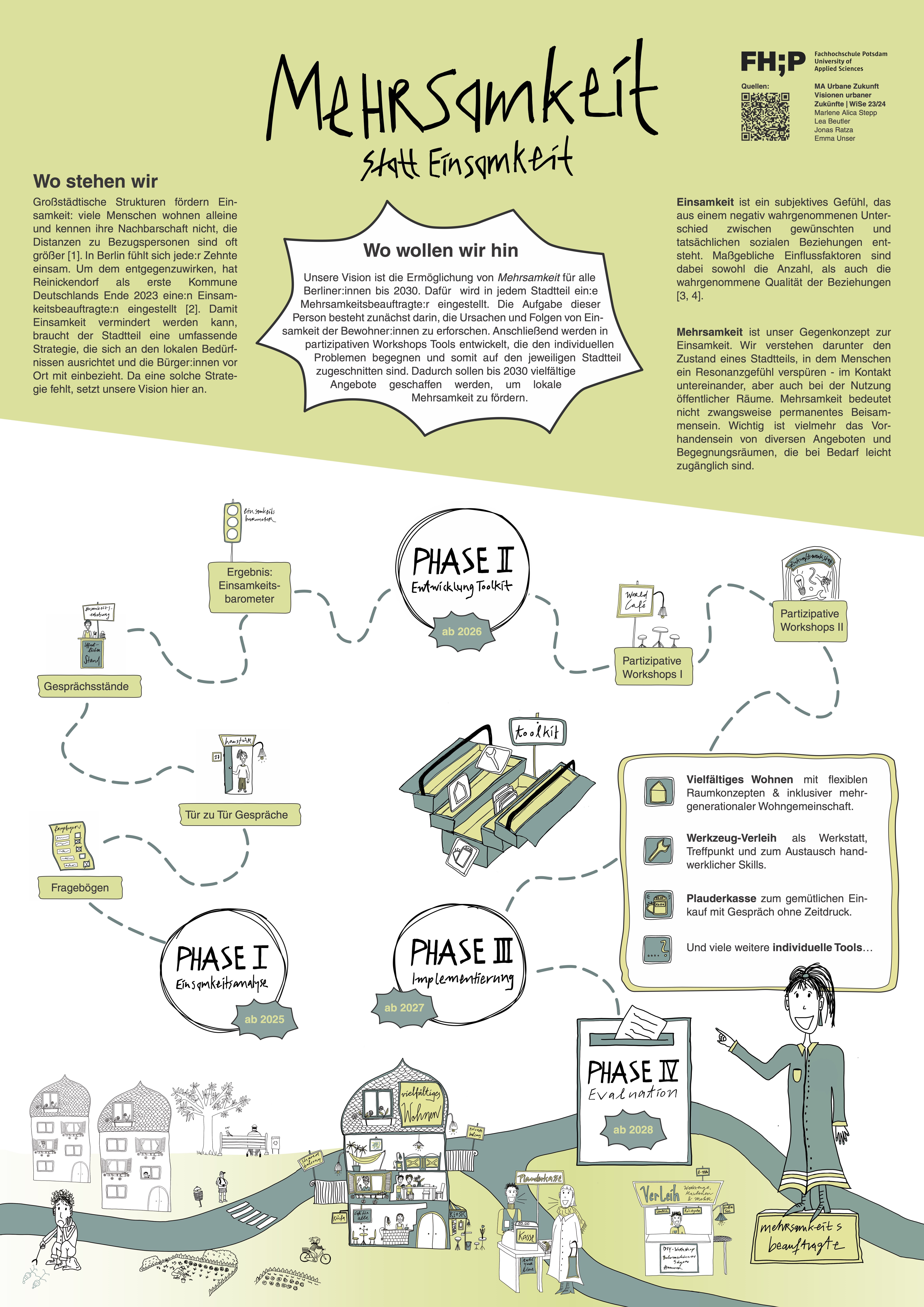
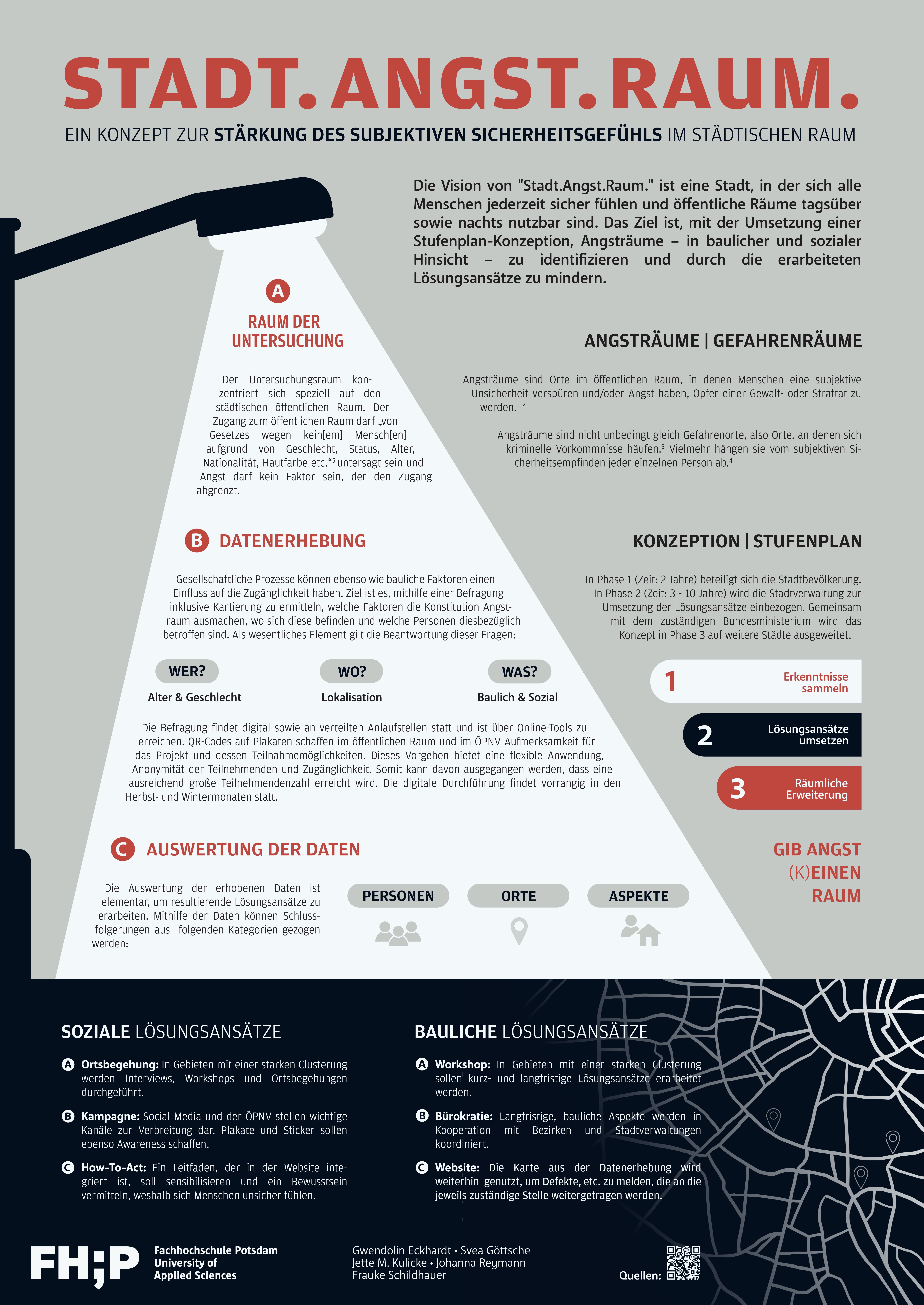
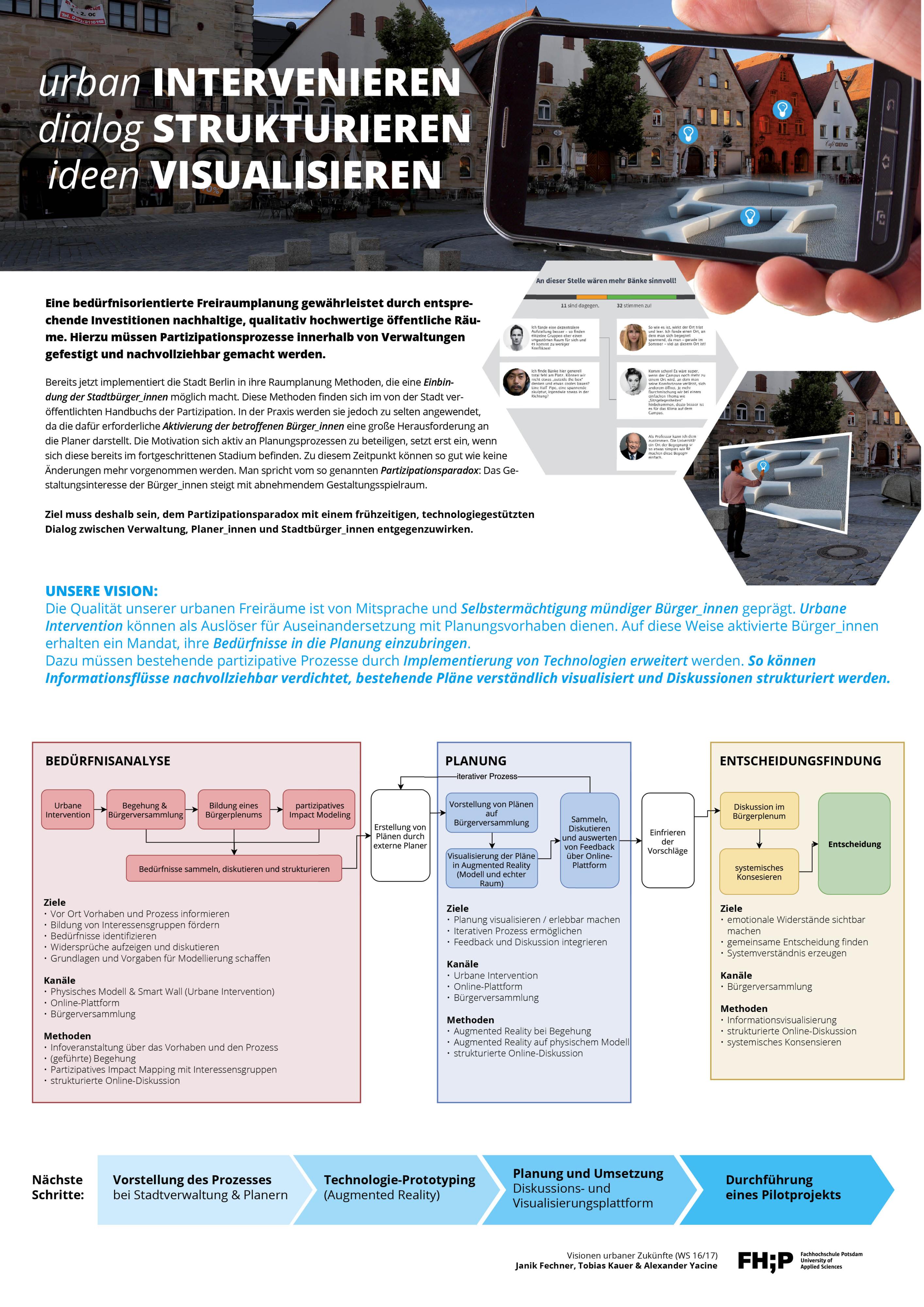
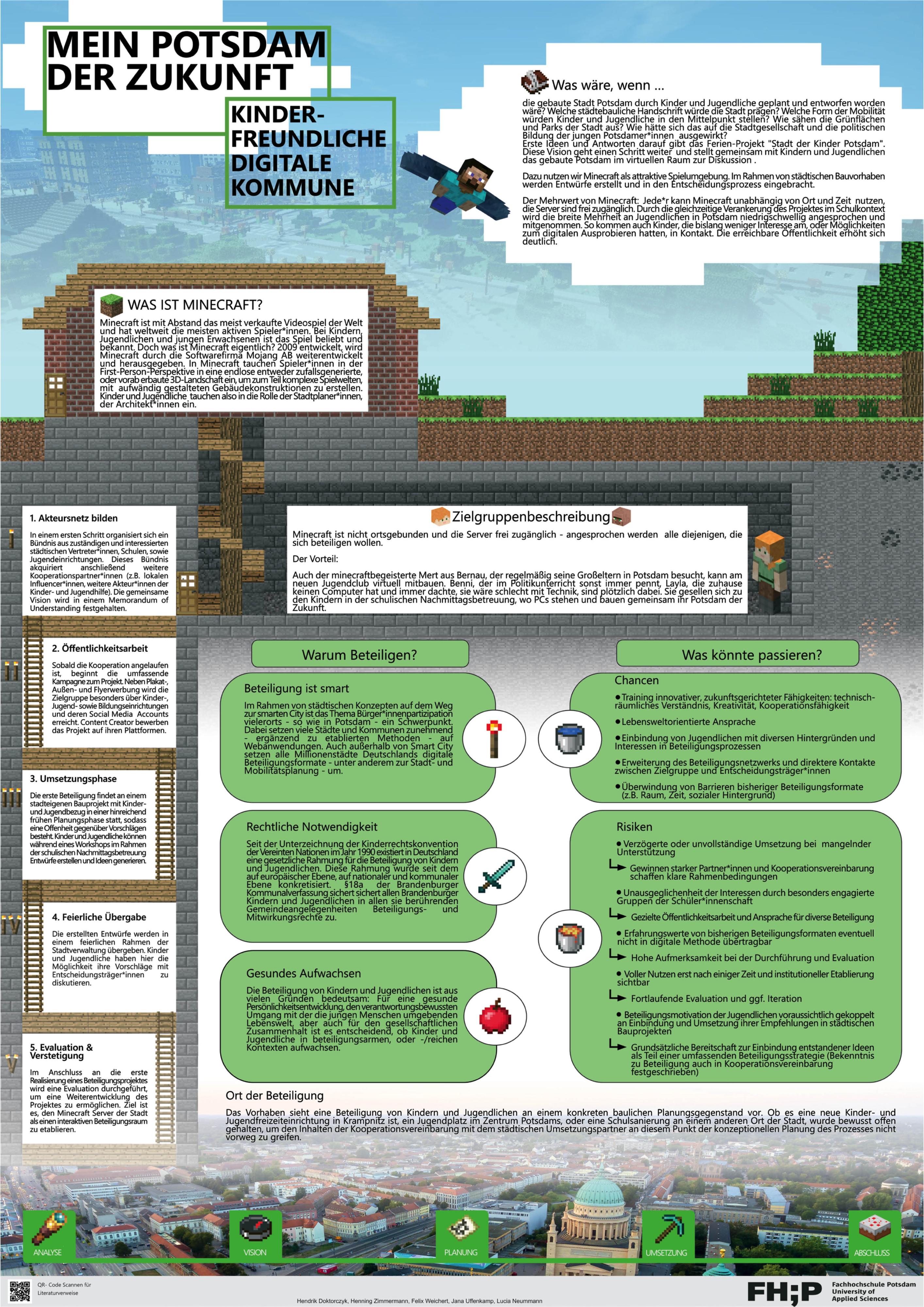
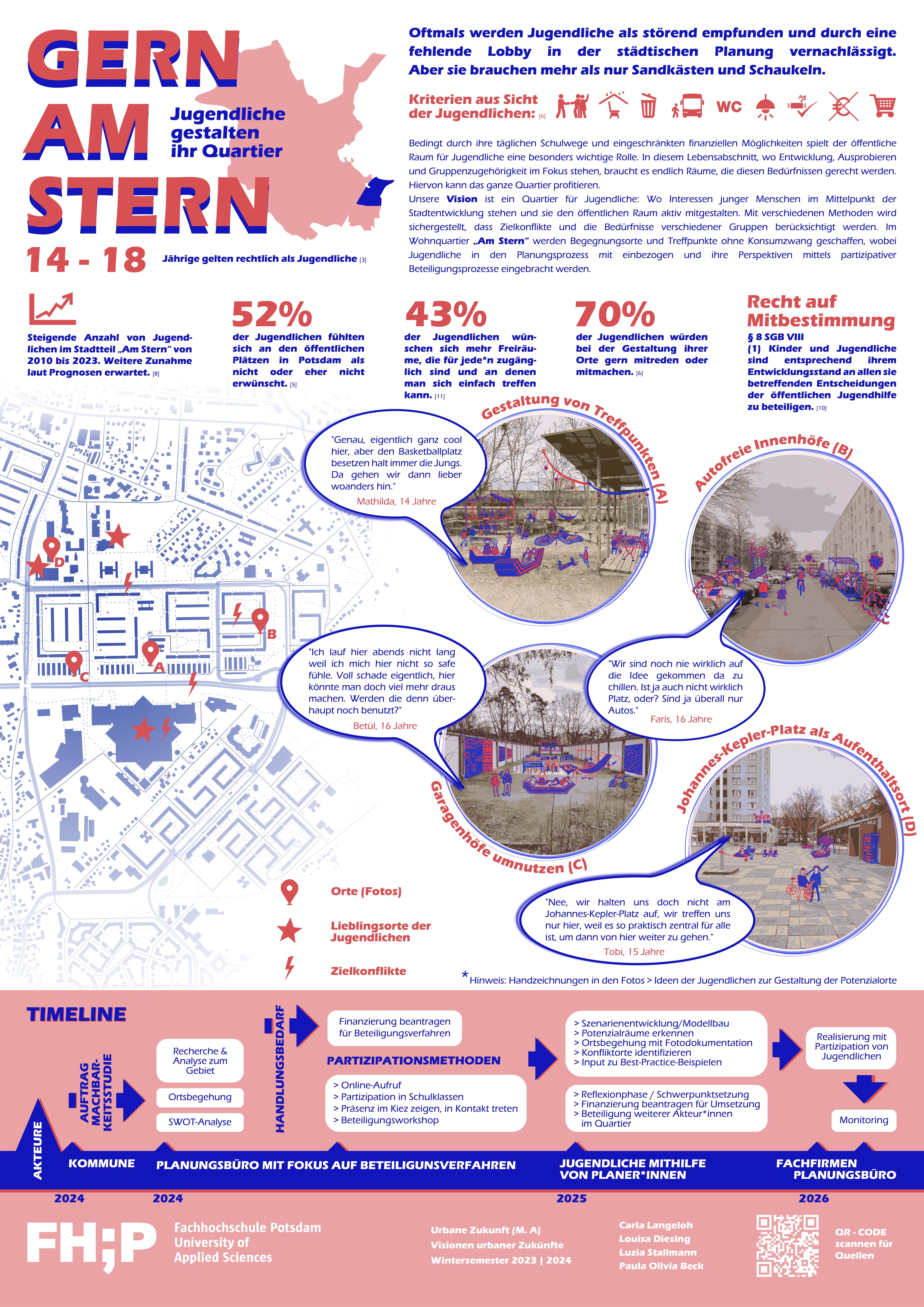
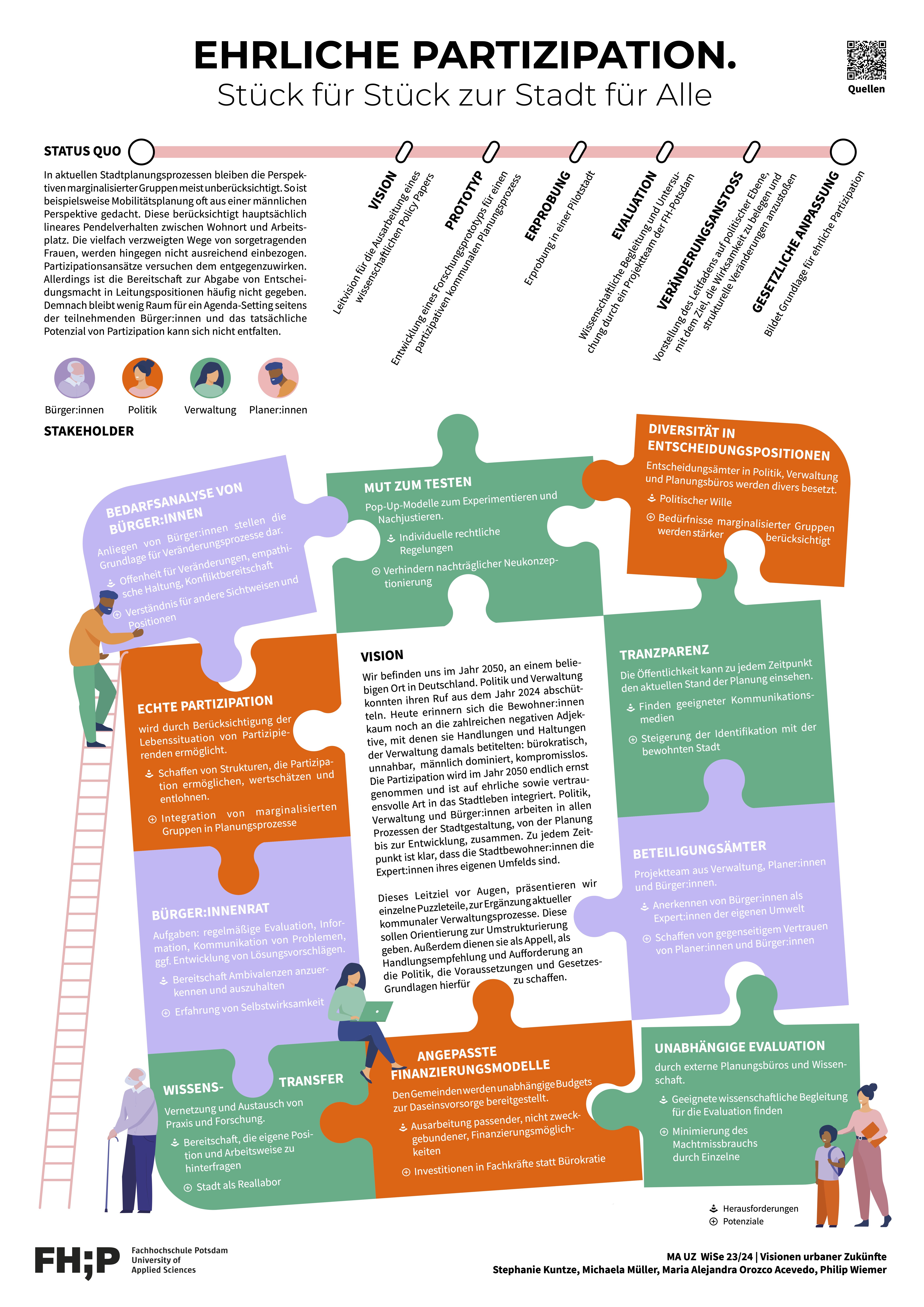
In the seminar "Visions of Urban Futures", real questions about the urban future are developed in interdisciplinary teamwork and put up for discussion by means of poster presentations.

Research projects

More projects

Transdisciplinary research at universities of applied sciences Sciences - Status quo and potentials of a sleeping giant

The project consortium analyses research at universities of applied sciences (HAW) with a special focus on transdisciplinary research projects.

GraDiM: Granularities of dispersion and Materiality: Visualisation of a Photo Archive on Diaspora

In collaboration with the photographer Frédéric Brenner and his international project team, the GraDiM research project is developing theoretical and technical concepts for the visualisation of a photographic archive, with particular sensitivity towards a collection documenting the Jewish diaspora.
Balkone mit grünen Pflanzen an einem Hochhaus

In study

On the pages of the Department of CITY | BUILDING | CULTURE you will find further useful information and documents on the degree programme, for example on the organisation of the degree programme, the course catalogue and the research internship. Furthermore, current projects of the degree programme are presented there.

Year Topic

Year topic 2026/2027


Planning for the city of tomorrow - Methodologies of exploratory urban research

Urban development today—as in the past—faces a fundamental challenge: decisions we make in the present will have far-reaching consequences in the future—in a context where climate conditions, technologies, and social dynamics will have profoundly changed. What is planned today will encounter a tomorrow shaped by artificial intelligence, new mobility patterns, and evolving lifestyles. How can we act responsibly under these conditions? How can we make robust decisions when the framework itself is constantly shifting? How can we consider the unpredictable to keep cities within a resilient development corridor? And how do we shape the "city of the day after tomorrow," whose concrete future eludes our imagination?

For the 11th grade, we invite you to explore these questions together. The focus is on the search for new perspectives, methods, and ways of thinking for urban development that understands uncertainty not as a deficit, but as a productive starting point for innovation. The Danish urban planner Jan Gehl formulated a clear priority for this: “If cities and buildings are to invite people to settle there, the human scale requires a new and consistent approach (…). The widespread practice of planning from the top down and from the outside must be replaced by new planning processes from the bottom up and from within, which follow the principle: first life, then space, then buildings.”

The spatial and temporal framework of this study is defined by the planned International Building Exhibition (IBA) Berlin-Brandenburg 2034–37. It focuses on the transformation of the built environment and sees itself as a catalyst for the implementation of existing strategies, concepts, and projects. At the same time, it offers a space to test innovative methods and model implementation strategies. This requires a departure from rigid planning logics towards a deeper engagement with the socio-cultural and systemic transformation processes of the metropolitan region.

In this context, we understand urban space not as a static backdrop, but as a dynamic process – driven by exploratory research, critical thinking, and the targeted activation of urban niches. In a conscious departure from primarily structural solutions, the focus is on the design of "intangible infrastructures": on social processes, sustainable service systems, and circular economic models within existing structures. It is less about the architecture of the building than about the architecture of the system. The goal is to increase the "intensity and diversity" of urban spaces through the intelligent layering of functions and cultures.

In line with the principles of "futures literacy" and "relational design," urban space is examined using methods from futures studies and speculative design, ethnographic fieldwork, and socio-spatial, systemic, and exploratory mapping approaches, deliberately without pre-existing planning templates. The aim is to reveal hidden development potential and to derive concepts for social innovations, resilient infrastructure systems, and new interaction models. These concepts go beyond mere problem-solving and design concrete, experiential scenarios as programmatic guideposts for the IBA 2034–37 and beyond.

Literature


Topic archive

The good life in the city

Normative visions in urban planning and transformation processes and their realisation in practical project work

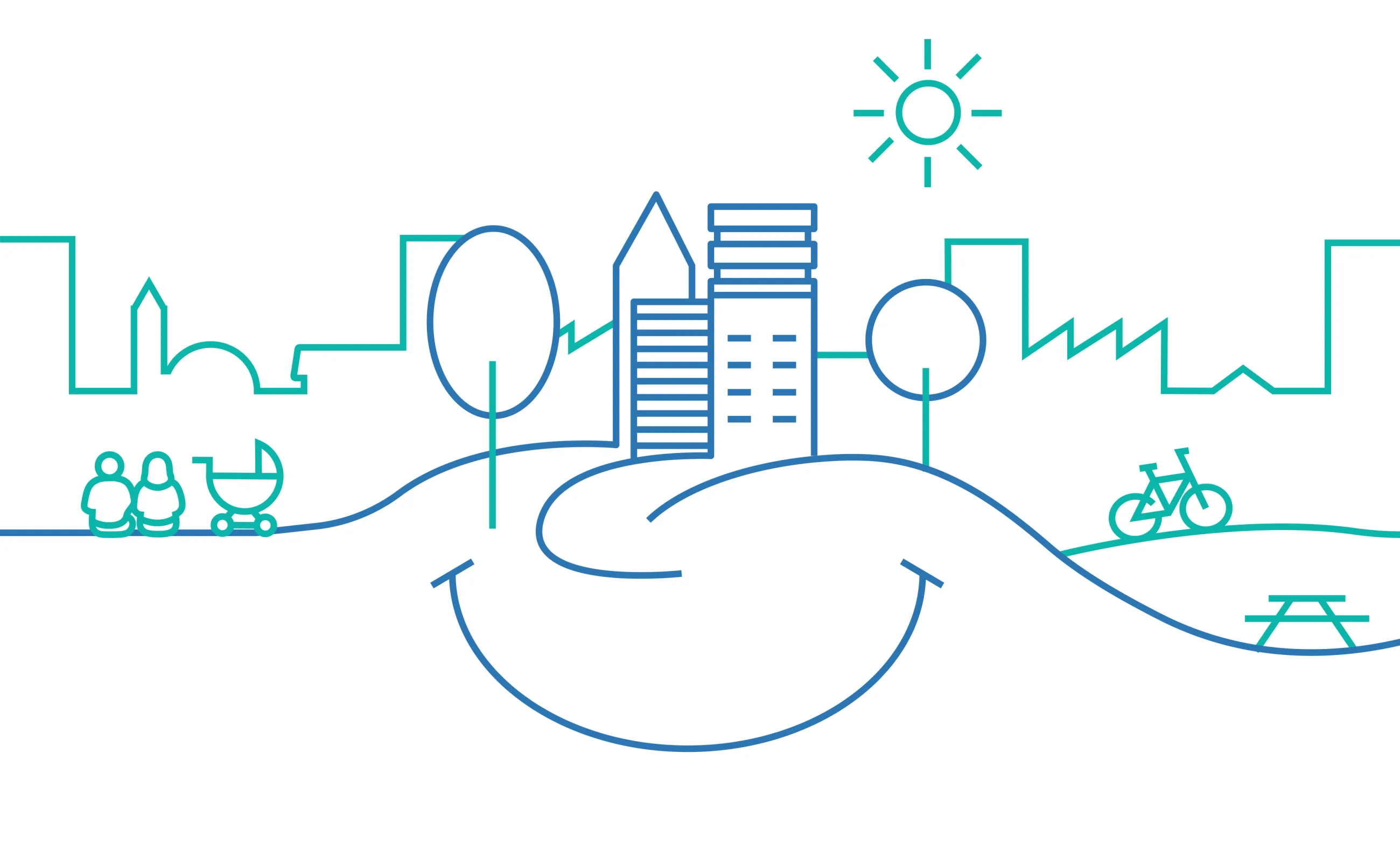
Grafik zum Jahrgangsthema 2025/26 des Master Studiengangs Urbane Zukunft. Eine Stadt in der Form eines lachenden Gesichts als Sinnbild für das gute Leben.
© Silvia Casavola

In view of the current global crises − climate change, social inequality, scarcity of resources and geopolitical uncertainties − the idea of the ‘good life’ as a leitmotif for dealing with urban futures may seem naive or even presumptuous. However, especially in times of polycrisis, it is essential to develop positive and optimistic visions of the future. Designing a liveable, just and sustainable urban life for as many residents as possible is not an abstract utopia, but an urgent necessity.


Urban and regional planning is based on normative models that reflect ideas of socio-spatial design and liveable cities. Nevertheless, textbooks and planning guidelines often fail to explicitly deal with socio-theoretical concepts of vibrant social spaces. Methodological approaches to the development of such visions are also rarely taught, although urban planning concepts are inevitably permeated by implicit guiding principles. Exemplary paradigms such as the ‘smart city’, the ‘post-growth city’ or the ‘city of short distances’ impressively illustrate this connection.

The socio-philosophical and methodological void of vision development in modern urban planning can be attributed, among other things, to the professionalisation and disciplinary structure of urban planning since the 19th century as well as to the negative experiences with ideologically shaped urban planning in the dictatorships of the 20th century. At the same time, specialised laws and municipal constitutions provide for citizen participation as an integral part of planning procedures. This creates a paradoxical situation: on the one hand, participation is emphasised, but on the other hand, it remains unclear which normative guiding principles can actually be developed and pursued.

Dealing with visions as elements of urban planning and transformation processes and their implementation in practical project work is the topic of the 11th year of the Urban Future degree programme.

The programme focuses on the following topics:

  • Theories of the ‘good life’ and urban quality of life: How has the concept of the ‘good life’ been conceived historically, philosophically and in terms of urban planning? What significance does it have for urban development today?
  • Guiding principles: What normative guiding principles underlie current urban planning projects?
  • Resilient and equitable cities: What strategies make it possible to make cities more resilient and equitable? How can social and ecological sustainability be combined?
  • Liveable urban spaces: Which spatial and social structures promote well-being and social cohesion in cities?
  • Post-growth and new economic forms: Which economic models and local initiatives can enable a fairer city?
  • Participation and urban democracy: Who shapes the future of the city? What role do citizen participation, a focus on the common good and new forms of urban governance play? Which power structures and actor constellations influence municipal planning processes?
  • Vision building: What methods exist for developing visions and how can they be integrated into planning processes? How can we develop our own methodological approaches to visioning in order to shape urban transformation processes in a targeted and participatory manner?

The year topic 2025/26 combines theoretical approaches with practical analyses and case studies. Students develop their own perspectives on urban issues of the future and create visions for a ‘good life’ in the city − not as a naïve utopia, but as a concrete response to the challenges of our time.

Literature

Arbeitstisch mit verschiedenen Instrumenten, die mit der Skizze einer Stadt im Hintergrund verbunden sind

© Nadia Zeissig

Work(ing) for the City of the Future


The world is undergoing significant transformation processes that will also have an impact on the working world of the future. Technological developments (e.g. the importance of digital data, artificial intelligence) and ecological challenges (e.g. climate adaptation) are changing job profiles, sometimes dramatically, to the point where old professions are disappearing and new ones are emerging. At the same time, demographic developments (e.g. ageing society, migration) are changing power relations on the labour markets and changing values (e.g. less acceptance of hierarchies, decreasing importance of work in life) are changing demands on the quality of working life.
In abstract terms, these changes are well known and have been described many times, but in detail there are uncertainties to deal with and there is often a lack of locally specific knowledge about how which trend will have a concrete impact in which region, for which professional group and for which organisation. This ‘translation’ of global trends into local, preferably concrete orientation knowledge is an essential skill that the Master's programme in Urban Futures aims to impart.

As an example, we will look at the situation of municipal employers (e.g. city administrations, companies providing public services) as part of the 2024/25 cohort topic. Cities are just as affected by the changes in working life as private companies, but face particular challenges in reacting flexibly to changing conditions in the world of work due to their highly legally regulated and hierarchical structures and organisational cultures.


At the same time, the pressure of the problem is great, because in a few years a large proportion of municipal specialists will retire or retire due to age. At the same time, expectations of local authorities' problem-solving skills and management qualities are rising, despite shrinking financial budgets and an increasing alienation between citizens and local politics, which is not only reflected in ever lower voter turnout. Cities must therefore develop creative solutions now if they want to guarantee their public functions in the future. In this context, questions such as the following are the focus of the projects in the upcoming year of the Master's programme Urban Future:

  • Quantitative forecast: What skilled labour requirements are actually likely to arise in individual municipal occupations in the Berlin-Brandenburg region by 2030, taking into account known data on fluctuation, retirement and the development of the regional labour market
  • Qualitative forecast: In view of the aforementioned social transformation processes, in which professions are particularly significant changes in the skills required or the design of jobs to be expected? Which new job profiles will become relevant for cities, will professions become obsolete? What impact will these developments have on training, study programmes and further education and training?
  • Comparative analysis: How are municipalities in other regions of the world reacting to demographic change and increasingly complex tasks?
  • Creative idea development: What specific measures can cities use to respond to the challenges identified?

The Master's degree programme Urban Future will work closely with the state capital of Potsdam on this topic, which is currently developing a sustainable skilled labour strategy in a cooperation project with the Potsdam University of Applied Sciences.

Literature

Comparative Urban Research

Cities have always been exposed to similar challenges such as growth and shrinkage or disruptive events such as wars, fires or epidemics. In their development, cities have learnt from each other and copied spatial, economic, political, aesthetic and infrastructural strategies in the implementation of sewage systems, energy supply or new transport or healthcare systems. While Camillo Sitte recommended ‘urban planning according to artistic principles’ (1889)[1] at the end of the 19th century, which he had researched in the medieval cities of Italy, Saskia Sassen observed the emergence of the ‘global city’ (1991)[2] at the end of the 20th century, which is characterised by the concentration of financial and service companies as an important hub in a networked global economy. In contrast, Jennifer Robinson argued in favour of recognising the ‘ordinary city’ (2006)[3], which should be regarded as equally important regardless of its position in the global economy and its diverse experiences should be integrated into urban research. Rem Koolhaas, for example, saw Nigeria's capital Lagos as a pioneering example of self-organisation processes for modern urban developments at the beginning of the 21st century (2005)[4].

Illustration zur vergleichenden Stadtforschung


Today, cities are confronted with tight housing markets, the development of a climate-neutral energy supply, adaptation to climate change and digitalisation processes. They are developing similar transformation strategies for climate protection, climate adaptation and resilience[5].


While cities face similar challenges, they are also extremely different themselves. For a long time, urban sociological research focussed on the processes and structures in cities. In recent years, the diversity or inherent logic of cities [6] itself has increasingly become the subject of research, as well as the study of comparative urban research as a methodological approach[7]. What are the current topics of urban research? Which methods of (comparative) urban research can be used to gain insights into the pressing issues of our time?


The focus of this year is on the study of methodologies and results of (comparative) urban research[8][9]. Here we deal with typical approaches from qualitative and quantitative social research, with studies of geographical and socio-economic location conditions or historical development paths. We also deal with planning theory and ethnographic approaches, current urban visions and models, explorative methods of futurology, urban cartographic comparisons and diverse methods of urban and data visualisation. Building on a systematic review in the first semester, the acquired knowledge will be exploratively deepened in the second semester in the context of city excursions in order to achieve a greater empirical breadth.

Sources

[1] Sitte, Camillo (1889): Der Städtebau nach seinen künstlerischen Grundsätzen. Wien
[2] Sassen, Saskia (1991): The global city: New York, Tokyo and London. Princeton University Press.
[3] Robinson, Jennifer (2006): Ordinary cities: Between modernity and development. Routledge.
[4]Submarine Media (Hrsg.) (2005): Lagos Wide and Close: An Interactive Journey into an Exploding City – Interview Rem Koolhaas
[5] Libbe, Jens et al. (2018): Stand der Transformationsforschung unter besonderer Berücksichtigung der kommunalen Ebene. Paper in Rahmen des Forschungsprogramms „Experimenteller Wohnungs- und Städtebau“ (ExWoSt)
[6] Berking, Helmuth / Löw, Martina (Hrsg.) (2008): Die Eigenlogik der Städte. Neue Wege für die Stadtforschung. - Frankfurt / Main: Campus
[7] siehe u.a. ILS (2018): International vergleichende Stadtforschung. Eine Handreichung für die wissenschaftliche Praxis im ILS. Dortmund: ILS – Institut für Landes- und Stadtentwicklungsforschung.
[8] Jessen, Johann / Siedentop, Stefan (2018): Stadtforschung. ARL – Akademie für Raumforschung und Landesplanung (Hrsg.): Handwörterbuch der Stadt‐ und Raumentwicklung, S. 2465 bis 2476
[9] Mieg, Harald A. / Heyl, Christoph (Hrsg.) (2013): Stadt. Ein interdisziplinäres Handbuch. Stuttgart: J.B. Metzler Verlag


Smart City Potsdam

Smart cities are usually used to describe cities that enable intelligent networking of different areas of life and infrastructure sectors through the ubiquitous use of information and communication technologies (ICT), thereby achieving a higher quality of life and an increase in energy and resource efficiency. [i]
Innovations in technical infrastructures have always had a major impact on urban development processes and urban lifestyles. For example, developments in urban water management, energy supply or communication systems since the mid-19th century have led to new patterns of work, mobility, consumption and resource regimes. The new information and communication technologies are the basis of many current technical, cultural and social developments, such as smart homes, new work, platform economies or Industry 4.0.

Grafik zur Verzahnung von erneuerbarer Energie mit der technischen Infrastruktur im Rahmen von Smart Cities

In July 2021, the state capital of Potsdam was selected by the Federal Ministry of the Interior, for Construction and Home Affairs in the funding programme „Modellprojekte Smart Cities“ ("Model Projects Smart Cities") [ii] with the application „Smart City Potsdam – Innovativ. Grün. Gerecht. Zusammen schaffen wir eine nachhaltige Stadt für morgen!“ ("Smart City Potsdam - Innovativ. Green. Just. Together we create a sustainable city for tomorrow!") [iii] was selected for funding together with 27 other cities.
The state capital intends to use the funding to,

  • exploit the opportunities of digitalisation for the provision of public services,
  • counteract climate change and
  • expand the opportunities for Potsdam residents to participate. [iv]

In this cohort, we are using the example of Smart City Potsdam to examine how municipalities can use digitalisation for sustainable, integrated and public welfare-oriented urban development, what opportunities and potential are associated with it, but also what challenges the digital transformation poses for municipalities.

What characterises a smart city and what effects can be expected from the use of innovative technologies on urban lifestyles, planning processes, urban development and urban form and the participation strategies underlying these activities? Based on extensive research on smart city strategies in various cities, small working groups will examine the actor networks, strategies and planned implementation measures in Potsdam in dialogue with the actors and develop visionary, practicable and strategic approaches to solutions in a project.
will be developed.

Sources:
[i] BBSR, BMI (2021): Smart City Charta. Digitale Transformation in den Kommunen nachhaltig gestalten. (22.02.2022).
[ii] BMWSB: Smart City Dialog, (o.D.), www.smart-city-dialog.de/ (22.02.2022).
[iii] LH Potsdam: Potsdam wird Smart City-Modellkommune, (o.D.), www.potsdam.de/potsdam-wird-smart-city-modellkommune (22.02.2022).
[iv] Vgl.: LH Potsdam: Potsdam wird Smart City Modellkommune. (o.D.).


Doing well by doing good: Entrepreneurial strategies for a sustainable society

In the next generation, humanity must move from an economic model in which natural resources are consumed to one in which economic activity is integrated into natural material cycles. In the long term, prosperity must not come at the expense of the regenerative capacity of natural resources.

Grafik mit städtischen Gebäuden und Windrad
© Lena Zagora

At the same time, large parts of humanity still live in inadequate conditions (despite all the progress made in the fight against poverty). Around 700 million people alone have no access to electric light; worldwide, the median income is barely more than 200 euros per month per person. Against this background, it is important that all people and countries have the right to (economic) development, similar to what the West enjoyed in the first wave of industrialisation. We are therefore faced with the challenge of improving global economic conditions quickly and massively, while at the same time reducing resource consumption just as quickly and massively.

What is the role of private companies in this? On the one hand, private enterprise has historically proven to be an effective and fast social mechanism to generate as much wealth as quickly as possible. On the other hand, private companies (especially in the discourse of Western societies) often have to accept the reproach that their pursuit of profit comes at the expense of ecological responsibility. The realisation that companies must actively face up to the challenges of climate change is also increasingly gaining acceptance among corporate leaders, such as Larry Fink: The CEO of the asset manager Blackrock, and thus responsible for over 8.6 trillion dollars of investors' money, is calling for "responsible and transparent capitalism" (Letter to CEOs 2020).

A whole series of renowned non-fiction authors have dealt with the constructive role of companies in the climate crisis - with encouraging results, e.g. Bill Gates, Andrew McAfee or Steven Pinker. Much hope is placed on start-ups, as shown for example by Google's recently launched start-up accelerator programme for "Climate Change".

In this context, questions such as the following are the focus of the projects in the upcoming master's programme Urban Future: What responsibility do companies bear for the necessary ecological turnaround? Can the tension between the pursuit of profit and the common good be resolved? Or is it still true in the 21st century: "The business of business is doing business" (Milton Friedman), so that ecological issues are the sole responsibility of the state.

From a business perspective: What are the strategic consequences of the discourse and global political action on sustainability for business activities? What risks arise from future environmental regulation (e.g. bans on technologies such as combustion engines), taxation (e.g. CO₂ taxation), liability rules (e.g. supply chain law) or public discourse (e.g. loss of reputation in social media)? Conversely, what opportunities arise from new markets (e.g. through state-generated demand or changing consumer awareness)?

Finally, on a very practical level: Can we develop our own ideas for the promising foundation of our own companies, which with their business model contribute to solving the global social and ecological problems of the 21st century, but also generate a good income?

The master's programme urban futures will work closely with the FHP Entrepreneurship School & Gründungsservice on this year's topic, a project of the University of Applied Sciences Potsdam to train entrepreneurial skills and support start-ups from within the university.


Living Labs for the 2,000-watt society

„Wir sind dran. Was wir ändern müssen, wenn wir bleiben wollen“("Our turn. What we need to change if we want to stay"). The title of the latest book by Ernst Ulrich von Weizsäcker and Anders Wijkman once again highlights current perspectives and requirements for action for a sustainable society. [1] In 30 years' time, all energy generation in Germany should be almost CO₂-neutral in order to contribute to meeting the global challenges of climate change and resource conservation. The transition to a CO₂-neutral society requires not only technological innovations and a huge transformation of urban (infrastructure) systems, but above all sustainable lifestyles. This touches on all questions of living and working, mobility and consumption behaviour, nutrition and food production. In Switzerland, the concept of the 2,000-watt society was developed more than 20 years ago.

Grafik Jahrgangsthema 2020/2021 im Master Urbane Zukunft

A maximum average energy output of max. 2,000 watts per inhabitant is defined as the target for a sustainable society. Many Swiss municipalities have now made this concept the guiding principle of their urban development. [2] Since the food sector alone, through the production, processing and distribution of food, consumes about 800 watts, more than a third of the targeted energy budget, it is clear how ambitious the formulated guiding principle is. In addition to the 2,000-watt society, we will also deal with other models of sustainable development such as „Der globale Green New Deal“ ("The Global Green New Deal") [3] or "Zero Emissions Research and Initiatives (ZERI)" [4] as well as with methods for environmental assessment. Building on these foundations, we develop concepts for living labs (real labs) in the context of current neighbourhood developments and investigate which strategies, measures and transformation processes are required to achieve these goals. An excursion to Switzerland is planned for the beginning of the second semester in April 2021 to visit model projects.

[1] Ernst Ulrich von Weizsäcker, Anders Wijkman (2017): Wir sind dran. Club of Rome: Der große Bericht. Was wir ändern müssen, wenn wir bleiben wollen. Eine neue Aufklärung für eine volle Welt.
[2] 2000-Watt-Areal, www.2000watt.swiss
[3] Jeremy Rifkin (2019): Der globale Green New Deal. Warum die fossil befeuerte Zivilisation um 2028 kollabiert – und ein kühner ökonomischer Plan das Leben auf der Erde retten kann.
[4] Gunter Pauli (2009/12): The Blue Economy. www.zeri.org


Resilience and transformation of urban systems

Whether it is global warming, demographic change, digitalisation processes, the future of work or the further development of technical infrastructure systems - when it comes to adapting to change and shaping transformation processes towards a sustainable society, a concept for explaining the development dynamics of complex systems has gained in importance: Resilience. Resilience refers to the ability of a complex system to return to its initial state or to establish a new system state that even exhibits improved system behaviour compared to the initial state, despite strong external disturbances. Understood in this way, resilience includes a system's inherent ability to learn and develop. In recent years, resilience has become a key concept in the discourse on sustainable urban development. While resilience is sometimes referred to as the "new sustainability", there is also criticism of the concept's theoretical vagueness and lack of practical relevance.

Grafik Jahrgangsthema 2019/2020 im Master Urbane Zukunft

Using concrete examples of urban and neighbourhood development, we examine what the concept of resilience can achieve in theory and practice. How must smart and liveable neighbourhoods in the 21st century be structured in order to meet the requirements for a regenerative energy supply, sustainable mobility, local climate adaptation, social cohesion and other pressing issues? What role will digital platforms play in the planning and management of neighbourhoods in the future? Can participatory planning processes, the sharing economy, new forms of communal living or community gardens make a significant contribution to neighbourhood development? And how must transformation processes be designed to achieve these goals? The focus of our research is Berlin, which with the planned Urban Tech Republic at today's Tegel Airport, the New Garden Field and many other neighbourhood developments is already a real laboratory of urban innovations and an arena of social debate. At the beginning of the second semester (April 2020), an excursion to the Netherlands is planned to inform us about international positions on the topic of sustainable neighbourhood development and resilience.

The vision of "Smart Cities" is linked to hopes of finding better solutions to the pressing problems facing cities through the use of new digital technologies. These include the urgently needed reduction of resource consumption and adaptation to climate change, smarter forms of mobility, but also issues of social division and demographic change. While the discourse surrounding Smart Cities and sustainability is a global one, and cities worldwide face fundamentally similar challenges, cultural and historical factors as well as differing institutional conditions influence the respective regional perspectives on urban futures. Using European and East Asian cities as examples (e.g., in the People's Republic of China, Taiwan, or Japan), the projects in the coming academic year will focus on questions such as the following:

  • What are the commonalities and differences in perceived urban future challenges and visions? How do usage patterns and evaluations of smart city concepts differ across various regions of the world?
  • How do differing attitudes, for example, regarding privacy and data security, influence the design of digital services and digital governance? 
  • What is the general openness to new technologies, sustainability paradigms, consumerism, participation, etc.? Given the differing local needs, values, and moral systems in various societies, how can productive and respectful global discourses on the future and development strategies be developed?
  • What significance do path dependencies (e.g., the organically grown European city vs. centrally planned new smart cities in East Asia) have for shaping sustainable cities?

The core of the thematic exploration will be an exchange with faculty and students from the National Taipei University of Technology (Taipei Tech) in Taiwan, which cooperates with FHP. A roughly two-week excursion is planned for May or June 2019, including a visit to the Pearl River Delta (Hong Kong, Guangzhou), a workshop week at Taipei Tech together with students there, and likely a visit to a globally operating mobility company. Applicants for the Master's program should therefore have sufficient English language skills and be willing to contribute to the costs of participating in the excursion. FHP Potsdam will endeavor to finance the majority of the costs through acquired third-party funding, but a personal contribution should be expected.

http://www.fh-potsdam.de/forschen/urbane-zukunft/masterstudiengang/

City.Country.Digital

The vision of "smart cities" is associated with hopes of finding better solutions to the pressing problems of cities through the use of digital technologies. These include the urgently needed reduction of resource consumption and adaptation to climate change, smarter forms of mobility, but also issues of social division, demographic change and political participation. However, "smart city" means very different things to many actors. Some envision technologically advanced metropolises where global technology companies provide the critical digital infrastructure. Others rather see the potential to enable marginalised social groups and regions to work on a smart and socially inclusive "city from below" through cheap, easy-to-learn open source technologies that can be used by individual actors. The projects in the coming year of the Master's degree programme move within the field of tension of these different smart city visions, with the aim of developing critical and constructive perspectives on the role of digital technologies. Particular attention will be paid to the disparity between urban and rural areas that is currently often discussed in public. This can be clearly felt in Potsdam: half an hour's drive in one direction is the globally important metropolis of Berlin, half an hour in the other direction are small towns and villages.

We want to answer questions like the following in the Master's projects under the title "Stadt. Land. Digital": How different are the future opportunities and challenges in metropolises and rural areas? Are the supposed opposites irreconcilable? What do desirable and feasible concepts for "smart cities" look like beyond the lighthouse metropolises that receive worldwide attention? Can digitalisation also become a lever for self-empowerment and levelling social differences? How can we use digital technologies to develop better urban planning tools that are adapted to different circumstances and take into account participation needs (e.g. simulation tools, data visualisation, interactive maps, augmented reality)?

Smart cities and communities in the 21st century

The digitalisation of society is leading to sustainable changes in cities and municipalities. These changes are driven, among other things, by the requirements of sustainable use of natural resources (energy and material flows, use of space), by new technological possibilities and new business models (e.g. car sharing services, autonomous driving), by social and demographic processes (growth/shrinkage, individualisation, diversity) and new simulation, analysis and representation methods (big data, system models, information visualisation). These changes are part of fundamental societal transformation processes and equally affect citizens, businesses and municipal administrations and other actors in their everyday practice. They have an impact on urban infrastructures, on forms of communication and mobility, on forms of work and living. Students and lecturers together examine what "Smart Cities and Communities in the 21st Century" look like and what perspectives and possibilities of influence the various urban actors have on these processes of change.

What role do municipal actors such as city administrations or municipal utilities play, how do they have to change and how can they influence or steer transformation processes? What opportunities and risks arise for metropolitan regions and rural areas as a result of these transformation processes? What research methods or digital planning and simulation options are available to anticipate possible future developments and make better decisions today for tomorrow?

FAQ

This list is intended to help you answer the most frequently asked questions about our Master's programme Urban Futures.

If you have any further questions, please feel free to send us a personal request via the e-mail address uz@fh-potsdam.de. We will answer you as soon as possible.

Urban Futures is not a Master's programme where the classical qualifications for urban and regional planning are taught. The focus is on inter- and transdisciplinary project work, but not on urban planning or urban design as is usually the case in planning degree programmes. We deal with the diverse questions of sustainable urban development in an interdisciplinary way. Here you can find an article that describes the intentions, methods and teaching formats of the study programme in more detail.

The composition of the Master's programme is interdisciplinary: About half of the 20 places in each year are allocated to students with a background in planning and design, natural sciences and technology, and the other half to students with a background in cultural and social sciences. In concrete terms, these are mainly geographers, urban and regional planners, architects, cultural and social scientists, political scientists, designers, media and communication scientists, psychologists, economists, but also cultural work, social work, information and library sciences, art history, choreography are represented disciplines – if there is a strong interest in the city and interdisciplinary work.

In the Master's programme, a distinction is made between compulsory and elective subjects. The programme is designed in such a way that the compulsory courses take place from Tuesday to Thursday. On Mondays and Fridays, as well as in the peripheral periods, there is the possibility to take elective subjects, to prepare for and follow up on courses, for self-study as well as for part-time work. Further information on the study structure, the study and examination regulations and the module regulations can be found here.

The Master's degree programme offers plenty of scope for deepening individual study interests within the framework of the electives. In addition to the electives at the University of Applied Sciences Potsdam (practically from all degree programmes), you can also attend courses at other universities and receive credit. Furthermore, MOOCs or "special forms" (such as summer schools, etc.) are possible course variants.

Apart from a completed Bachelor's degree with 180 ECTS credits (or more), there are no further formal admission restrictions for the degree programme. The admission restriction automatically results from the fact that more applicants apply for the Master's degree than there are places available (20).
Further information on the admission requirements

The Master's programme is only offered in the winter semester. The application period is 2023 until the 15th of June.
Further information on the application

Since the introduction of the Master's programme in the winter semester of 2016, we have seen a steady increase in demand. In the last two years, we have had between 90 and almost 120 applicants for every 20 places. Since the selection for the admission procedure is based on the Bachelor's grade and the application letter, no clear NC can be determined for admission. We recommend that you apply regardless of your grade point average. Further information on the application procedure can be found here.

The project outline should be formulated with regard to the year's topic. We want to know from you what you are interested in and what could be a particularly interesting topic for you. This can (but does not have to) refer to your own preliminary work or to already existing studies.

You can find the year's theme at the bottom of the page here.

Individual part-time study is also possible. Further information and requirements can be found here.

The aim of the research internship in the third semester (module 9 with a scope of 20 ECTS credit points or 600 working hours) is to gain practical experience with organisational structures and operational processes in the internship institution and to work on complex research questions in the context of urban transformation processes. With a qualified secondary activity, the intended qualification goals can also be achieved during the course of study; crediting of secondary activities for the research internship is therefore possible upon application. In order to avoid a time overload, other study achievements may then have to be completed in deviation from the planned regular course of studies.

Career Prospects

Career prospects

You will be trained to conduct inter- and transdisciplinary research into visions of the future so that you can develop complex approaches to solutions for sustainable urban development in the context of building and housing, technical infrastructure and mobility, as well as demography and social structure. The competent use of data spaces and visualisations and other digital research methods is a central cross-cutting theme in all of the above-mentioned subject areas.

Extensive research projects and development projects are created in cooperation with practical partners from the economy, municipal administrations and scientific institutions. These enable a research-oriented study structure and direct participation in research and development processes within the framework of the study projects, internships and master's theses.

The concept of a transformation manager who works as an interface communicator, especially in the field of urban development and in the communication of political and social institutions or associations, serves as a model.

Possible areas of application

  • Companies and institutions whose task is the production, design and mediation of urban living spaces, such as consulting companies, interface and communication design, research and development in the field of human-machine interfaces as well as cultural work, media and communication, marketing and tourism.
  • International companies with a service portfolio for urban services and infrastructures
  • Start-ups
  • International organisations
  • Access to management positions and higher service

Scientific career

The entitlement to a doctorate also opens the way to an academic career, e.g. in university or non-university research and teaching.

  • The approach of this inter- and transdisciplinary degree programme is absolutely contemporary, because the city as a crystallisation point of social, economic, technological and ecological developments absolutely requires the training of competences that can be summed up very nicely with the term transformation manager.

    Beate Schulz-Montag
    foresightlab, member of the advisory board
  • The city and infrastructure form a unit, but are often thought of separately. There was a close co-evolution between infrastructure and urban development. I think we have to rethink this co-evolutionary process. An integrated development of city and infrastructure, that is the central question for me. That is the meta-question behind everything. The aim of the degree programme is to think of the city and infrastructure as a unit again.

    Jens Libbe
    German Institute of Urban Affairs, member of the advisory board
Application & Contact

Dates & requirements for your application

The most important deadlines, dates and admission requirements for the Master's programme Urban Futures are compiled here. You can find out which steps you need to take for a successful application in the next section.

Dates

Admissions requirements

First professional university degree (at least 180 ECTS credits) in the following fields of study:

  • technical/design-related: e.g. architecture and urban planning, design, urban and spatial planning, civil engineering
  • social science-related: including sociology, psychology, social work, cultural work, politics, geography
  • related to data and information processing: including computer science, information science, statistics and data science, computer visualistics

This is how you apply!

In the following, we explain which aspects you should pay attention to from the online application to matriculation (enrolment).

Applications for the winter semester are accepted online at from the 15th of May to the 15th of June via the MyCampus university portal of the University of Applied Sciences Potsdam.

Documents to be submitted

When applying online, the following documents must be submitted as PDF files in the application portal:

  • University degree certificate(s) including diploma supplement or current overview of achievements with the ECTS credit points and grade earned to date, if the degree programme has not yet been completed.
  • Letter of motivation (max. two pages): The letter of motivation should provide information about the motivation and identification with the chosen degree programme and the intended profession. In particular, the motivation to study should be explained in a differentiated manner and placed in the context of the applicant's previous career and professional prospects.
  • Project outline – description of a possible research project – for the master's degree programme, maximum two pages in length.
    - State of the art in research or technology on the topic, with a reference to relevant literature
    - Description of the research objective
    - Content-related proximity to the current year's topic is desired
  • Tabular curriculum vitae

Checklist

After completing your online application in the MyCampus university portal, you will receive a personal checklist with the following information:

  • List of all supporting documents that you have uploaded as PDF files according to the information you provided in your online application
  • Notes on the further course of the procedure

Selection procedure

Applicants who fulfil the admission requirements take part in the procedure for awarding places.

In the allocation procedure, the following are deducted in advance from the number of study places to be allocated:

  • All applicants who were unable to accept an earlier admission due to service and all applicants who belong to the national squad of a national sports federation of the German Olympic Sports Confederation
  • 11 % for applicants with a foreign university entrance qualification
  • 3 % for applicants who are to be considered on the basis of hardship.

The remaining study places are allocated 90 % according to the result of a university selection procedure and 10 % according to waiting time.

The result of the university selection procedure is determined on the basis of the following criteria (weighting in brackets):

  • Grade of the professionally qualifying university degree (40 %).
  • Project outline for the Master's programme (30 %)
  • Letter of motivation (30 %)

Admission

Following the university selection procedure, admissions procedure is carried out. Applicants with a correspondingly high ranking receive a time-limited offer of admission in the MyCampus university portal, which they must actively accept. After accepting the offer of admission, you will find your notification of admission in the MyCampus university portal. If you do not accept the offer of admission by the deadline, the ranking list will continue to be processed and the place will be reallocated.

You have accepted the offer of admission and received your letter of admission? Then you have the opportunity to submit an enrolment application for the upcoming winter semester in the MyCampus university portal of the University of Applied Sciences Potsdam.

Following online enrolment, upload all required documents as PDF files via the upload portal. Enrolment is only valid once all documents have been uploaded in full and on time.

Documents to be submitted

  • University entrance qualification
  • If applicable, further documents according to the enrolment application form.

Do you have any questions about the enrolment process at the University of Applied Sciences Potsdam? Our enrolment page offers you further information and a FAQ section on all aspects of admission and enrolment.

Further information

The following links provide you, and especially international applicants, with further information on the topics of application and enrolment at the University of Applied Sciences Potsdam.

International applicants

You would like to apply for studies from the first or a higher semester and have acquired your school-leaving qualification and/or university degree abroad? Then you can have degrees and achievements acquired abroad recognised and study with us.

Application & Enrolment Procedure

The application and study service provides information and advice on general questions regarding the application process, admission and enrolment at the University of Applied Sciences Potsdam, application for a higher semester, but also on topics such as compensation for disadvantages, part-time studies, waiting semesters and hardship applications.

Contact & Services

The Student Counselling Services provides information and advice on general questions about studying as well as on topics such as choosing a degree programme, application, enrolment and study organisation.

For programme-specific questions on module content, credit transfer, examinations or specialisations in the Urban Futures degree programme, the programme-specific student advisory is the right place to go.

Programme-specific student advisory

Programme-specific student advisory

Research professor for resource-optimised and climate-adapted construction
Head of Urban Future (M. A.)

Student Counselling Services

Room 102

Book an appointment online

Student Financing

Room 3.02a

Family Affairs Officer

Room 026

Office hours

Tue and Thu 9.30 am – 1.30 pm

Accessibility and Inclusion Officer

Office hours

Monday and by appointment

Contact Study Administration Services