Skip to main content Skip to main navigation Skip to footer
Information and Data Management (BA)
Fit for the digital future!
Profile: Digital Space – Data, Interaction, Knowledge
Zwei Studierende sitzen vor einem Laptop auf dem HTML-Codes zu sehen sind. Eine Person zeigt auf den Bildschirm.

The practice-oriented Information and Data Management degree programme provides the know-how for the efficient administration and use of large and complex amounts of data. Data and information specialists manage information processes holistically, secure data sustainably and prepare information for specific target groups.

Degree:
Bachelor of Arts
Type:
full-time
Course language:
German
Standard study period:

7 semesters

Start of study:
Winter semester
Application deadline:

15/06/ – 15/08/ (admission-free)

Admission requirements:
General higher education entrance qualification/ technical college entrance qualification/ equivalently recognised practical vocational training
Credits:

210 ECTS credit points

Module Manuals & Regulations
Profile

Is this degree programme right for me?

The bachelor's degree program in Information Studies at University of Applied Sciences Potsdam suits you if you are enthusiastic about information technologies and enjoy dealing with complex topics. Dealing with sensitive data requires the ability to concentrate and diligence. If you are also empathetic and communicative, you will enjoy working with various experts in your daily work.  

You have these qualities

  • Curiosity and willingness to experiment with new digital technologies
  • Interest in the organisation of digital data and information
  • Structured and abstract thinking skills and enjoy dealing with complex topics
  • Analytical and communication skills
  • Motivation to learn, to accompany complex information projects from analysis to conception to implementation
  • Team spirit

Online study choice assistant

Would you like to find out more about the Information and Data Management degree programme, get opinions and tips from students and lecturers or take a look at typical study tasks?

With the online study choice assistant OSA, you can test whether the degree programme suits you.

Podcast of the campus specialists

Elias and Tim study Information and Data Management and inform prospective students about their degree programme as campus specialists. In the podcast, they share personal impressions of student life and their degree programme.

FAQ on the Information and Data Management degree programme

In our FAQs on the Information and Data Management Bachelor's degree programme, you will find answers to frequently asked questions about studying, content, careers and much more.

Data management refers to the entire process of collecting, storing, organising, maintaining and using data within a company or organisation.

The aim is to administer data in such a way that it is always correct, secure, accessible and usable. This includes data quality assurance, data protection, data integration, database management and the development of data strategies.

Effective data management makes it possible to gain valuable insights from existing data and make well-founded decisions.

Information management refers to the systematic handling of information within a company or organisation. This includes the collection, processing, storage and provision of information to ensure that it is correct, up-to-date and accessible at all times.

The aim is to manage information in such a way that it optimally supports business processes and decision-making. This also includes the development of strategies and procedures for information security, quality and utilisation in order to derive the maximum benefit from the available information.

Data management and information management are closely related, but have different focuses.

Data management focuses on the administration of raw data, including its collection, storage, maintenance, backup and integration to ensure its accuracy, security and accessibility. Information management, on the other hand, is concerned with the processing, analysis, organisation and provision of information derived from data. The aim is to use this information to optimally support business processes and decision-making.

In short: Data management administers the data, while information management extracts and utilises useful information from it.

The Data and Information Management degree programme focuses on the administration and analysis of data and information, with an emphasis on database management, data analysis and information strategies.

Computer Science, on the other hand, covers a broader range of technical topics such as programming, software development and algorithms. Business informatics combines computer science with business administration to develop IT solutions for business processes.

While data and information management is practice-orientated in data processing, the practical relevance in computer science varies greatly. Business informatics integrates real business processes and interdisciplinary projects.

In terms of professorial recruitment, data and information management is orientated towards data analysis and information management, computer science towards technical IT roles and business informatics towards the interface between IT and business processes.

You do not need any special prior knowledge to study at the University of Applied Sciences Potsdam. Admission to the degree programme is not restricted. All you need is a general higher education entrance qualification such as a high school diploma, entrance qualification for universities of applied sciences or vocational training.

In order to acquire the programme-specific prerequisites required for further studies in the areas of programming, mathematics or scientific work, we offer corresponding compulsory introductory courses as part of the regular degree programme in the first semester, equivalent to bridging courses at other universities.

The degree programme is taught in German and requires language skills at least at level C1 of the Common European Framework of Reference for Languages.

Information on how international student applicants can prove the necessary language skills can be found on the application procedure website.

The degree programme in Potsdam pursues a generalist approach that opens up a wide range of career prospects in the public sector, the cultural sector or in the private sector. A number of degree programmes are directly related to Informationswissenschaften.

The degree programme also benefits from the interdisciplinary courses offered together with the other degree programmes in the Department (Archival Studies and Library Science).

You can choose to specialise in web content management and digital marketing, data modelling and management as well as information and knowledge management.

Contact us

The staff members at the Student Counselling Services provide prospective students, first-year students, parents, teachers and students with information on all general questions relating to studying. If you have specific questions or concerns about the Information and Data Management Bachelor's degree programme, please contact the programme-specific student advisory service.

Student Counselling Services

Room 102

Book an appointment online

Programme-specific student advisory

You may also be interested in these degree programmes

More courses
Department Degree programme Teaching language Start of study Application deadline
Archival Science (MA) German Winter semester

15/05 – 10/06 in odd-numbered calendar years (admission restricted)

Archival Studies (BA) German Winter semester

15/06 – 15/08 (free of admission)

Digital Information Management (MA) German Summer semester, Winter semester

15/01/ – 01/03/ (study track DI3) and 15/06/ – 01/08/ (study track DI4)

Information and Data Management (BA) German Winter semester

15/06/ – 15/08/ (admission-free)

Library Science (BA) German Winter semester

15/06 – 15/08 (free of admission)

Career prospects

Career paths in Information and Data Management

Digitalisation requires experts and offers a wide range of job opportunities in information management and data management, including

  • knowledge manager,
  • data analyst,
  • media documenter,
  • digital Marketing Manager or
  • web Analytics Specialist.

Information and data managers are active in all areas in which digital data and information play a role – whether in business, the public sector, science or culture.

As the requirements in this professional field increase, so does the demand for qualified graduates.

Alternatively, instead of starting your career directly, you can continue your studies at the Department of Information Sciences with the Master's degree programme Digital Information Management.

Public and scientific institutions

  • Documentation departments and archives in media organisations (e.g. press and broadcasting)
  • Picture and news agencies
  • Parliamentary documentation in the Bundestag and state parliaments
  • Museums
  • Libraries
  • Information supply in public research institutions
  • Public authorities (e.g. e-government, document management, web editing and social media management)

Private companies

  • Commercial enterprises with information services (e.g. content management or social media management)
  • Internet service providers such as web agencies, digital marketing agencies
  • Software manufacturers and database producers
  • Services for information and knowledge management
  • Web agencies for search engine optimisation
  • Information supply in private research institutions
  • Management consultancies (e.g. organisational and IT consulting)

A brief introduction: Possible occupational fields

Information managers administer and control information

Data is often referred to as the "oil of the 21st century". Just like oil, data needs to be processed before it can be utilised in a meaningful way. One of the challenges for commercial enterprises is to make the information relevant to economic activity accessible from the growing flood of data – known as big data.

"Go Digital" has therefore long been a core component of many corporate strategies. Topics such as machine learning, artificial intelligence, business intelligence and the automation of information management processes are on the agenda in small and medium-sized companies as well as in corporations and administrations.

Life sciences, for example

In research-intensive companies, such as the life sciences sector, a lot of information is generated from internal and external data sources for the development of new, innovative medicines. This data must be correlated, analysed and made available to the relevant health authorities for market approval. In addition to industry-specific expertise, the skills of information managers are required here. In interdisciplinary co-operation with researchers and developers, they ensure that all the necessary information arrives where it is needed.

Take Bayer AG, for example

BAYER AG is a life sciences company that offers interns on our degree programme a first insight into the world of work and attractive opportunities for our graduates to enter a professional working environment. The possible areas of employment are diverse. Examples include Research Data Management, Information Services, Data Science – for example in Clinical Development – and Regulatory Affairs – for example in Document and Data Management.

Digital marketing on the World Wide Web marketplace

Digital marketing deals with the planning, development, realisation, management and control of marketing tasks with the aid of digital media and technologies.

Important areas of responsibility in this field include, for example

  • Search engine marketing with the two sub-areas of search engine optimisation (SEO) and search engine advertising (SEA)
  • Social media marketing/advertising
  • Sentiment analysis/opinion mining
  • Content marketing

Learning to understand search engines

Search engine optimisation plays a major role for companies in order to hold their own against competitors. The better the position of important keywords in the search engine results lists, the greater the number of visitors to your own website. The basics for understanding how search engines work and the measures for optimising websites to achieve better ranking positions are taught in modules on information retrieval and project modules on search engine optimisation.

Start-up and established company at the same time

One interesting employer in the field of digital marketing is the Viessmann Group – one of the leading international manufacturers of heating, industrial and cooling systems. In the digital department of Viessmann – called VC/O – a young and dynamic team works under the Head of a graduate of ours in a "start-up flair" in the centre of Berlin. The digital department develops strategies to persuade potential buyers to make a purchase through various campaigns. Customised campaigns are developed for the end consumer. The adverts can be played out via social media, for example, according to the hobbies and interests specified.


Knowing how knowledge can be utilised - knowledge management

Knowledge management aims to make efficient use of knowledge and experience in companies or organisations in order to help them achieve their own goals. In this context, the tasks and activities performed by knowledge managers are very diverse.

They range from the Procurement Services, preparation and presentation of information for internal organisational websites – such as intranets, wikis or blogs – to the moderation of internal work meetings at which employees share their experiences on a product development project, a marketing project, an IT introduction or similar. In addition to these operational tasks, the job profile of knowledge managers can also include conceptual tasks as well as strategic tasks.

Unlimited deployment

The field of application of knowledge managers knows no boundaries. They are needed in commercial enterprises, public administration, associations and other non-profit organisations, where they are already employed in some cases. However, the term knowledge manager has not yet become firmly established in practice. This is why other terms often appear in job adverts, such as content manager, community manager or web editor.

Dealing with people. Dealing with information technologies.

Since knowledge and experience can be found both in the minds of an organisation's employees and in documents and databases, knowledge managers must be familiar with and be able to deal with both people and information technologies. This is the only way they can ensure the effective and efficient utilisation of knowledge as a resource. With the skills acquired on the Information and Data Management degree programme, students are very well prepared to successfully fulfil the tasks in this developing professional field.

Information and Data Management: Cultural Heritage Documentation

Preserving and making cultural heritage available is one of the most interesting fields of activity in Information and Data Management. The range of cultural heritage institutions that need knowledge and energy in this area extends from museums, libraries, archives, art and castle foundations to memorials and institutions for the preservation of monuments, culture and tradition.

These institutions are faced with the challenge of setting up information infrastructures and information systems for the recording and administration of existing collections. Another task is the creation of digital utilisation copies for digital portals such as Museum.digital or the German Digital Library.

Digitisation projects on site

To this end, extensive digitisation projects are carried out with information specialists in all cultural heritage institutions. Other tasks include the administration of collections with the help of databases and the long-term preservation of digital collections through digital preservation measures.

Brandenburg-digital

The Department of Information Sciences maintains the Coordination Office Brandenburg-digitalwhich coordinates all activities in the field of digital cultural heritage in the state of Brandenburg. It also networks all cultural institutions in the state. As an IuD degree programme, we have a digitisation laboratory in which – with student participation – digitisation projects are carried out with practical partners from various cultural institutions. This also results in contacts with cultural heritage institutions, which can be helpful either for carrying out compulsory internships during the degree programme or for later professorial recruitment in this field.

Good prospects: Data management in research and business

Graduates of the Information and Data Management degree programme have very good career prospects in all knowledge- and data-intensive fields of activity.

In publicly funded research institutions, the focus is often on complex tasks of data provision and data integration for the purpose of broad reuse by the scientific community. In the digitalised economy, on the other hand, data is treated as a strategic resource. In addition to data organisation, data integration and data quality management, commercial enterprises also focus on data analysis (data analytics) of large, often heterogeneous data volumes ("big data") as a component of strategic knowledge management or for the optimisation of complex business processes.

The information and data life cycle – from A to Z

With its wide range of modules, the Information and Data Management degree programme lays a solid foundation for the entire breadth of the information and data lifecycle. After completing the Information and Data Management BA programme and a subsequent Master's degree, for example in Data Science, Data Engineering or Data Analytics, our graduates are also qualified for senior management positions. This applies, for example, to positions as Chief Data Officer (CDO) in companies or as Head of Data and Information Services in public research institutions.

Focus on technology

In addition to an interest in conceptual challenges, student applicants who are aiming for this type of professorial recruitment should also have a specific affinity for technological issues and a willingness to experiment.

Broadening horizons non-stop: media documentation and archiving

Media documentarians have their finger on the pulse of the times. They are constantly confronted with new topics and are constantly broadening their horizons. And the jobs are varied ...

Whether it's a broadcasting archive, a picture agency or a press archive, our specialists can expect a varied range of tasks everywhere. Working with multimedia resources not only brings a fascination for modern media. It also requires a confident handling of Informationswissenschaften working methods such as metadata structuring and metadata generation, standardisation, mastery of retrieval methods and sound technological knowledge such as web languages and database structures.

Service for editorial teams and AI training

Metadata and technologies create "smart" products from the raw material of archive material. The numerous areas of work in media documentation include

  • Content indexing and archiving
  • Provision of online information services for editorial offices
  • Carrying out complex cross-media research for editorial users
  • Collaboration on projects for the digitisation of analogue media

It is also foreseeable that with the increasing importance of AI technologies in data processing, information specialists in media companies will also work as artificial intelligence curators and AI trainers in addition to their traditional fields of activity.

  • I like the wide range of modules on offer! Every year you learn lots of new things that can be applied directly in other modules the following semester. The practical application of the things learnt from the individual courses

    Elias
    Student
  • We get to know a wide range of methods and programmes in the field of digitalisation. There are close and good contacts with the lecturers in case there is a concern or help is needed.

    Tim
    Student
Programme content

Bachelor's degree programme Information and Data Management

The study plan for the Information and Data Management degree programme combines modern information technologies with sound management knowledge. It prepares you to handle data professionally, design digital processes and actively develop information systems – a future-proof qualification in times of digitalisation.
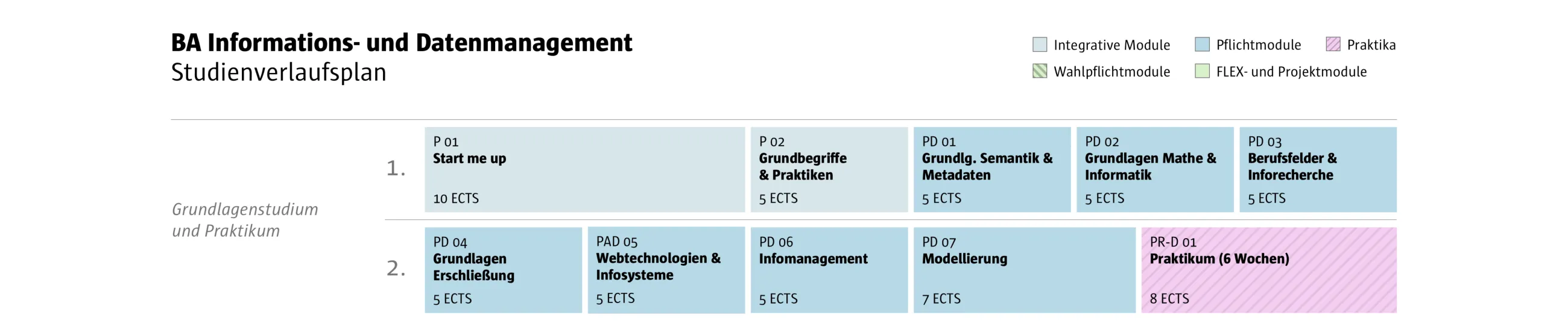
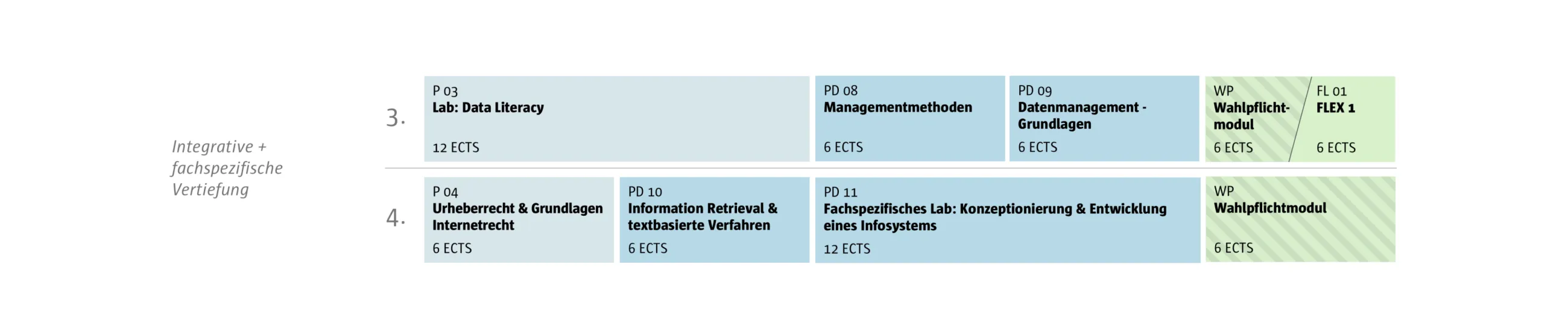
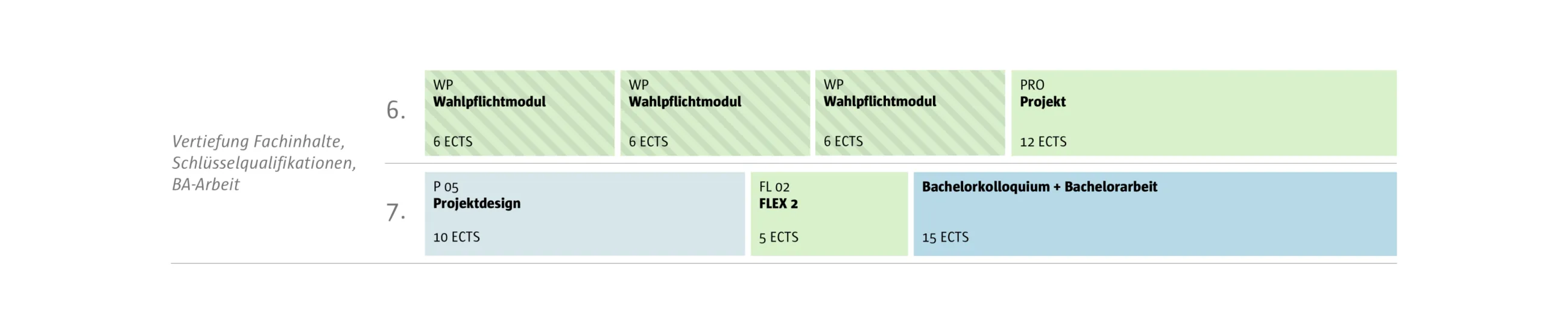
At the beginning of the degree programme, you will acquire key technical and methodological foundations. The focus is on topics such as data modelling, information management, the basics of computer science and mathematics, metadata standards and data management. You will learn how information is structured, stored, processed and made accessible.

The foundation degree programme is supplemented by a six-week internship, which you complete in an information processing institution – for example in a company, an administration or a documentation centre. This internship helps you to apply theoretical knowledge in practice and gain initial professorial recruitment experience. At the same time, it provides valuable orientation for your further specialisation during your studies.

In the third and fourth semesters, you will deepen your knowledge in the areas of data literacy, information systems, information retrieval and the legal framework for information institutions.

Compulsory elective modules give you the opportunity to focus on specific topics.

The majority of the compulsory elective modules that you have to choose during the course of your studies are assigned to one of three possible specialisations:

  • Web Content Management and Digital Marketing consisting of the modules Website Design & Usability, Digital Marketing & Analytics and Website Development
  • Data Modelling and Management consisting of the modules Data Management – Advanced, Data Mining and Semantic Technologies
  • Knowledge management consisting of the modules Fundamentals and Practice of Knowledge Management and Document Management

If you successfully complete the three compulsory elective modules of a specialisation, this specialisation will be shown on your degree programme certificate.

However, you can also choose your own elective modules.

The fifth semester is designed as an internship semester. You will work for several months in an organisation that works with large or complex amounts of information and data – e.g. in IT departments, research institutions, companies or public authorities.

You will learn how data management projects are implemented, analyse existing processes and take on your own initial tasks. The final internship day at the University of Applied Sciences Potsdam provides an opportunity for reflection and exchange with other students.

In the sixth and seventh semesters, the focus continues to be on your individual specialisation. You will take in-depth compulsory elective modules, work in a team on a project course with practical relevance and further develop your interdisciplinary skills – e.g. in the area of project design.

With your Bachelor's thesis, you will show that you are able to work independently on a topic in the field of Information and Data Management in a practical and scientifically sound manner. This will provide you with a strong basis for your career entry or a subsequent Master's degree programme.

Programme content

In the currently valid module handbooks and study and examination regulations of the Department of Information Sciences you will find the module overview, a detailed description of the modules and course content as well as the study plan for the Information and Data Management degree programme.

Teaching formats

We work with different forms of learning on the Information and Data Management degree programme to ensure that the knowledge imparted is appropriate to the respective topic and that the students' day-to-day studies are varied.

  • Seminars, workshops (special seminar form)
  • Lectures
  • Exercises in small groups
  • Work in PC pools
  • Practical projects, sometimes with external partners


Integrative modules

  • Start me up
  • Basic concepts and practices of Informationswissenschaften
  • Copyright law and the basics of internet law for information organisations
  • Project design
  • Lab: Data Literacy

Compulsory modules

  • Basics of semantics and metadata
  • Fundamentals of mathematics and computer science
  • Introduction to professional fields and information research
  • Basics of indexing
  • Web technologies and information systems
  • Information management
  • Modelling
  • Management methods
  • Data management – basics
  • Information retrieval and text-based methods
  • Lab: Conceptualisation and development of an information system

Compulsory elective modules

  • Semantic data models
  • Introduction to object-orientated programming
  • Website design and usability
  • Data management – in-depth study
  • Digital marketing and analytics
  • Website development
  • Knowledge management – practice
  • Document management
  • Data mining
  • Semantic technologies

Integrative and partially integrative compulsory elective modules

  • Digital editions
  • Openness in the information society
  • Data and information visualisation
  • Teaching data and information literacy
  • English in Information Services
  • Knowledge management – basics
  • Fair data management and long-term archiving
  • FLEX modules
  • PRO: Project

Excursions

Depending on current topics and co-operation partners as well as respective offers for visits and specialist conferences

Internships & Projects

  • two internships: six weeks after the 2nd semester and 20 weeks in the 5th semester
  • two projects (4th semester and 6th – 7th semester)

Information on internships in the Bachelor's programme at the Department of Information Sciences

Final thesis

  • Independent preparation and defence of a Bachelor's thesis

Downloads

Application & Contact

At a glance

The most important deadlines, dates and admission requirements for the Information and Data Management bachelor's degree programme are listed here. You can find out which steps you need to follow for a successful application in the next section.

Deadlines & dates

  • by the 15th of July: apply for a higher semester in order to continue a degree programme already started at the University of Applied Sciences Potsdam
  • by 15th of August: Submit an application for enrolment
  • 6th of June 2026: Open Day at the University of Applied Sciences Potsdam

Admission requirements

  • General higher education entrance qualification in accordance with the Brandenburg Higher Education Act: general higher education entrance qualification or entrance qualification for universities of applied sciences or a professional qualification recognised as equivalent

How to apply!

Do you have a higher education entrance qualification? Then you have the opportunity to submit an enrolment application for the winter semester from the 15th of June to the 15th of August in the MyCampus university portal of the University of Applied Sciences Potsdam.

Following online enrolment, you upload all required documents as PDF files via the upload portal. Enrolment is only valid once all documents have been uploaded in full and on time.

Documents to be submitted

  • officially certified copy of the higher education entrance qualification or university degree certificate
  • electronic notification of your insurance status for statutory student health insurance or electronic notification of exemption from the statutory insurance obligation
  • proof of payment or order confirmation of the semester fee
  • photo for the issue of the Campus.card
  • certificate of exmatriculation from the last university attended, if applicable

Please refer to the enrolment application form to see whether you need to submit any other documents.

Do you have any questions about the enrolment procedure at the University of Applied Sciences Potsdam? Our Enrolment page offers you further information and a FAQ section on all aspects of admissions and enrolment.

Starting your studies

Once you have successfully completed the application process, we recommend that you take a look at the Department of Information Sciences' study start page. There you will find important information and dates for starting your studies at the University of Applied Sciences Potsdam at the beginning of the semester.

Further information

Under the following links you, and especially international applicants, will find further information on the topics of application and enrolment at the University of Applied Sciences Potsdam.

International applicants

Would you like to apply for a degree programme from the first or a higher semester and have obtained your school-leaving certificate and/or university degree abroad? Then you can have your qualifications and achievements from abroad recognised and study with us.

Application & enrolment procedure

The Application and Study Administration Services provides information and advice on general questions about the application process, admissions and enrolment at the University of Applied Sciences Potsdam, applications for higher semesters, as well as on topics such as compensation for disadvantages, part-time study, waiting semesters and hardship applications.

Contact & Services

The Student Counselling Services provides information and advice on general questions about studying as well as on topics such as choosing a degree programme, application, enrolment and study organisation.

For programme-specific questions about module content, recognition of prior learning achievements, examinations or specialisations in the Information and Data Management degree programme, the programme-specific student advisory service is the right place to go.

Programme-specific student advisory

Student Counselling Services

Room 102

Book an appointment online

Student Financing

Room 3.02a

Family Affairs Officer

Room 026

Office hours

Tue and Thu 9.30 am – 1.30 pm

Accessibility and Inclusion Officer

Office hours

Monday and by appointment

Contact Study and Examination Services