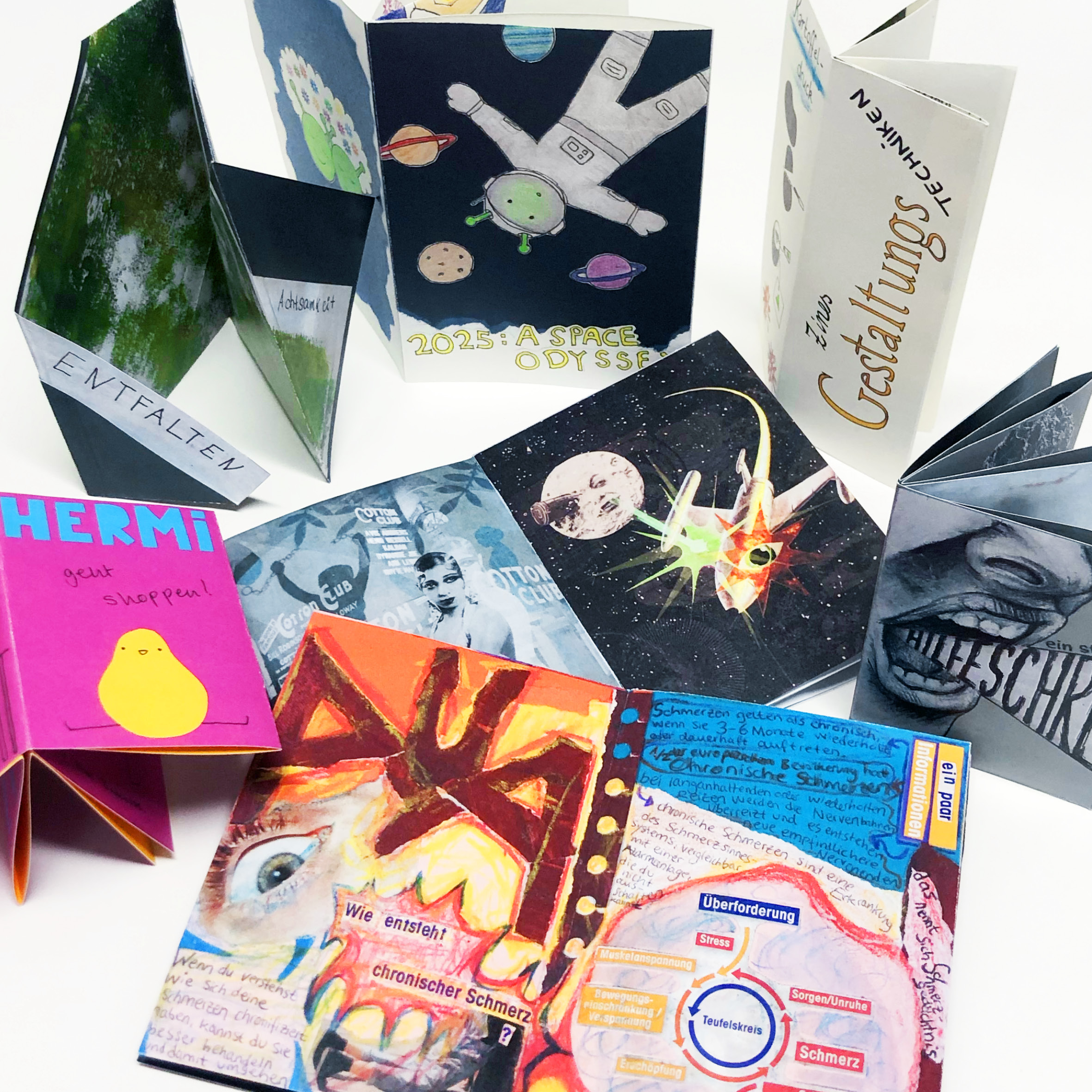
In this course, participants learn basic bookbinding techniques for working with groups of children, young people and adults. They work practically with materials and tools, implement the techniques and document their knowledge creatively in the form of zines. In this way, they combine craftsmanship with pedagogical application and create tangible learning outcomes.
Bookbinding as a Social Practice
Folding and binding techniques for practical learning and creative documentation

Period:
19. - 21.10.2026
Status:
Free places
Format:
Seminar
Degree:
Certificate of attendance
Credits:
24 teaching units
Requirements:
none
Participation fee:
990.00 Euro
At a glance
Our everyday lives are increasingly digital - the haptic experience is often neglected. Working with your hands plays a central role in education and knowledge transfer in particular: understanding promotes self-efficacy and strengthens self-confidence.
Bookbinding makes it possible to physically record, document and pass on acquired knowledge. The course enables participants to independently lead workshops with groups of all ages, design creative publications and convey learning content in a vivid, hands-on way.
Focal points
- Bookbinding techniques
- Material science and tool handling
- Documentation methods (zines and small publications)
- Design tools and creative process
- Reflection and presentation of own work
- Sustainability in dealing with materials
Working method:
- Practical and manual
- Promoting creative thinking and self-efficacy
- Focus on immediate realisation
Target price
- Participants learn basic and advanced bookbinding techniques that they can use independently in workshops with groups of children, young people and adults.
- They develop the ability to document knowledge creatively and by hand, e.g. in zines or small publications.
- Participants promote learning and self-efficacy experiences by integrating haptic work into educational and learning settings.
- They can plan, conduct and reflect on workshops so that theoretical knowledge can be experienced in practice.
- The aim is to promote the ability to combine educational programmes with craft creativity and generate sustainable learning outcomes.
Target groups
- Teachers
- Educators
- Social workers
- Workshop leaders

Grasping has a lot to do with the sense of touch. Bookbinding techniques can be used to make knowledge tangible. The training course offers you sound specialist knowledge and practical experience to guide groups of children, young people and adults and to document content.
Lea Giesecke
Project management
Lea Giesecke, Head of the Bookbinding Workshop, University of Applied Sciences Potsdam
As a graphic designer specialising in print, she loves working with paper and developing individual design solutions from the concept to the finished product. In addition to her work as head of the bookbinding workshop at the University of Applied Sciences Potsdam, she also gives workshops at other locations, gives lectures and receives teaching assignments in both design and social work.
In 2023, she published "BuchBauKasten", a publication consisting of a poster and cards, which was honoured with the European Design Award in 2024.
Modules & contents
Interview mit Lea Giesecke, Leiterin der Buchbindewerkstatt

Weiterbildung
Interview
Buchbinden als Methode für kreative Bildungs- und Sozialarbeit
Lea Giesecke spricht über die neue Weiterbildung "Buchbinden als soziale Praxis" und zeigt, wie sie in der Arbeit mit Menschen genutzt werden kann.
Impressionen




Dates & Schedule
Autumn holidays 2026 (Monday, Tuesday, Wednesday)
Course and examination performance
Course services:
- Preparation before the modules (bring a nice/special book)
- Active participation
- Preparation and follow-up of the modules
Final examination
- Presentation / paper of up to 15 minutes on your own project or the publications produced
Registration & Information
ZEW – Centre for Further Education
Room 4.1.10
(House 4)

Coordination & Organisation ZEW
Further courses

Intensive daycare centre management
The "Intensive Daycare Centre Management" training course deals in compact form with the key topics of managing daycare centres.

Action-centred coaching
Action-centred coaching is action-oriented, relationship-focused and sensitive to private and professional roles. Based on a humanistic view of the human being and psychodrama, our training offers a sound understanding and methods for practical application in your own field of work.

Family Council Coordinator
The family council is a procedure for activating the family system to develop and implement individually suitable solutions to existing family issues on the basis of a care formulation by child and youth welfare services.