"Alter Dorfkrug" Tylsen: Building Survey, Renovation Concept and Possible Uses of a Low German Hall House
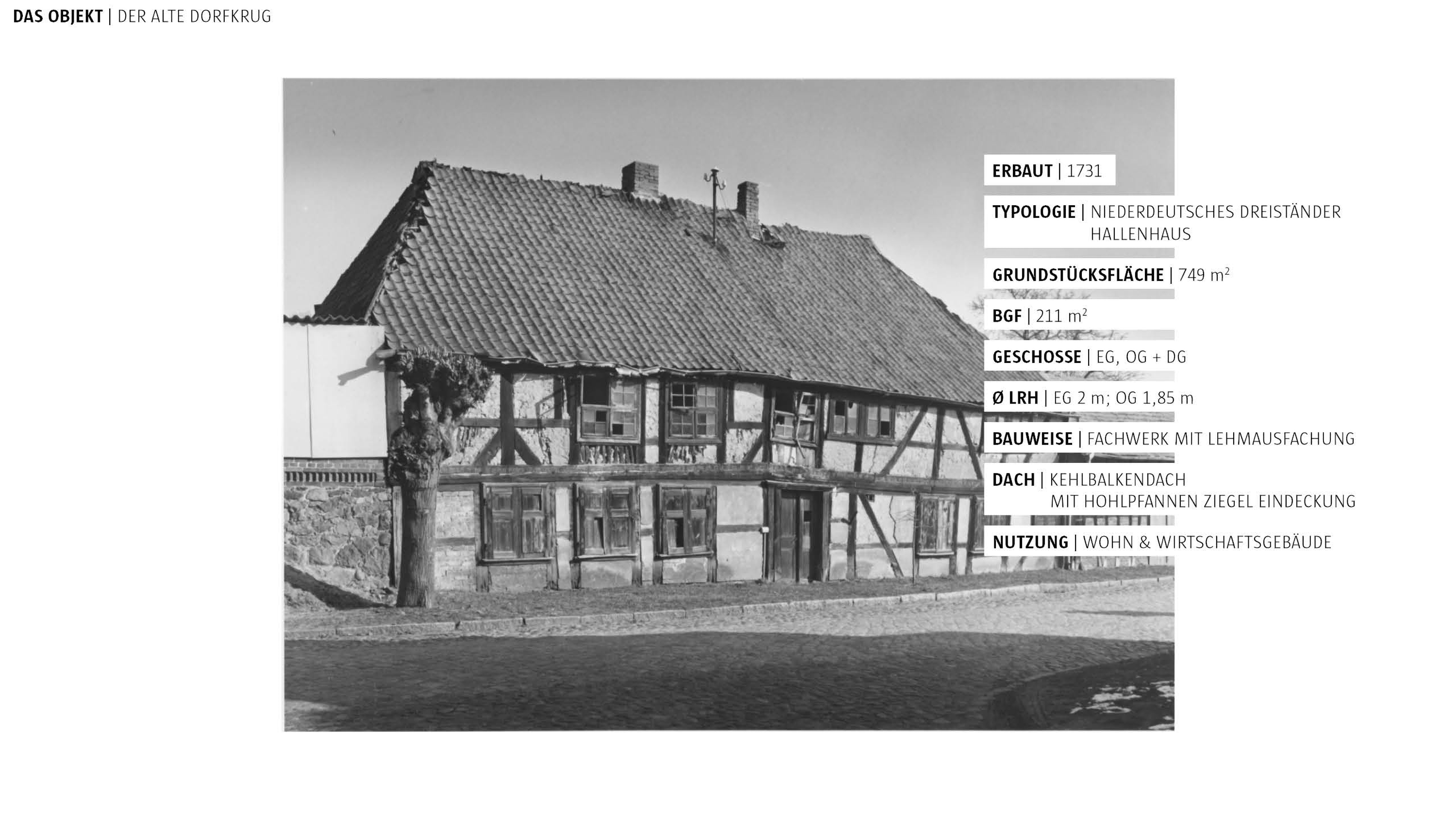
The village pub "Alte Dorfkrug" in Tylsen is a Low German hall house with the special feature that it has two storeys facing the street in addition to the eaves of the courtyard. It is the only surviving half-timbered house of this mixture of Low and Middle German construction. The aim of this work is to use digital building surveys to create a planning basis that is as precise as possible, i.e. one that is appropriate to the deformation, and to use this to record the existing structure in drawings as well as to determine and record the damage and develop appropriate measures to preserve the building. With the help of dendrochronological measurements and research in archival records, the work is dedicated to breaking down the layers of time with which the structure from the construction period has been reshaped.

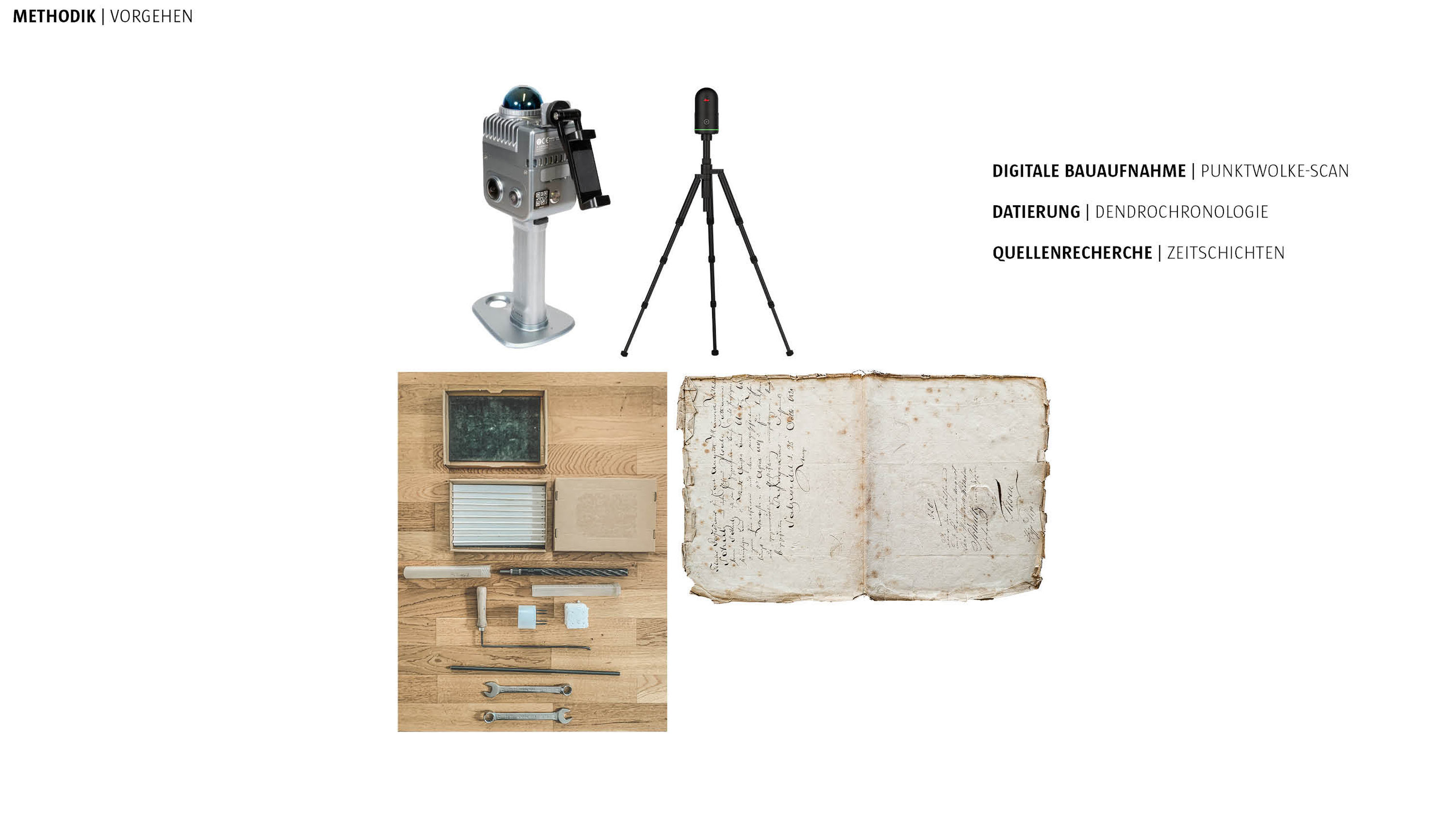
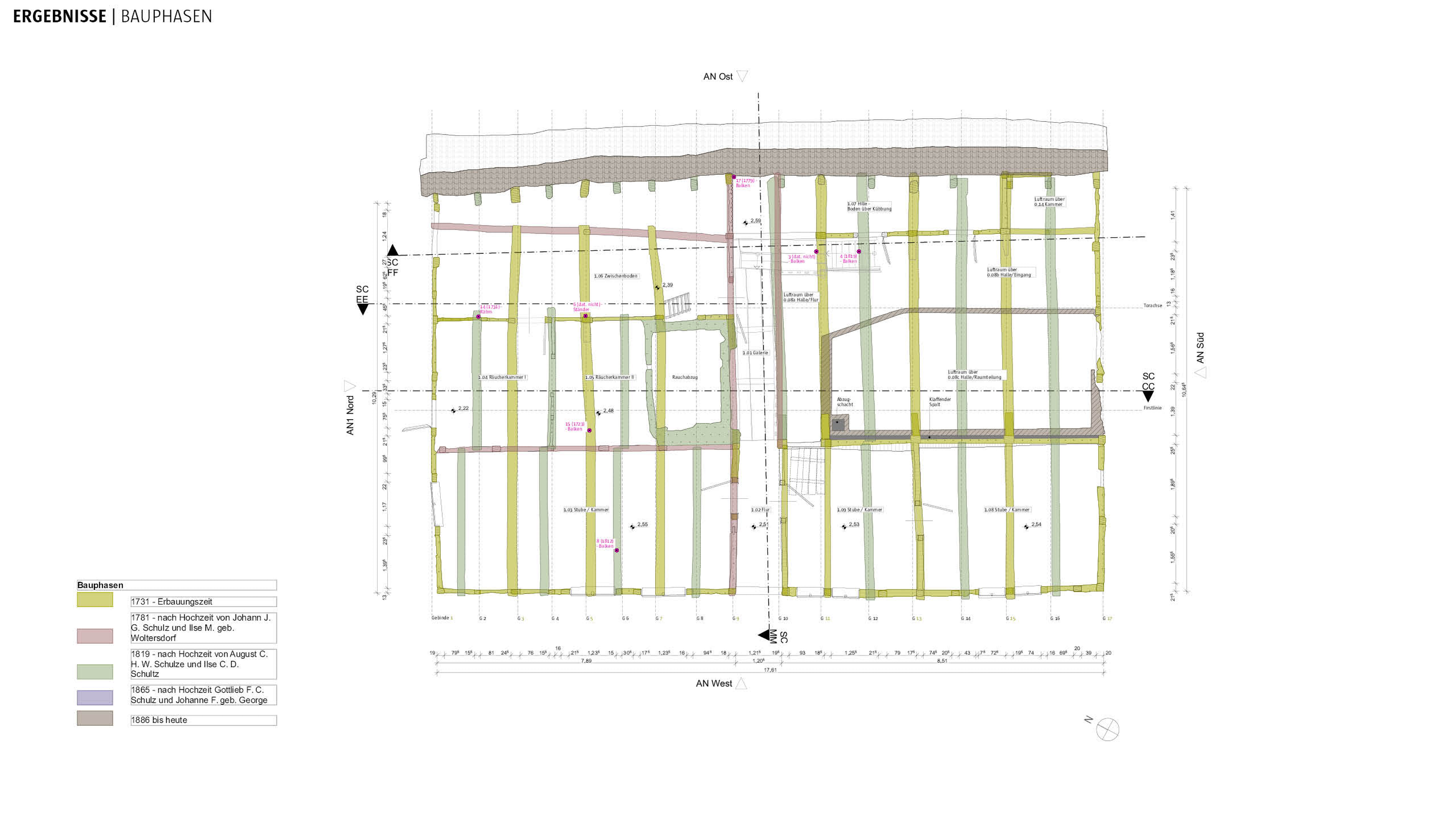
The point cloud laser scan recorded the sometimes considerable deformation of the timber frame structure, enabling the particularly critical points to be identified and, in addition to a large number of damage patterns, transferred to a catalogue of measures. The measurement results of the timber samples were used to refute theories and develop new, more valid ones. Probably the most important results of this work are the resulting plans and the mapping of the condition of the building and the measures required to preserve this unique structure.
Summary
The surviving condition of the Alter Dorfkrug has been preserved due to special circumstances. Its monumental value was misjudged by its past owners. There were also never sufficient financial resources available to ensure that demolition or major remodelling could have destroyed or even just obstructed its original condition. So it is left to us, in its structural uniqueness, a relic from a long-forgotten time, which reaches and grips everyone at the latest when they enter the black kitchen.
This work can now serve as a basis for communicating the uniqueness of the Alter Dorfkrug. Its structure and inner workings have been made transparent, its strengths and weaknesses revealed. Great importance was attached to pointing out every detail worth preserving and also to revealing its damage and diagnosing its cause. The anamnesis was favoured by the deformation-accurate laser scan measurement in the sense that every movement to which the building is subject due to the various weak points can be traced and counteracted accordingly. Furthermore, it would have been difficult to understand the actual condition and plan remedial measures using a less accurate record of the deformed structure, and much more challenging with other measurement methods. The recording via point cloud paired with panoramic photography enables a much more precise planning on the computer and thus facilitates the direct handling of the damage formation. The facade and room book of this work is a snapshot and testimony that records the condition for all future reference. The sampling of the timbers and dendrochronological measurements, which were carried out as part of this work, also represent an important step in deciphering the history of the building. Complete deciphering, if such a thing can be achieved at all, will indeed require further research. Additional wood samples will be necessary, as it has become clear in the course of the work that a large number of reused timbers were used, and restoration work, especially checking the veneers, is also essential to establish the exact history of the building. A lot of work lies ahead. This planning basis is a valuable prerequisite for the Alte Dorfkrug to enter a new phase of its life.
Project participants
1st Expert report

2nd Expert report
Dipl. Ing. Architect Ullrich Lemme
Master's graduate
Hannes Prasse, B.A.