New DFOS Infrastructure for Research and Knowledge and Technology Transfer in Civil Engineering
The University of Applied Sciences Potsdam is expanding its metrology research infrastructure in Civil Engineering. With a new infrastructure for Distributed Fibre Optic Sensing (DFOS), strains and temperature changes can in future be continuously measured along optical fibres.

Unlike individual point-type sensors, this measurement technology enables high-resolution monitoring of entire measurement sections. This makes it possible, for example, to investigate in detail local changes in strain, crack initiation and crack propagation, as well as other changes in the condition of components and load-bearing structures. Continuous measurement along the sensor fibre is a key advantage of distributed fibre-optic measurement methods.
Initial test to prepare the methodology
Even before the newly funded infrastructure is commissioned (currently undergoing Procurement Services), initial trials on the application and evaluation of DFOS measurement technology are being carried out at the Structural Engineering Laboratory of the University of Applied Sciences Potsdam.
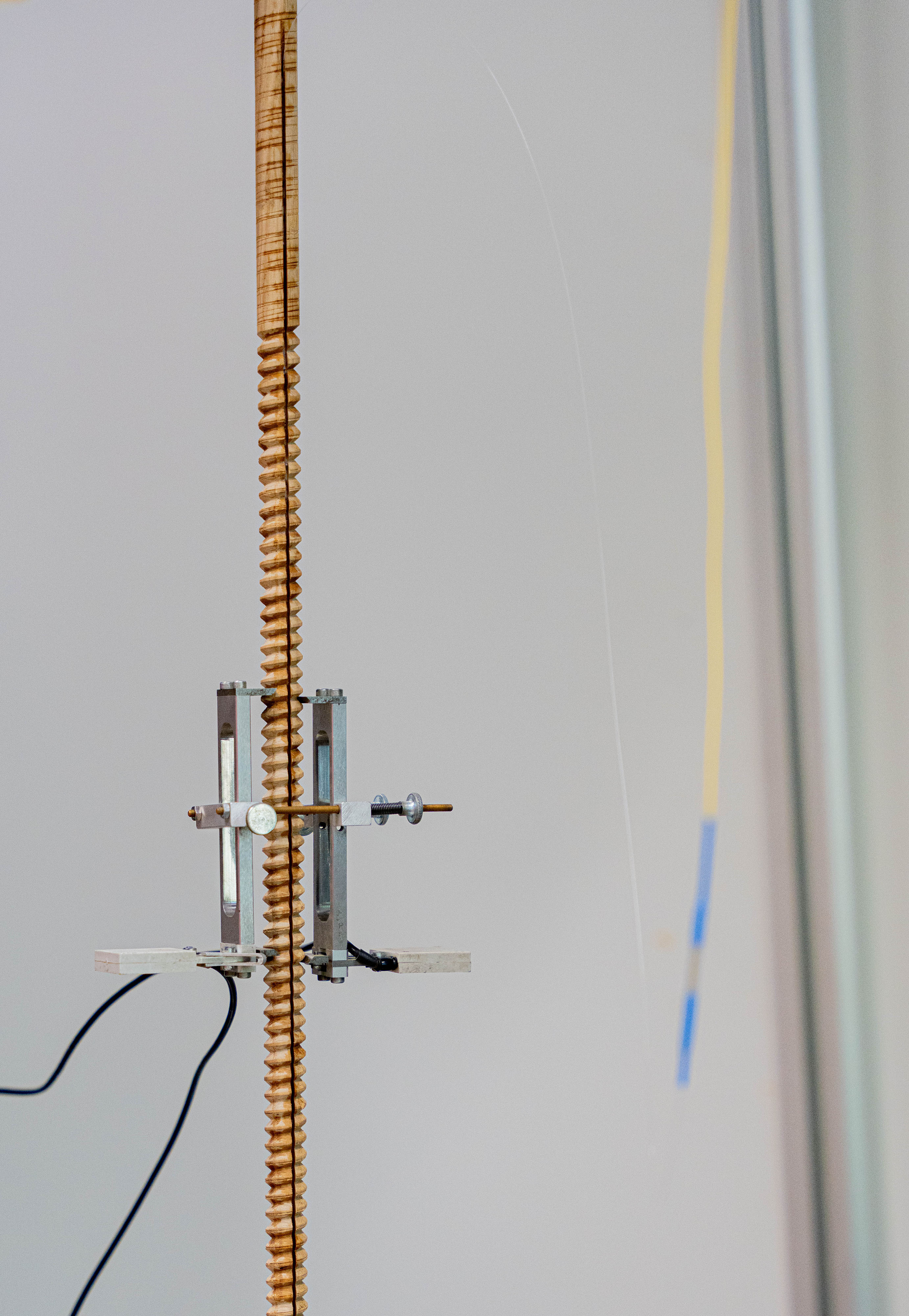
In an initial example tensile test, the axial strain of a timber profile bar was recorded along an attached optical measurement fibre (Figure 1). For the test, Magdeburg-Stendal University of Applied Sciences (h²) kindly made its DFOS measuring device available on loan (Figure 2, top).
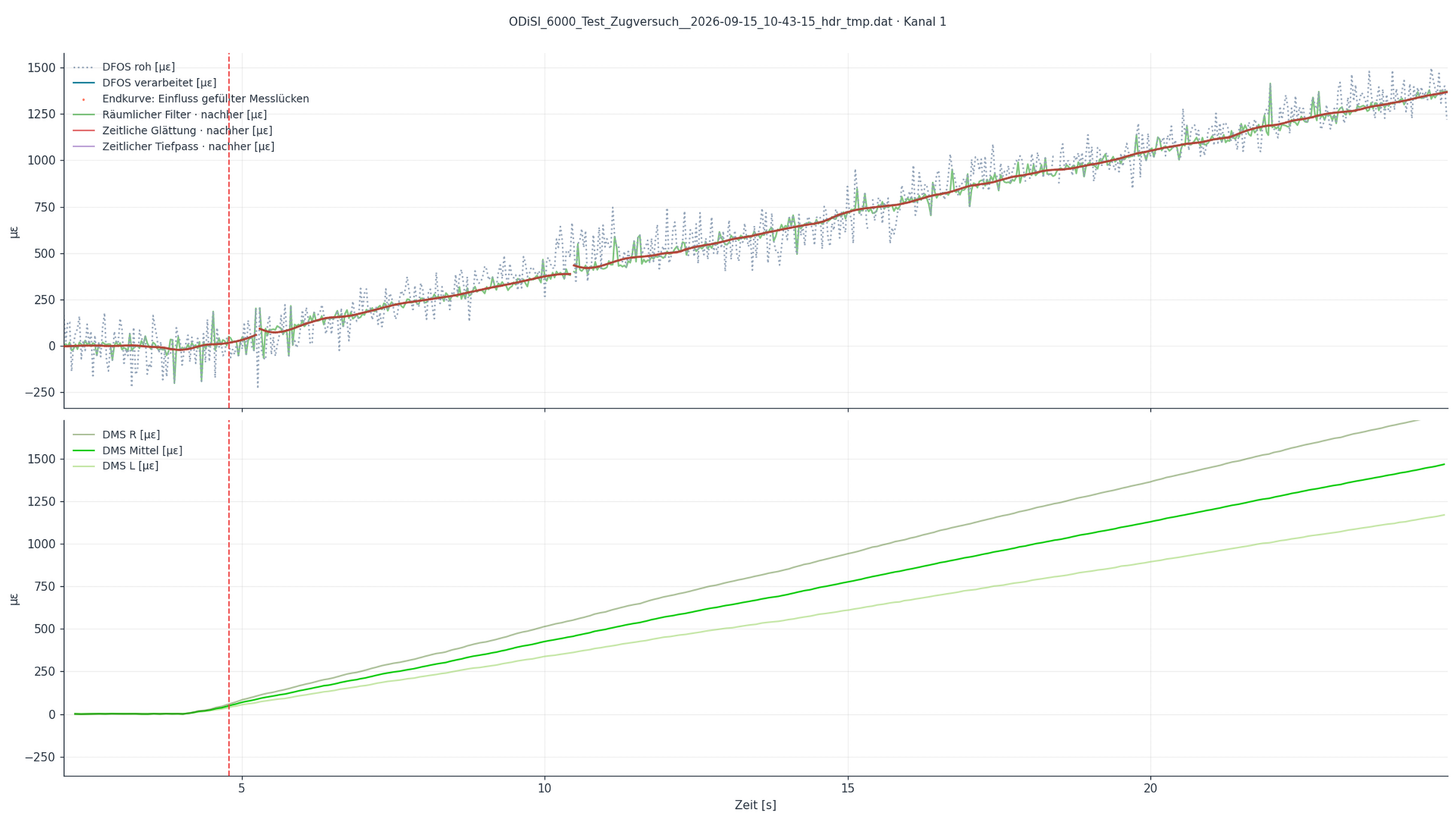
The test is intended, in particular, to trial the measurement setup, the application of the sensor fibre, and the processing and evaluation of the high-resolution measurement data. In addition to analysing the raw data, methods for filtering and processing the measurement signals were tested, and the results were compared with conventional reference measurements. An example of the temporal progression of the measurement data, including the individual steps of signal processing, is shown in Figure 3.
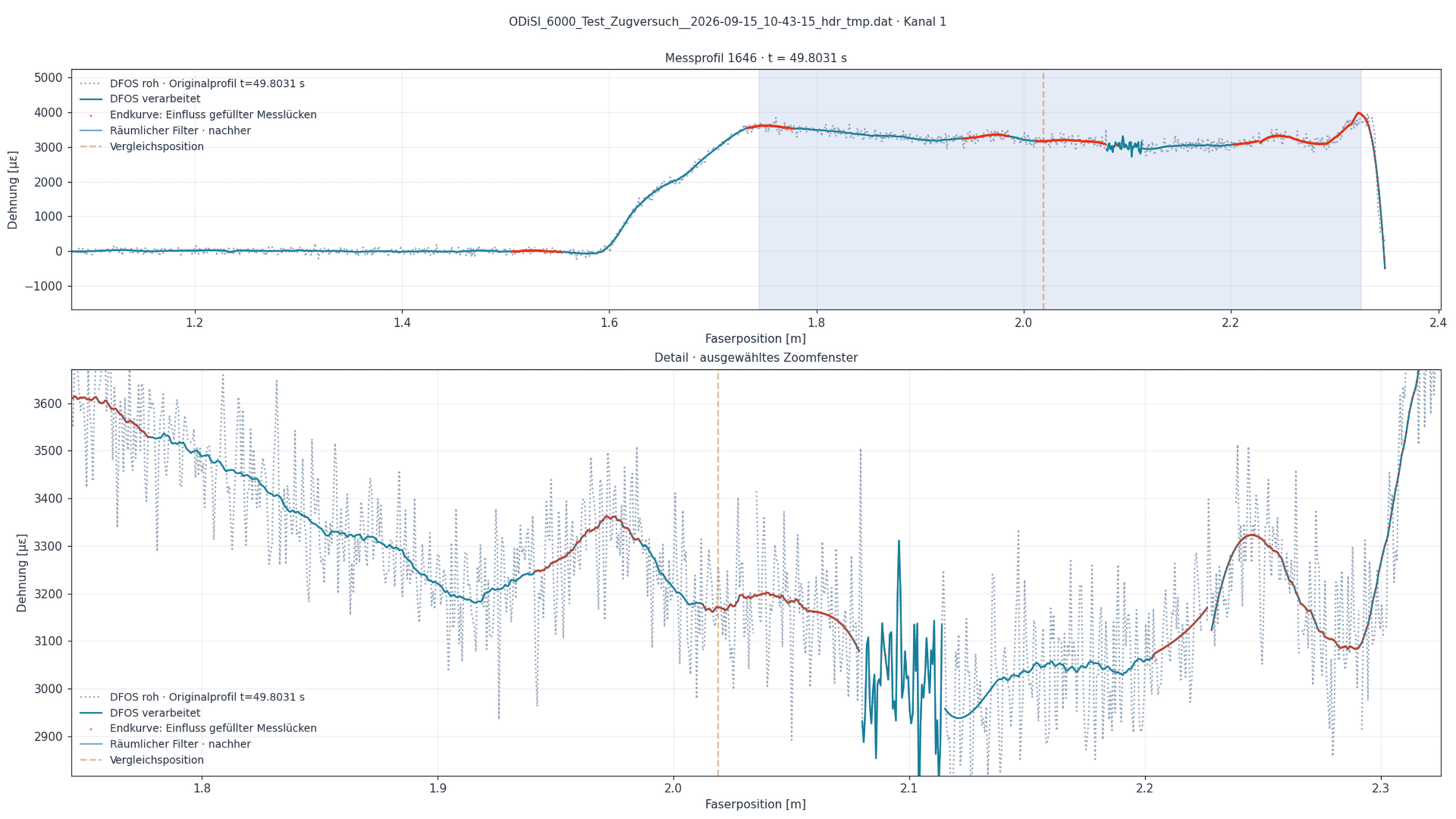
A key advantage of DFOS measurement technology is that strain can be measured not only at individual measurement points but also with spatial resolution along the optical fibre. Figure 4 shows, by way of example, a strain profile along the measurement fibre at a selected point in time and compares the raw data with the processed measurement curve.
The experience gained will, amongst other things, serve to prepare for further investigations within the ERIMA research project. There, DFOS measurement technology is to be used in the future to investigate the composite behaviour between timber anchors and clay. In particular, the spatially continuous recording of the strain distribution offers the possibility of investigating load transfer and local changes within the composite zone in a differentiated manner.
At the same time, the initial results highlight the requirements for further methodological development: in addition to the actual measurement, sensor application, calibration, data processing and the evaluation of local measurement artefacts play a particularly important role.

Two projects for a shared DFOS infrastructure
The investment is being made as part of two projects that are thematically linked.
Contribution to sustainability and knowledge transfer
Both projects support the digital and resource-efficient further development of Civil Engineering. More precise information on the actual load-bearing and deformation behaviour of existing structures can help to plan maintenance, repair and refurbishment measures on a more sound basis and to continue using existing structures for as long as possible.
At the same time, the new infrastructure strengthens the transfer of knowledge and technology between universities, research institutions, public bodies and industry partners. Research, digitalisation, sustainability and application-oriented testing are also key themes of the State of Brandenburg’s Regional Innovation Strategy.