Retrospective
MoodEcho: What’s the Mood Like in Brandenburg?

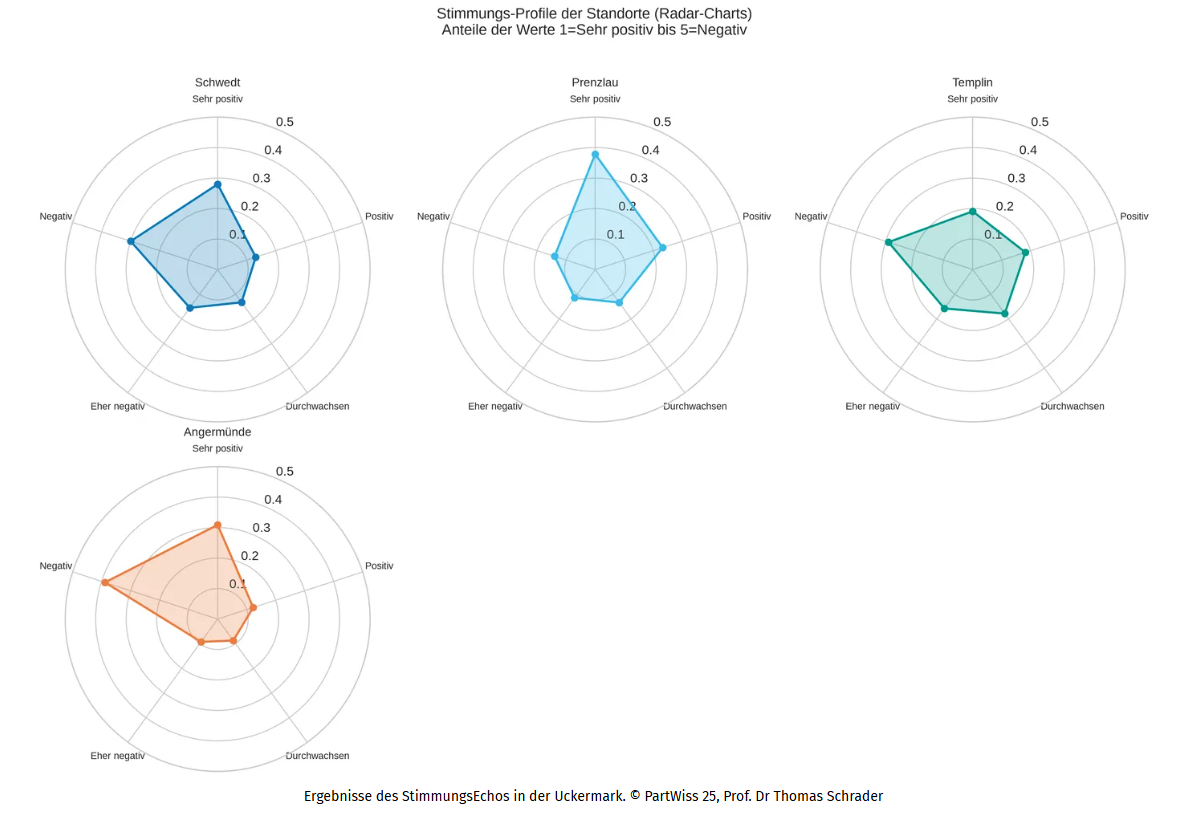
The "MoodEcho" project, funded by the InNoWest Transfer Fund, surveyed residents in several towns and cities across Brandenburg to gauge their mood. What is the collective sense of well-being like in the locations where the survey was carried out?
How does the „MoodEcho“ work?
From September 2025 to April 2026, members of the public were able to record their mood daily at various public locations in the Oberhavel region. The project then moved on to the Uckermark. The science and art project „MoodEcho“ is being carried out jointly by the University of Applied Sciences Brandenburg (THB), the University for Sustainable Development Eberswalde (HNEE) and the local branches of Brandenburg’s universities.
Using hand and foot-operated buttons, visitors could answer the question “How are you today?” on the interactive input unit of the “StimmungsEcho” project. The scale ranged from 1 (very good) to 5 (very bad). It was also possible to submit responses online.
The following locations took part:
- Hennigsdorf Town Hall and Alexander S. Pushkin Grammar School
- Oranienburg Town Hall and Library
- Plentz Bakery and Bollhagen Grammar School, Velten
The StimmungsEcho also visited four Bürgerwerkstatt locations across the Uckermark region from May to July. The results from these are currently being processed.
- Kulturwerk Prenzlau
- Straße des Friedens, Templin
- Haus mit Zukunft, Angermünde
- Talsand Comprehensive School, Schwedt/Oder
What’s the mood?
The StimmungsEcho analyses carried out to date cover four different locations in Oberhavel. A common underlying pattern emerges across all locations. The most positive rating (value 1) was the most frequently selected in each case, followed by value 2 (positive). The middle rating, 3 (mixed), remains consistently in the middle range. Rating 4 (somewhat negative) is the least frequently selected category across the board, whereas rating 5 (negative) was selected to varying degrees at the different locations.
In general, structural differences were evident between the types of location. The two local authorities, for example, demonstrate a high and consistent level of participation due to the longer duration of the scheme and regular visitor numbers.
Overall picture: predominantly positive
In summary, a nuanced yet, on the whole, predominantly positive picture emerges across all locations surveyed to date. The distributions show stable underlying patterns with location-specific characteristics, which can essentially be explained by differences in data collection periods, user groups and levels of participation. As the data set grows, the newer locations in particular will become statistically more reliable, meaning that even clearer trends may become apparent in the long term.
Details of the results can be found on the StimmungsEcho project page.
The StimmungsEcho project is funded by the InNoWest Transfer Fund.
